St. Mark’s Church stands in the heart of Zagreb’s Upper Town, a quiet corner that feels like a world apart from the city’s bustle. Its most striking feature is the colorful tiled roof, where the coats of arms of Croatia, Dalmatia, and Slavonia share space with the medieval emblem of Zagreb. This isn’t just decoration—it’s a visual story of the city’s layered past, a reminder of how history has shaped both the place and the people who call it home.
The church’s origins trace back to the 13th century, when it began as a small Romanesque chapel. At the time, Zagreb wasn’t a single city but two rival settlements—Gradec and Kaptol—locked in a long-standing feud. St. Mark’s found itself on the border between them, a neutral ground that was rebuilt and reinforced over the centuries. By the 14th century, it had taken on Gothic elements, and later, in the 18th century, Baroque touches were added. The result is a building that feels like a patchwork of eras, each layer revealing something about the time that created it.
Inside, the church is far simpler than its exterior suggests. The walls are adorned with frescoes by Josip Račić and Jozo Kljaković, two artists whose work became defining pieces of Croatian art. The most notable is a series depicting the life of Christ, painted in the early 20th century. There’s no gilded opulence or marble grandeur here—just a quiet, almost intimate atmosphere. The wooden pews, the unadorned altar, and the soft light filtering through the stained glass create a sense of stepping back in time, as if the church has preserved the rhythms of medieval life within its walls.
St. Mark’s isn’t just a religious site; it’s a witness to Croatia’s political history. For centuries, the Croatian Parliament met within its walls, making decisions that would shape the nation’s future. In the 19th century, as Croatia sought independence from Austro-Hungarian rule, the church became a symbol of national unity. Even today, the square in front of it remains a gathering place for protests, rallies, and public debates, a space where history and modern life intersect.
The area around the church is always alive with activity. St. Mark’s Square is one of Zagreb’s most vibrant spots, where tourists snap photos of the roof, locals rush past on their way to work, and students linger on the steps, deep in conversation. In summer, the square hosts concerts and festivals, while in winter, it’s lit up with holiday decorations. The church stands at the center of it all, a steady presence amid the city’s constant motion.
Despite its historical importance, St. Mark’s hasn’t become a museum piece. It’s still an active place of worship, with services held every Sunday and visitors welcome on weekdays. There’s no admission fee, but the atmosphere inside is one of quiet respect—no loud conversations, no flashing cameras. It’s a place where people come to reflect, to pray, or simply to sit in the stillness.
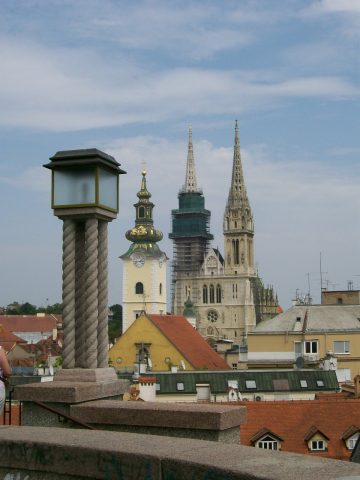
From the hill where the church stands, you can see all of Zagreb’s Upper Town unfolding below. The view captures the contrast between the old and the new—the narrow cobblestone streets giving way to modern buildings, the red-tiled roofs blending into the skyline. St. Mark’s feels like a bridge between these worlds, a reminder that history isn’t something distant or abstract. It’s part of the city’s fabric, woven into the daily lives of those who walk its streets.
In recent years, the church has become one of Zagreb’s most recognizable landmarks, appearing on postcards and souvenirs. But for those who live here, it means something deeper—a place where the past feels tangible, where you can sense the weight of centuries in the stones beneath your feet. In a world that moves faster every day, places like St. Mark’s offer a rare sense of continuity, a quiet assurance that some things endure.