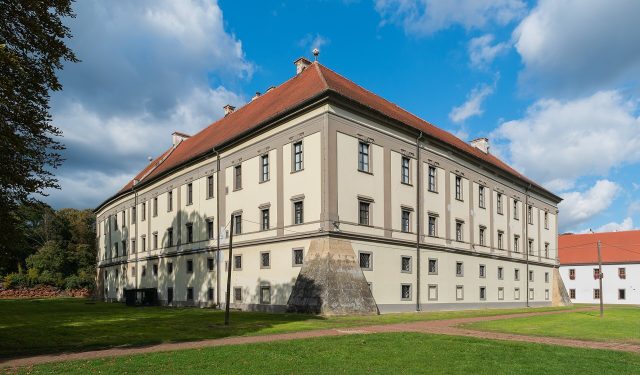
Čakovec’s Zagreb Gate is one of those quiet witnesses to history that doesn’t demand attention but rewards those who pause to notice it. Tucked away in a small northern Croatian town, it stands as a remnant of the city’s fortified past, a stone archway that once controlled the flow of people and goods between the medieval settlement and the road leading toward Zagreb. Unlike the grand castles or bustling squares that dominate travel brochures, these gates carry their significance lightly, blending into the everyday rhythm of the town while still holding onto the stories of centuries gone by.
The history of the Zagreb Gate is inseparable from Čakovec itself, a town that has long existed at the crossroads of empires. Situated in the Međimurje region, near the borders of modern-day Hungary and Slovenia, the area has always been a strategic prize. In the 16th century, when these lands were under Hungarian rule and later the Habsburg monarchy, Čakovec became a fortified stronghold. Its walls, towers, and gates were built not just for defense but as a statement of power, marking the town as an important administrative and military center. The Zagreb Gate, named for the road it guarded leading to the capital, was one of the main entrances, a checkpoint where merchants paid tolls and travelers were scrutinized before entering.
The architecture of the gate is unassuming yet sturdy, a simple stone arch constructed from large, weathered blocks. Above the passage, a small upper chamber hints at its original purpose—likely a guardroom or customs post where officials monitored the comings and goings of traders. Today, the most striking detail is the faded coat of arms carved into the stone, a relic of the town’s past as a seat of noble families. It’s a subtle reminder that Čakovec was once more than just a provincial outpost; it was a place where decisions were made and histories intersected.
Over time, the gate’s defensive role faded. As the town expanded beyond its medieval walls, the fortifications fell into disrepair, with only fragments remaining. The Zagreb Gate survived, perhaps because it stood along a well-traveled route, its stone arch enduring even as the world around it changed. Now, it sits in the middle of a modern town, surrounded by apartment buildings and busy streets, a quiet anachronism in the urban landscape. A small park has grown up around it, where locals sit on benches in the shade, and visitors pause to trace the rough texture of the old stones with their fingers.
For Čakovec, the gate is more than just a historical monument—it’s a symbol of resilience and continuity. The town has been ruled by Hungarians, Austrians, Croats, and even briefly by the Ottomans, each leaving their mark on its culture and architecture. The gate stands as a silent testament to these layers of influence, a physical link between the past and the present. In this part of Croatia, the proximity to Hungary and Austria is still felt, not just in the names of streets or the style of buildings, but in the way people live, the food they eat, and the languages they speak.
Walking through the gate today, it’s easy to imagine the scenes of centuries past: merchants leading laden carts, soldiers returning from campaigns, or nobles arriving for audiences with the local lord. The road that once carried horse-drawn carriages now hums with cars and pedestrians, but the arch itself remains unchanged, a bridge between eras. Unlike the crowded tourist spots of Dubrovnik or Split, the Zagreb Gate sees few visitors, and that’s part of its charm. There are no souvenir stalls or guided tours here, just the quiet presence of history, waiting to be noticed.
In recent years, Croatia has placed greater emphasis on preserving its historical sites, and the Zagreb Gate has benefited from careful restoration. Yet there’s no attempt to turn it into a sanitized museum piece or reconstruct it beyond recognition. Instead, it remains a living part of the town, a place where the past and present coexist naturally. The gate doesn’t dominate the streetscape; it simply belongs there, as much a part of Čakovec as the cafes and shops that have sprung up around it.
Čakovec itself is rarely on the itinerary of first-time visitors to Croatia, and that’s precisely what makes it worth a detour. There are no crowds, no overpriced trinkets, no pressure to perform the role of a tourist. The Zagreb Gate is a place for slowing down, for touching the rough surface of history and letting the imagination wander. It doesn’t shout its stories—it whispers them, leaving room for those who pass through to fill in the gaps with their own thoughts. In a country where so many places are defined by their beauty or their fame, this unassuming archway offers something rarer: a sense of connection to the quiet, unbroken thread of time.