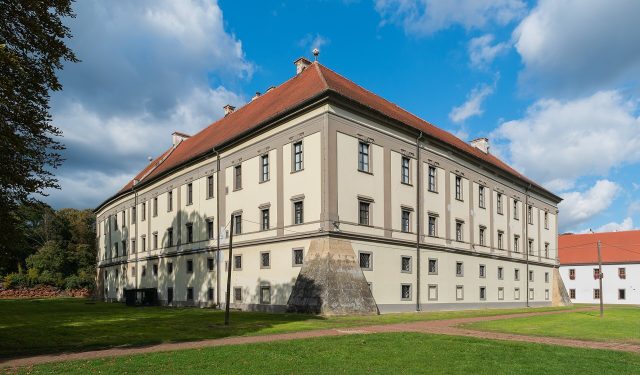
St. Nicholas Church in Čakovec is the kind of place that doesn’t demand attention but lingers in memory long after you’ve left. Tucked away in the heart of the town, it sits on a quiet square surrounded by low-slung houses with terracotta roofs, blending seamlessly into the everyday rhythm of life here. There are no crowds, no tourist traps—just the unhurried pace of provincial Croatia, where time moves differently.
The church is dedicated to St. Nicholas, the patron saint of travelers and sailors, a fitting choice for a town that, though far from the sea, has always been a crossroads. Čakovec’s history as a trading hub, linking continental Europe to the Adriatic, is woven into its streets, and this church stands as a quiet testament to that legacy. Built in the late 18th century under Habsburg rule, its architecture straddles the line between Baroque and Neoclassical styles. The façade is restrained, almost austere, with tall windows and a modest portal, but step inside, and the space opens up, filled with light and air, as if the weight of the outside world has been left at the door.
The interior doesn’t overwhelm with opulence, and that’s part of its charm. The altar is adorned with wooden sculptures crafted by local artisans, their details worn smooth by time. The frescoes on the vaulted ceilings are muted, their warm tones a contrast to the brighter, more vivid works found in coastal churches. The real treasure here is the organ, installed in the 19th century and still in use today. Its sound fills the church during services, and musicians occasionally travel from other towns just to play it, drawn by its well-preserved quality.
St. Nicholas Church has witnessed much of Čakovec’s history. Over the centuries, it has been a place of coronation prayers for Austrian emperors, a refuge during wars and epidemics, and a silent observer during the decades when religious life in Yugoslavia was suppressed. Today, it’s once again an active parish, where locals and curious visitors alike gather for services. The church doesn’t try to impress—it simply endures, a steady presence in a town that has seen its share of change.
Outside, the small square around the church hums with life in the mornings, when the market sets up. Stalls offer fresh vegetables, homemade cheese, and honey, along with local wines from the surrounding vineyards. In summer, the square transforms into a cultural hub, hosting concerts and festivals where the church isn’t just a place of worship but a backdrop to community life. In winter, the pace slows, and the only sound breaking the silence is the occasional peal of the church bells echoing over the rooftops.
Čakovec itself is a town where time feels suspended. Narrow streets wind past old mansions with carved balconies, and cafés serve coffee in the Viennese style, as if the 20th century never quite arrived. St. Nicholas Church fits into this landscape effortlessly, as though it has always been here. It doesn’t strive to be remarkable—it just is, a quiet reminder that beauty often lies in the unassuming.
If you find yourself in Čakovec on a Sunday, consider attending a service. The local choir’s voices, the scent of incense, the flicker of candlelight—it all feels like a connection to something enduring. Afterward, the town invites you to linger: wander the main street, stop for coffee, or stroll through the nearby park, where old trees shade benches and fountains. St. Nicholas Church isn’t the kind of place you’d travel across the country to see, but if you’re already here, it’s a discovery worth making.