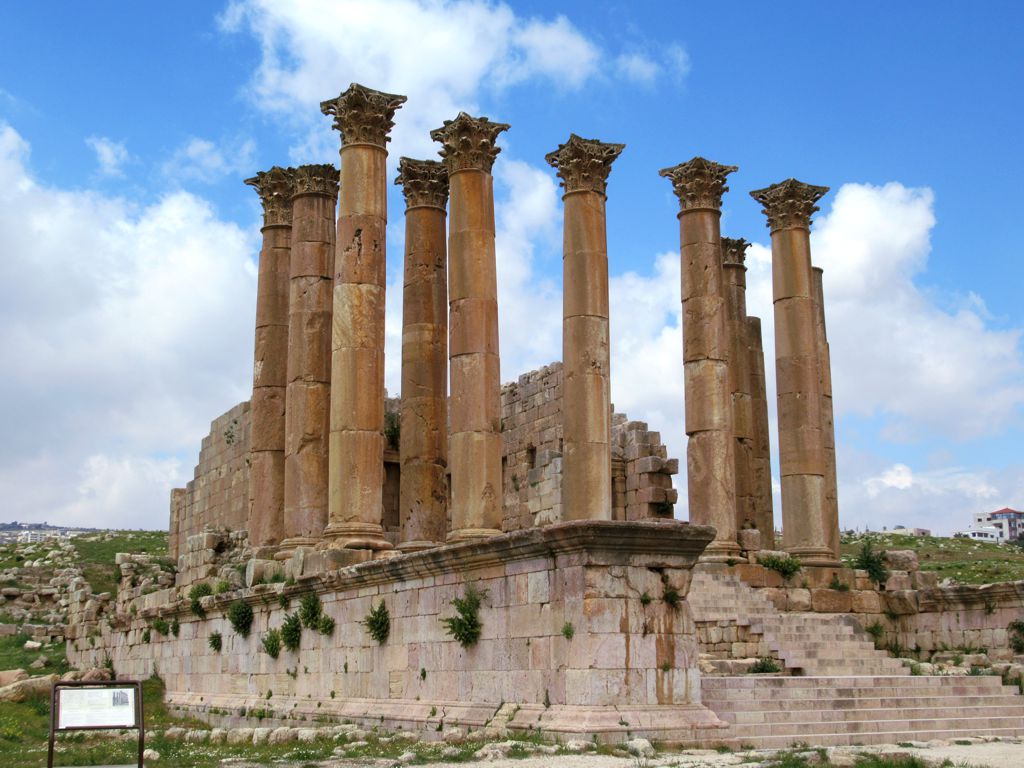
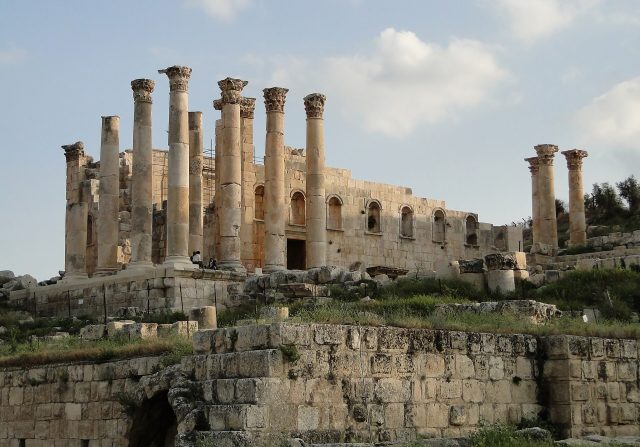
Jerash is a city where time seems to stand still, and few places capture that sense of timelessness as vividly as the Temple of Zeus. Built in the second century AD, when this region was part of the Roman Empire, the temple was once a towering symbol of religious devotion and imperial power. Though its ruins are far from intact, they still convey the grandeur of its original design, offering a glimpse into what must have been an awe-inspiring structure nearly two thousand years ago.
The temple was dedicated to Zeus, the king of the Greco-Roman gods, and its location was chosen with deliberate intent. Perched on an elevation overlooking the ancient city, it commanded a view of Jerash, reinforcing its role as both a spiritual and political center. In its prime, the temple was more than a place of worship—it was a statement of Rome’s dominance over the region, a hub where culture, commerce, and civic life intersected. Today, the remnants of its columns and foundations hint at the countless people who once gathered here, their voices echoing under its vaulted ceilings.
The architecture of the Temple of Zeus reflects the Roman style of its era, though with subtle influences from the eastern provinces of the empire. The surviving columns are Corinthian, the most ornate of the classical orders, their capitals adorned with intricate acanthus leaves. These columns once supported a massive portico framing the entrance to the sanctuary, where a statue of Zeus likely stood. Little remains of the sanctuary itself, but even the fragments that survive suggest the temple’s former magnificence.
Like many pagan structures, the Temple of Zeus did not escape the transformations of later centuries. When Christianity became the state religion under Byzantine rule, many temples were repurposed or dismantled. The stones of this temple were reused in the construction of churches, and over time, the building fell into ruin. It wasn’t until the 20th century that archaeologists began efforts to preserve what remained, stabilizing the site for future generations.
Now, the Temple of Zeus is one of the most striking sights in Jerash, especially at sunset. As the light softens, the ancient stones take on warm hues of gold and rose, while the shadows of the columns stretch long across the ground. The atmosphere is quiet, almost reverent, as if the modern city fades into the background, leaving only the weight of history. Visitors come not just for photographs but to stand among these ruins, to feel the passage of time and imagine the rituals that once took place here.
Nearby lies another of Jerash’s key landmarks, the Oval Forum, which was once connected to the temple by a colonnade. Together, they formed the heart of the ancient city, a unified architectural complex that shaped daily life. Today, this area remains one of the most visited in Jerash, not only for its historical significance but also for its role in contemporary culture. The ruins often serve as a backdrop for festivals and events, including the famous Jerash Festival, where music, dance, and theater bring the ancient stones to life. In those moments, the temple feels less like a relic and more like a living part of the city’s identity.
Walking through the Temple of Zeus is more than a stroll among ruins—it’s a chance to connect with the layers of history that define this place. Jerash, like much of the Middle East, has seen empires rise and fall, religions come and go, yet its monuments endure as silent storytellers. The temple is one such story, a reminder of how closely human lives, cultures, and eras are intertwined. Even in its fragmented state, it has the power to leave a lasting impression, inviting reflection on the enduring nature of time and memory.