Jerash
Jordan · 8 places
Photo: E. Rehfeld, CC BY-SA 3.0
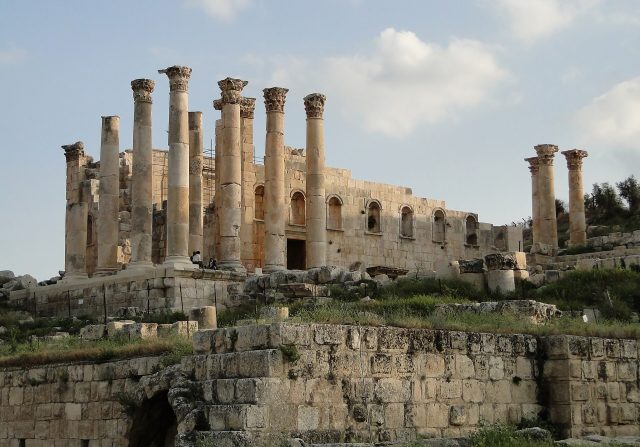
Jerash feels like a place where time hasn’t so much stopped as simply settled into a slower rhythm. Tucked in the hills of northern Jordan, it’s one of those rare cities where the past isn’t locked behind glass or roped off for tourists—it’s still part of the everyday. Walk beneath Hadrian’s Arch, built to welcome the Roman emperor nearly two thousand years ago, and you’re not just stepping into history; you’re stepping into a living city where ancient stones line streets still used by locals, where the clatter of a café blends with the echo of footsteps on worn marble. The ruins here aren’t relics; they’re neighbors.
The heart of Jerash is its Roman theater, still very much in use. On summer evenings, the tiered stone seats fill with people, and the air hums with music—just as it did centuries ago. But the city offers more than just a single landmark. The cardo maximus, the grand colonnaded street that once carried chariots and merchants, now carries the quiet footsteps of visitors tracing the same path. The stones are smooth underfoot, polished by time, and the columns lining the road stand as silent witnesses to the city’s layered past. Nearby, the oval forum, with its uneven paving and weathered columns, feels less like a tourist attraction and more like a place where history still breathes.
What makes Jerash special is how effortlessly it weaves together different eras. Roman temples stand near Byzantine churches, Ottoman-era buildings share streets with modern shops, and on the outskirts, traditional Arab houses with inner courtyards offer a glimpse of life that hasn’t changed in generations. The city doesn’t try to hide its age—some columns lean precariously, walls are cracked, and patches of mosaic floor are worn thin. There’s no attempt to polish it into perfection, and that’s what gives Jerash its charm. It feels real, not like a stage set for visitors but a place where people have lived, worked, and left their mark for centuries.
The locals here are warm without being intrusive. In the small cafés near the archaeological park, you can sip strong Arabic coffee or try knafeh, the sticky-sweet pastry soaked in syrup. The shops along the cardo sell spices, handmade jewelry, and simple souvenirs, not the mass-produced trinkets found in bigger tourist hubs. Jerash doesn’t compete with Petra’s grandeur or Amman’s energy—it doesn’t need to. What it offers instead is a quiet kind of magic, the chance to wander without a map, to touch a column worn smooth by generations of hands, and to feel, just for a moment, like you’re part of something older and deeper than the trip itself. It’s a place where history isn’t something you observe from a distance; it’s something you step into.
See & Do
All of them

Places on the map
Marker colour follows the categoryClimate and weather
Detailed weather: Jerash- Average temperature
- 18 °C
- Precipitation per year
- 137 mm
- Sunshine hours per day
- 8.5 h
Average air temperature
°C
9
10
13
18
22
25
27
26
25
21
15
11
Jan
Feb
Mar
Apr
May
Jun
Jul
Aug
Sep
Oct
Nov
Dec