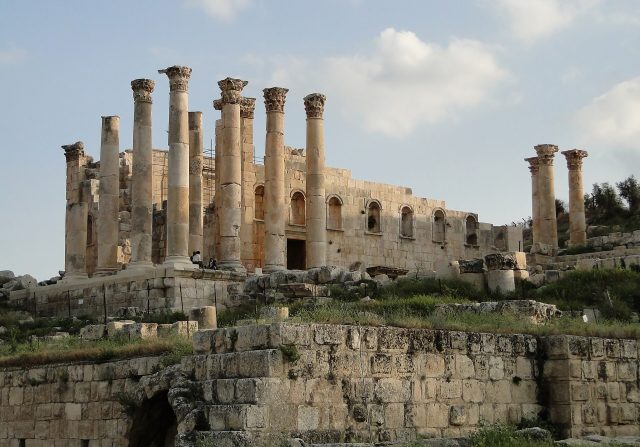
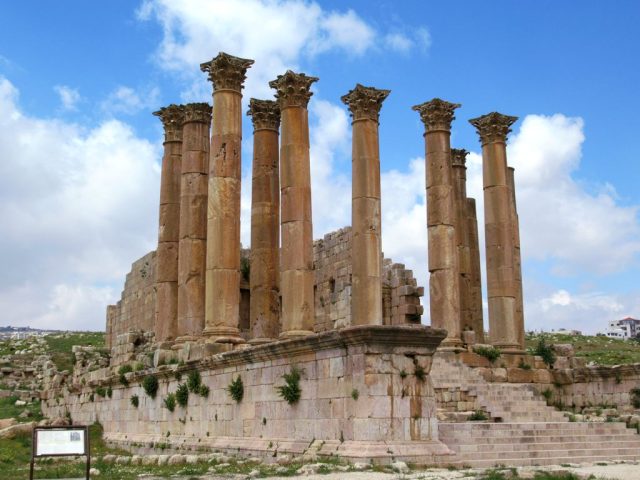
Perched on a gentle rise overlooking the ancient city of Jerash, the Temple of Artemis stands as a quiet witness to a world that has long since faded. Its towering columns, still defiant after nearly two millennia, cut a striking silhouette against the sky, their weathered stone bearing the marks of time and the hands of countless visitors who have stood in their shadow. Built in the second century AD, when Jerash—then known as Gerasa—flourished under Roman rule, the temple was more than a place of worship. It was a statement of power, a civic landmark, and a gathering point for a city that thrived at the crossroads of trade and culture.
The architecture of the temple reflects the precision and ambition of its creators. Twelve Corinthian columns, each rising nearly fifteen meters, once supported an imposing portico, their ornate capitals carved with the delicate acanthus leaves that defined the style. The columns rest on a high podium, accessed by a broad staircase that lent the structure an air of grandeur and reverence. Inside, the sanctuary would have housed a statue of Artemis, the city’s patron goddess, though today only the empty space remains, filled now with nothing but the whisper of the wind and the occasional echo of footsteps on stone.
What makes the Temple of Artemis particularly compelling is its place within the larger urban fabric of ancient Jerash. It wasn’t an isolated monument but part of a carefully planned cityscape, connected to the main thoroughfare—the cardo maximus—by a wide processional way. This street, lined with colonnades and once bustling with merchants, officials, and worshippers, would have led directly to the temple, reinforcing its role as the spiritual and social heart of the city. Even now, fragments of that past linger in the ruins: the remnants of altars, the worn paving stones, the occasional broken statue half-buried in the earth.
Jerash itself has a history that stretches back to the Hellenistic period, but its golden age came under Roman rule. By the second century AD, the city was a hub of commerce and craftsmanship, its streets alive with the sounds of trade and the clatter of artisans at work. The Temple of Artemis was one of its crowning achievements, a testament to the wealth and sophistication of its people. Yet like so many cities of the ancient world, Jerash eventually declined. The fall of the Roman Empire, shifting trade routes, and a series of earthquakes took their toll, and the temple, like the rest of the city, was left to the mercy of time. Its stones were plundered for building materials, its walls crumbled, and for centuries, it lay forgotten beneath the earth.
It wasn’t until the 19th century that European explorers rediscovered Jerash, and with it, the Temple of Artemis. Excavations began, slowly revealing the extent of the city’s former glory. Today, the temple is one of the most striking sights in Jerash, though it remains a place of quiet reflection rather than tourist clamor. The columns, bleached by the sun and worn smooth by the wind, cast long shadows across the ground, while the surrounding ruins—theaters, baths, other temples—hint at the scale of what once was. There’s a sense of stillness here, as if the past is holding its breath, waiting to be acknowledged.
Visiting the Temple of Artemis is less about ticking off a landmark and more about stepping into a different era. It’s easy to imagine the processions that once wound their way up the temple steps, the murmur of prayers, the scent of incense lingering in the air. The temple wasn’t just a religious site; it was a symbol of identity for the people of Gerasa, a place where the divine and the civic intersected. That dual role is what makes it so fascinating—it wasn’t built solely for worship but to project the city’s status, to impress visitors, and to serve as a reminder of the gods’ favor.
What remains today is a fragment of that ambition, a skeleton of the original structure that still manages to convey a sense of its former majesty. The temple’s survival is remarkable, given the centuries of neglect and the forces of nature that have worn it down. Yet it endures, not just as a relic but as a bridge to the past. There’s something humbling about standing among its columns, knowing that generations of people—worshippers, merchants, soldiers, travelers—have done the same. The stones don’t speak, but they don’t need to; their presence is enough to evoke the weight of history.
Jerash as a whole is often described as one of the best-preserved Roman cities outside of Italy, but the Temple of Artemis stands out even among its impressive ruins. It’s a place that invites contemplation, where the boundaries between past and present blur. The city around it has changed—modern Jerash is a small town, a far cry from the metropolis it once was—but the temple remains, a silent sentinel over the centuries. It doesn’t offer easy answers or grand narratives; instead, it leaves room for the imagination to fill in the gaps, to wonder about the lives that unfolded here and the people who once called this place home.
In the end, the Temple of Artemis is more than just an ancient ruin. It’s a reminder of how fleeting even the mightiest civilizations can be, and how the things we build often outlast the purposes for which they were created. The temple was meant to honor a goddess, to glorify a city, and to endure for eternity. In a way, it has succeeded—just not in the way its builders intended. Today, it stands not as a place of worship but as a testament to the passage of time, a quiet monument to the idea that some things, no matter how solid they seem, are never truly permanent. And perhaps that’s why it continues to draw visitors: not just for its beauty or its history, but for the way it makes the past feel tangible, almost within reach.