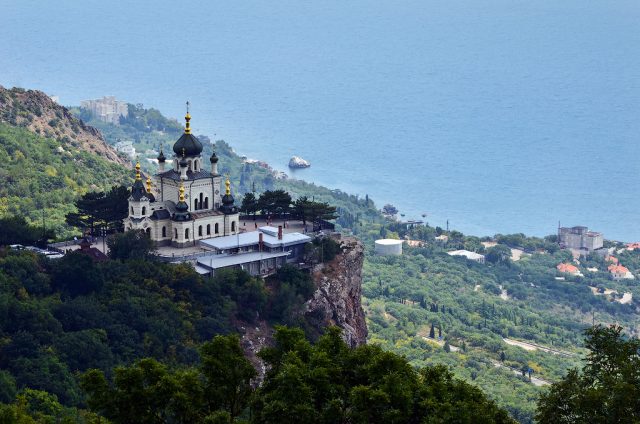
The Church of the Resurrection of Christ perched on a cliff near Foros is one of those rare places where human craftsmanship and nature exist in perfect harmony. Rising nearly four hundred meters above the Black Sea, its white walls and golden domes seem to float against the vast expanse of water below. From this height, the view stretches endlessly—waves crashing against the rugged Crimean coastline, the distant outline of the Yalta headland on clear days, and the endless blue of the horizon. But the church is more than just a viewpoint. Its history and architecture tell a story of a time when Crimea was a crossroads of empires, where builders had to contend with the raw power of the landscape itself.
The church was commissioned in the late 19th century by Alexander Kuznetsov, a Moscow merchant and philanthropist best known for his tea empire. In Crimea, however, his legacy is tied to this church, built in memory of his daughter, who died young. Kuznetsov wanted a place of worship not just for his family but for the local community and the growing number of visitors drawn to the region’s mild climate. The architect, Nikolai Krasnov, was already well-known for his work in Yalta and Livadia, and he designed the church to blend seamlessly with the rocky terrain. Construction took several years, and in 1892, the church was consecrated in honor of the Resurrection of Christ.
Krasnov’s design merges Neo-Byzantine elements with traditional Russian ecclesiastical architecture. The white stone of the church stands in sharp contrast to the gilded domes and the deep blue of the sea, creating a striking visual effect. Inside, the space is small but bright and intimate, with frescoes painted in an academic style. The iconostasis, crafted by prominent artists of the time, draws particular attention. One of the most remarkable aspects of the church’s construction is its resilience—its foundation is anchored deep into the cliff, and its structure was engineered to withstand earthquakes, a wise precaution in a seismically active region. Over the decades, the church has weathered tremors that have shaken the peninsula, yet it remains standing, a testament to its sturdy design.
The Foros church is deeply intertwined with Russia’s history at the turn of the 20th century. At the time, Crimea was a favored retreat for the aristocracy and the imperial family, attracting writers, artists, and musicians. Foros, with its gentle climate and breathtaking scenery, was a particularly popular destination. The church became not only a spiritual center but also a gathering place for the creative elite. Anton Chekhov, who lived nearby in Yalta, is said to have visited the church during his time in the region. Like many religious sites, however, its fate took a dark turn after the revolution. The church was closed, repurposed as a warehouse during the Soviet era, and eventually abandoned. It wasn’t until the 1990s that it was returned to the faithful and restored to its original purpose.
Today, the Church of the Resurrection of Christ is one of the most recognizable landmarks on Crimea’s southern coast. The only way to reach it is by car or bus along a narrow, winding road that snakes up the mountainside. Those who attempt the hike on foot should be prepared for a steep, hour-long climb, but the effort is rewarded with more than just a visit to the church. The viewpoint in front of the building offers a sweeping panorama—endless sea meeting the sky at the horizon, the sprawling greenery of Foros below, and the white villas dotting the landscape. On clear days, the spot is especially popular, drawing tourists eager to capture the view and locals who come to pray or simply enjoy the quiet.
The atmosphere around the church is one of serene isolation. Unlike the bustling resort towns along the coast, Foros retains a sense of tranquility even in peak season. The church seems to hold within its walls the memories of those who built it, those who prayed here a century ago, and those who sought solace in its shadow. The air is filled with the scent of pine and juniper, mingling with the saltiness of the sea, while the only sounds are the distant crash of waves and the occasional rustle of wind through the trees. As the sun sets, the church’s domes glow in the fading light, casting a warm, golden hue over the scene.
Many visitors combine a trip to the church with a walk through the surrounding area. Nearby, the famous Sail Rock juts out from the sea, its shape resembling a ship under full sail—one of Crimea’s most photographed natural landmarks. The Foros Park, established in the late 19th century, is also worth exploring. Filled with exotic plants from around the world, its shaded paths offer a cool respite from the summer heat. Together, the park and the church form a unique ensemble where architecture and nature coexist in perfect balance.
The Church of the Resurrection of Christ is more than just a tourist attraction; it’s a place that lingers in the memory long after the visit. Here, history and nature intertwine, and the spiritual blends with the beauty of the surrounding world. Perhaps that’s why it draws not only pilgrims but also those in search of quiet reflection or inspiration. In an age where everything seems to change at a relentless pace, places like this remind us of the things that endure. The church on the cliff is one of them.