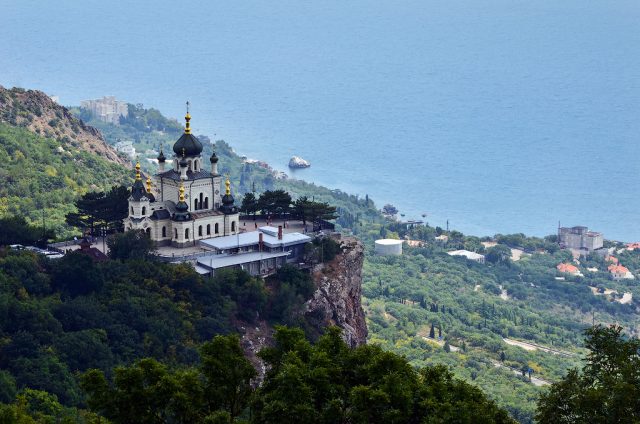
Foros Park is one of those rare places in Crimea where nature and history intertwine so seamlessly that time itself seems to move differently here. Perched on the slopes of Mount Koshka, it feels as though it was designed to offer an escape from the noise of the world, a quiet corner where the sea, the cliffs, and the ancient trees exist in harmony. Unlike the rigid, manicured gardens of Europe, Foros Park retains a wild, untamed beauty, shaped by the rugged landscape of the southern coast.
The park’s origins are tied to the vision of Alexander Kuznetsov, a wealthy merchant and avid plant collector who, in the late 19th century, set out to transform this land into a masterpiece of landscape art. Kuznetsov wasn’t just a businessman; he was a passionate horticulturist who dreamed of creating a botanical garden where rare and exotic plants from across the globe could thrive. To bring his vision to life, he hired the finest gardeners and botanists of his time, personally overseeing the layout of every path and planting. Thanks to his efforts, Foros became home to groves of stone pines, cedars, magnolias, and even bamboo—species that were almost unheard of in Crimea at the time.
Today, the park covers around forty hectares, and its uneven terrain makes every walk an adventure. Narrow trails wind between rocks, sometimes descending toward the sea, other times climbing small hills that offer sweeping views of the coastline and mountains. Below, the waves crash against the shore, while above, the rustling leaves and birdsong create a peaceful soundtrack. The park is especially magical in spring, when magnolias and rhododendrons bloom, filling the air with their rich fragrance, and in autumn, when the foliage turns to shades of gold and crimson.
One of the park’s most striking features is the Church of the Resurrection of Christ, perched atop the Red Cliff. Its white walls and golden domes are visible from afar, making it not just a symbol of Foros but one of the most recognizable landmarks on Crimea’s southern coast. The church was built in 1892 at Kuznetsov’s request to commemorate the survival of Emperor Alexander III and his family in a train crash four years earlier. The architecture blends Byzantine and Old Russian styles, and its dramatic location on the cliff gives it the appearance of a fairy-tale castle floating above the sea.
A walk through Foros Park is more than just a chance to enjoy nature; it’s a journey into the past. The park still holds remnants of its heyday—old gazebos, stone bridges, and even a small grotto carved into the rock. These details serve as reminders that Foros was once one of the most fashionable resorts of the Russian Empire, attracting aristocrats, artists, and writers. Anton Chekhov, Ivan Bunin, and Feodor Chaliapin were among those who strolled these paths, their names now woven into the park’s legend. While time has worn down many of the structures, even in their faded state, they carry the spirit of that era.
A particular highlight is the Sun Trail, a path that leads from the church down to the sea. Laid out during Kuznetsov’s time, it was designed for leisurely walks with breathtaking coastal views. Today, it offers a route to a small, secluded beach where cliffs plunge directly into the water, forming natural coves. The water here is crystal clear, and the shore is lined with smooth pebbles. Though the beach isn’t the most comfortable for swimming, it’s perfect for those seeking solitude and a sense of being at one with this untamed stretch of nature.
Foros Park isn’t a museum in the traditional sense, nor is it just a collection of trees and rocks. It’s a place where every element—whether an old gazebo, a centuries-old cedar, or a winding path—has a story to tell. Unlike the crowded tourist spots in Yalta or Alushta, the park remains relatively quiet, making it a treasure for those who value authenticity and tranquility. You could spend an entire day here, moving from one corner to another, or simply sit on a bench and listen to the rhythm of the waves.
Of course, the park hasn’t remained untouched by time. Some of the plants Kuznetsov introduced didn’t take root, while others grew so vigorously that they altered the garden’s original design. Yet this is part of what makes Foros Park special—the sense that nature is slowly reclaiming what was once shaped by human hands. It doesn’t strive for perfection; it lives and breathes, and that’s where its charm lies. Here, you can forget the rush of modern life, the ticking of the clock, the noise beyond the mountains. Perhaps that’s why it still draws those who seek not just beauty, but something deeper—peace, inspiration, a connection to the past.