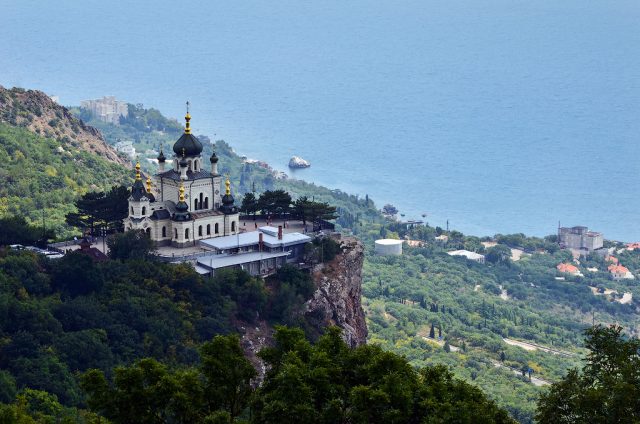
Perched on a sheer cliff above the Black Sea, the Foros Church seems to hover between earth and sky. Its white walls and red roof stand out against the rugged landscape, catching the light as the waves crash far below. The location was chosen deliberately—four hundred meters above the coast, where the view stretches endlessly over the sea and the forested mountains. The church feels like a natural extension of the land itself, as if the rock had simply risen to cradle it.
The story of Foros Church begins in the late 19th century, when the Crimean coast was a retreat for Russia’s aristocracy. The land belonged to Alexander Kuznetsov, a wealthy industrialist who wanted to honor a miracle—the survival of Tsar Alexander III and his family after a train derailment in Borki. According to legend, the tsar’s escape was so improbable that Kuznetsov saw it as divine intervention. To give thanks, he commissioned a church on the most breathtaking spot of his estate. Construction took years, and the church was finally consecrated in 1892.
The architecture blends Byzantine influences with local traditions. Though small, the church is perfectly proportioned, its domes and arches giving it an airy, almost weightless quality. Inside, the walls are covered in faded frescoes, their colors softened by time and dampness. Some details have been lost, but the space still carries a quiet intensity, especially when the wind whispers through the vaulted ceilings.
The real marvel of Foros Church is its setting. Reaching it requires effort—a winding climb up a steep road or a ascent up stone steps carved into the cliff. The journey is tiring, but the reward is immediate. From the top, the entire coastline unfolds, from Cape Sarych to Yalta, and on clear days, the distant shores of Turkey shimmer on the horizon. Locals say the view clears the mind, and it’s easy to believe—there’s something about the silence and the vastness that invites reflection.
For much of the 20th century, the church was closed to the public. During the Soviet era, it was used as a warehouse before falling into neglect. Restoration began in the 1990s, and today, services are held occasionally, though not as often as in larger cathedrals. Most visitors come for the history and the view. The interior is open, but photography is discouraged, as if to preserve the stillness of the place.
Unlike the crowded resorts nearby, Foros Church exists in a world apart. There are no souvenir stalls, no blaring music, no crowds jostling for space. Even in peak season, the area remains quiet, partly because getting here isn’t easy. Those who make the trip tend to linger—sitting on benches, watching the sea, listening to the waves. Sometimes, locals come just to escape the noise of the city, to sit in the quiet and breathe.
This isn’t just a historic site or a scenic viewpoint. The Foros Church is where history, nature, and faith intersect. It’s a reminder of how fragile life can be and how precious moments of stillness are. That might be why people keep returning—not for photos or to check off a tourist list, but to feel something deeper. Time moves differently here, and when you leave, the place stays with you.