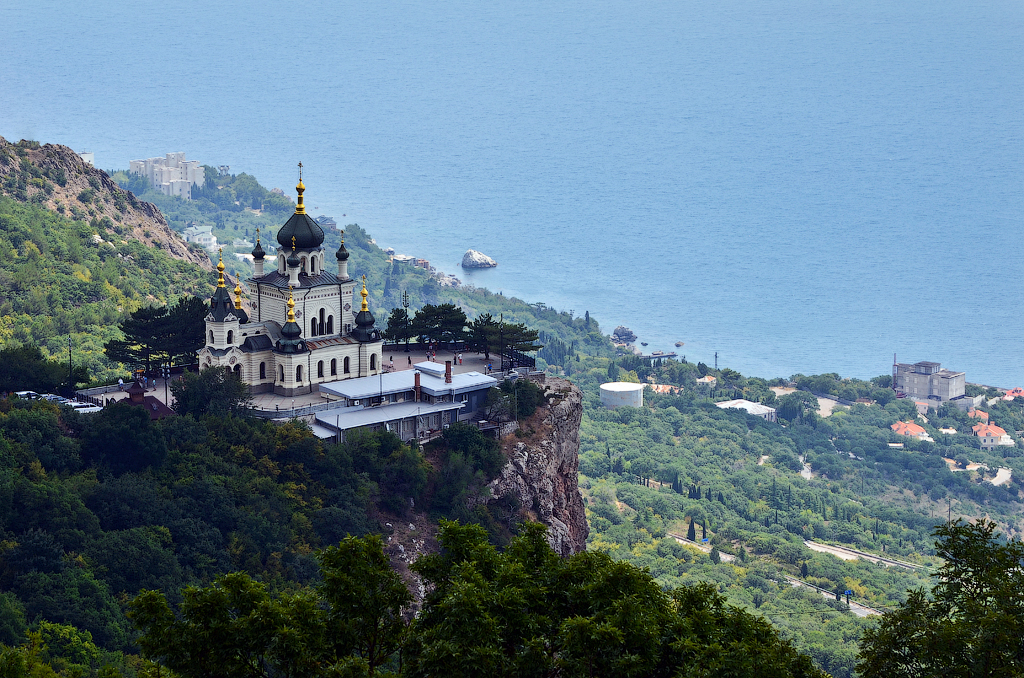
Perched high above the Black Sea coast, the Baydar Gates are one of those rare places where human craftsmanship and nature’s grandeur exist in perfect harmony. This isn’t just a viewpoint—it’s a landmark that feels as though it has always belonged here, as if the mountains and sea conspired to frame it just so. From this spot, the coastline unfolds in dramatic sweeps, where cliffs plunge into the deep blue below and the winding road along the shore vanishes into the haze. On clear days, the outlines of Yalta shimmer in the distance, and if the weather holds, you might even glimpse the faint silhouettes of mountains across the bay.
The gates themselves date back to the late 19th century, a time when Crimea was becoming a fashionable retreat for Russia’s aristocracy and artistic elite. They were commissioned by a local landowner to mark the beginning of a new stretch of road connecting Foros with the Baydar Valley. The design was simple but striking—two stone arches joined together, forming a natural frame for the vast expanse of sea and sky beyond. In those days, travelers would pause here to rest and take in the views before descending toward the coast, their carriages rattling over the cobblestones that still lie beneath the modern road.
Over time, the Baydar Gates became more than just a waypoint. They took on a life of their own, wrapped in stories and half-remembered legends. Some say Alexander Pushkin passed through here during his travels in Crimea, though there’s no definitive proof. What is certain is that by the Soviet era, the gates had become a favorite stop for tourists exploring the southern coast, a place to snap a photograph and soak in the scenery. Today, people come not just for the view but for the sense of stepping into an older, quieter Crimea—one that hasn’t yet been swallowed by resort sprawl or the rush of peak season.
The architecture of the gates is unassuming, and that’s part of their charm. The stone blocks were chosen to blend seamlessly with the surrounding cliffs, giving the structure a timeless quality. It feels solid yet unobtrusive, as if it grew from the earth rather than being built by human hands. Nearby, remnants of the old cobblestone road still remain, a quiet reminder of the carriages and travelers who once passed this way. Even now, the pace of life here slows down, and the occasional hum of traffic fades into the background, leaving only the sound of wind through the pines and the distant murmur of the sea.
Beyond their architectural appeal, the Baydar Gates serve as a gateway to a network of trails and hidden corners of the region. From here, you can descend toward the coast along a path that winds through pine forests, or head into the Baydar Valley, where traditional Crimean Tatar villages and old estates still stand. Nearby, the Foros Church clings to a cliffside, its white walls stark against the rock, while the Laspi Pass offers equally breathtaking vistas. But even if you don’t venture farther, the gates themselves are worth lingering over—whether you’re sitting on a sun-warmed stone or watching the light shift across the water.
The weather here is as changeable as the landscape, and that unpredictability only adds to the place’s allure. Mornings often bring a thick mist that slowly lifts to reveal glimpses of the coast, one piece at a time. By midday, the sun burns through, turning the sea into a sheet of shimmering silver. As evening approaches, the shadows lengthen, and the mountains take on a violet hue, as if the whole scene has been dipped in watercolor. It’s easy to see why this stretch of coastline has long captivated artists and writers—every view feels like it was composed with intention, as if the land itself is inviting you to look closer.
These days, the Baydar Gates attract more than just tourists. Locals stop here on their way to work, families come for picnics, and some simply arrive to escape the noise of everyday life. There are no bustling cafes or souvenir stalls crowding the area, which only makes the place feel more authentic. This is Crimea as it has always been—unpolished, unhurried, and untouched by the gloss of tourism brochures.
Of course, like many places on the peninsula, the gates haven’t escaped the march of time. The road running past them is busier now, and the occasional rumble of cars can break the silence. But step just a few paces away, and the modern world fades—replaced by the rustle of pine needles and the distant crash of waves. That’s the real magic of the Baydar Gates: they manage to straddle past and present without losing what makes them special. And as long as there are people who want to pause here, even for a moment, they’ll remain one of the quiet symbols of Crimea’s enduring beauty.