Bulguksa Temple sits on the slopes of Mount Toham in Gyeongju, a city that once served as the heart of the ancient Silla Kingdom. More than just an architectural landmark, this place feels like a living chapter of history, where every stone and wooden beam carries the weight of an era when Buddhism wasn’t merely a religion but the foundation of an entire nation’s worldview. Built in the 8th century, the temple has endured wars, fires, and restorations, yet it retains the harmony its creators intended—a balance between humanity, nature, and the spiritual.
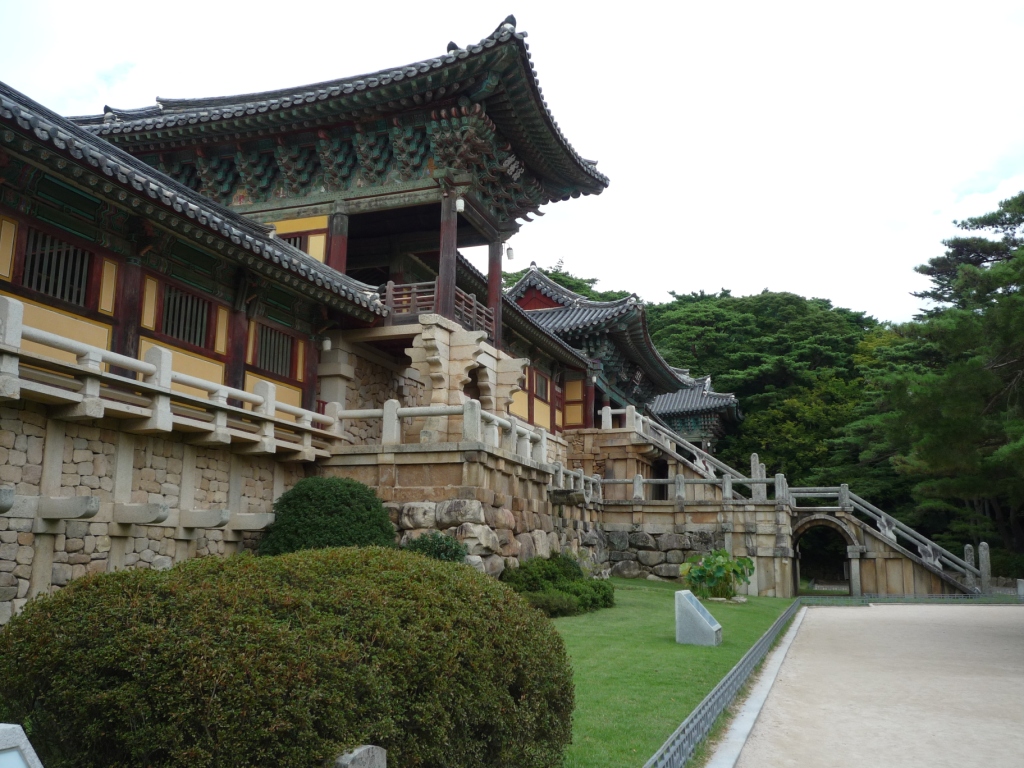
The architecture of Bulguksa is striking even by Korean standards, where temples often impress with their refinement. Here, nothing feels excessive. The clean lines of the pagodas, the graceful bridges leading to the main halls, and the stone staircases that seem to float above the ground all contribute to a sense of quiet elegance. Two bridges, Cheongungyo and Baegungyo, are particularly famous. Their names—Bridge of Blue Clouds and Bridge of White Clouds—hint at their symbolic meaning, representing the path to enlightenment. On misty mornings, they almost appear to lead somewhere beyond the ordinary world. The temple’s pagodas, Tabotap and Seokgatap, are more than decorative elements; they embody core Buddhist teachings. Tabotap, with its intricate design, symbolizes the complexity of truth, while Seokgatap, with its simple structure, represents clarity and purity.
Bulguksa’s significance deepens when you consider its connection to the Silla Dynasty. During that time, Gyeongju was the political and cultural center of the Korean Peninsula, and Buddhism wasn’t just a faith but a state ideology. The temple was commissioned by the royal family, and its design reflects their vision of an ideal world. Everything here follows strict symmetry and proportion, meant to mirror the order of the universe. Even the placement of the buildings isn’t arbitrary—the main halls face south, aligning with traditional beliefs about harmony with nature.
Stepping inside the temple, the atmosphere shifts. Outside, the architecture is defined by precise lines and geometry, but within, there’s a quiet dimness, filled with the scent of incense. The main hall, Daeungjeon, houses a statue of Buddha Shakyamuni, surrounded by murals depicting his life. Unlike some other Korean temples, Bulguksa avoids bright colors, and this restraint creates a sense of calm. Nearby, a library holds ancient sutras, once painstakingly copied by hand by monks. Today, these texts are part of the nation’s heritage, but within the temple, they still feel like living witnesses to the past.
Bulguksa isn’t just a place for pilgrims. Visitors often include tourists, artists, and people simply seeking quiet. The temple grounds are surrounded by a park of ancient pine trees and benches, where you can sit and gaze at the mountains. In spring, cherry blossoms bloom, while autumn turns the maple leaves into shades of red and gold. In winter, snow dusts the stone steps, adding to the temple’s mystique. Locals sometimes come just to walk, and this casual presence is part of what keeps Bulguksa from feeling like a museum. It’s a place where history isn’t frozen in time but continues to breathe.
One of the most intriguing aspects of Bulguksa is its underground treasury, which holds artifacts from the Silla era. Among them are a famous gilded Buddha statue discovered in one of the pagodas and bronze bells that once rang to signal the start of services. These items aren’t always on display, but their existence reminds visitors that the temple is more than just architecture—it’s a repository of spiritual and cultural treasures. Occasionally, exhibitions are held, but even without them, there’s a sense that something meaningful lies behind every wall.
Bulguksa has survived its share of trials. During the Japanese invasions in the 16th century, parts of the temple were destroyed, and in the 20th century, it underwent restoration to preserve its original appearance. Today, it’s a UNESCO World Heritage site, but for Koreans, it’s more than a monument—it’s a part of their national identity. Buddhist services are still held here, and the monks who live on the grounds maintain traditions passed down through generations. For them, Bulguksa isn’t a museum but a home where they continue the spiritual practice it was built for.
Visiting Bulguksa, you realize it’s not just a beautiful place. It’s a point where past and present intersect, where architecture becomes a language for expressing timeless truths. There’s no hustle, no overbearing tourist infrastructure—just silence, mountains, and the feeling that time moves differently here. Maybe that’s why people return, not for photographs, but for the sense of peace that’s hard to find in the modern world.