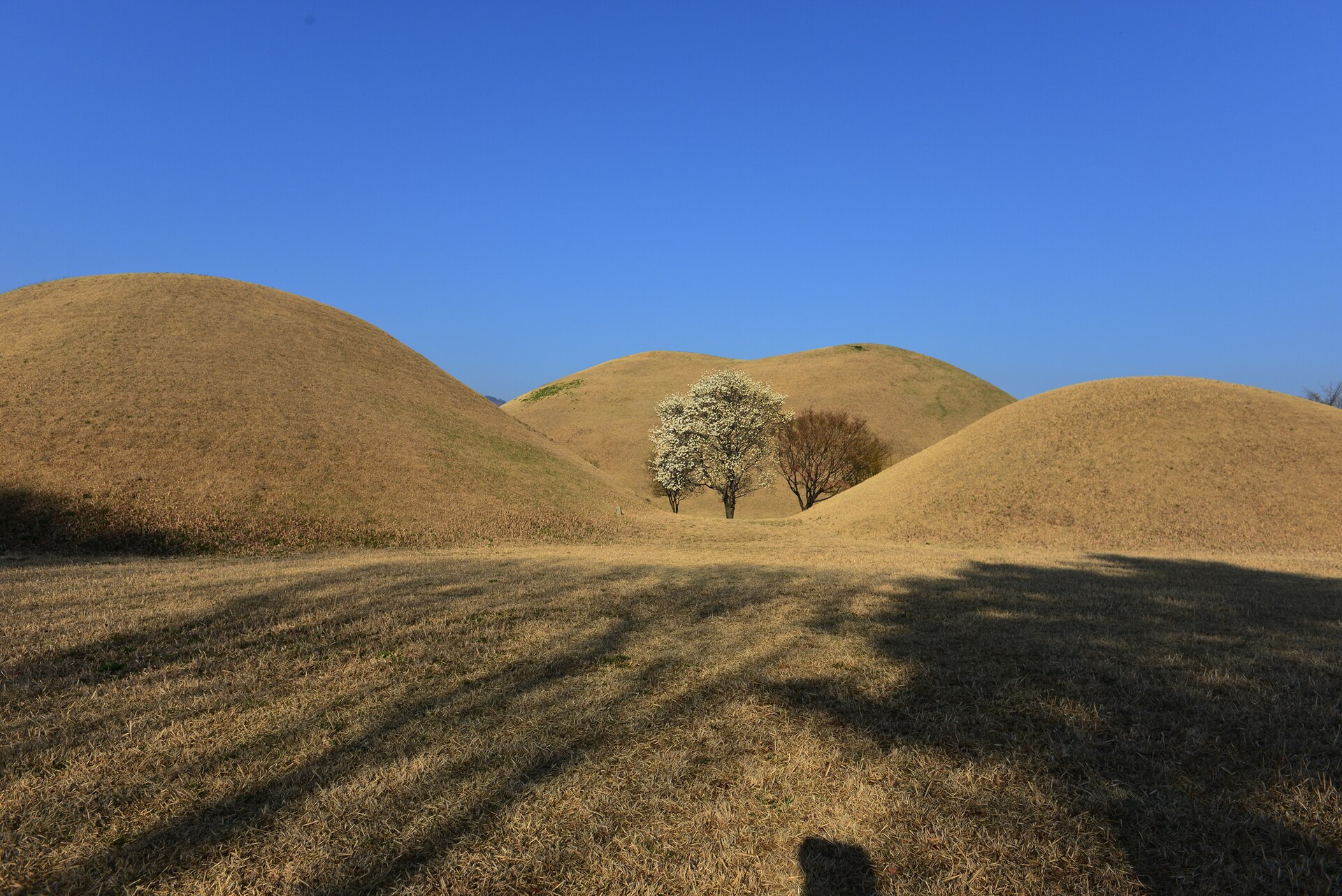
Gyeongju is a city where history lingers in the air, in the quiet rustle of leaves. On the outskirts of what was once the capital of the Silla Kingdom, the burial mounds of Daereungwon stand as reminders of an era that shaped the Korean Peninsula. These grass-covered hills hold the remains of rulers and nobles whose names once dictated the fate of a nation.
The tombs are simple earthen mounds, their slopes framed by low stone walls. The absence of ostentation is striking. These were resting places, designed to blend into the landscape, as if the people buried here wanted to return to the earth as quietly as they had ruled over it.
The Silla Kingdom lasted nearly a thousand years, and Gyeongju was its heart. Daereungwon dates back to the kingdom’s golden age. The dead were laid to rest in wooden coffins surrounded by objects meant to accompany them into the afterlife. Archaeologists have uncovered gold crowns, pottery, weapons, and jewelry—artifacts that show a society that believed in continuity beyond death. A golden belt adorned with pendants was found in the tomb of King Naemul. Though his mound looks no different from the others, this relic confirms his legacy as one of the rulers who helped unify much of the peninsula under Silla’s rule.
The tombs are arranged with care. Many are aligned with the cardinal directions, reflecting an ancient belief in harmony with nature. Some still contain traces of the wooden structures that once supported the earthen domes above the coffins. In their prime, these mounds would have been surrounded by stone statues and steles, though most have disappeared, leaving only the quiet hills behind. The low stone walls that encircle each tomb were boundaries, a way to honor the space between the living and the dead.
Daereungwon is not a place that demands attention. There are no crowds here. The atmosphere is quiet, a stillness in a world that often feels too loud. Locals occasionally visit to pay their respects, but more often, the tombs are left to the wind and the trees. The paths between the mounds are narrow, inviting you to walk slowly, to listen to the way the grass sways in the breeze.
Gyeongju is called an open-air museum, and Daereungwon might be its most honest exhibit. There is no pretense here. The tombs simply exist, as they have for centuries, bearing witness to a time when Korea was still finding its identity. They remind us that history isn’t always written in grand gestures. Sometimes, it’s in the quiet persistence of the earth, in the way a hillside can hold the weight of a kingdom.
If you’re in Gyeongju, you might be drawn to the more famous sites—the temples, the palaces, the relics that tell the loudest stories. But take a detour to Daereungwon first. Sit on one of the benches at the base of a mound and look out over the city. The view isn’t spectacular, but there’s something in the way the past and present coexist here. You won’t hear the voices of the kings and nobles buried beneath your feet, but you’ll feel their presence in the way the land has absorbed them. It’s a place where history doesn’t feel distant—it feels like something you could reach out and touch.