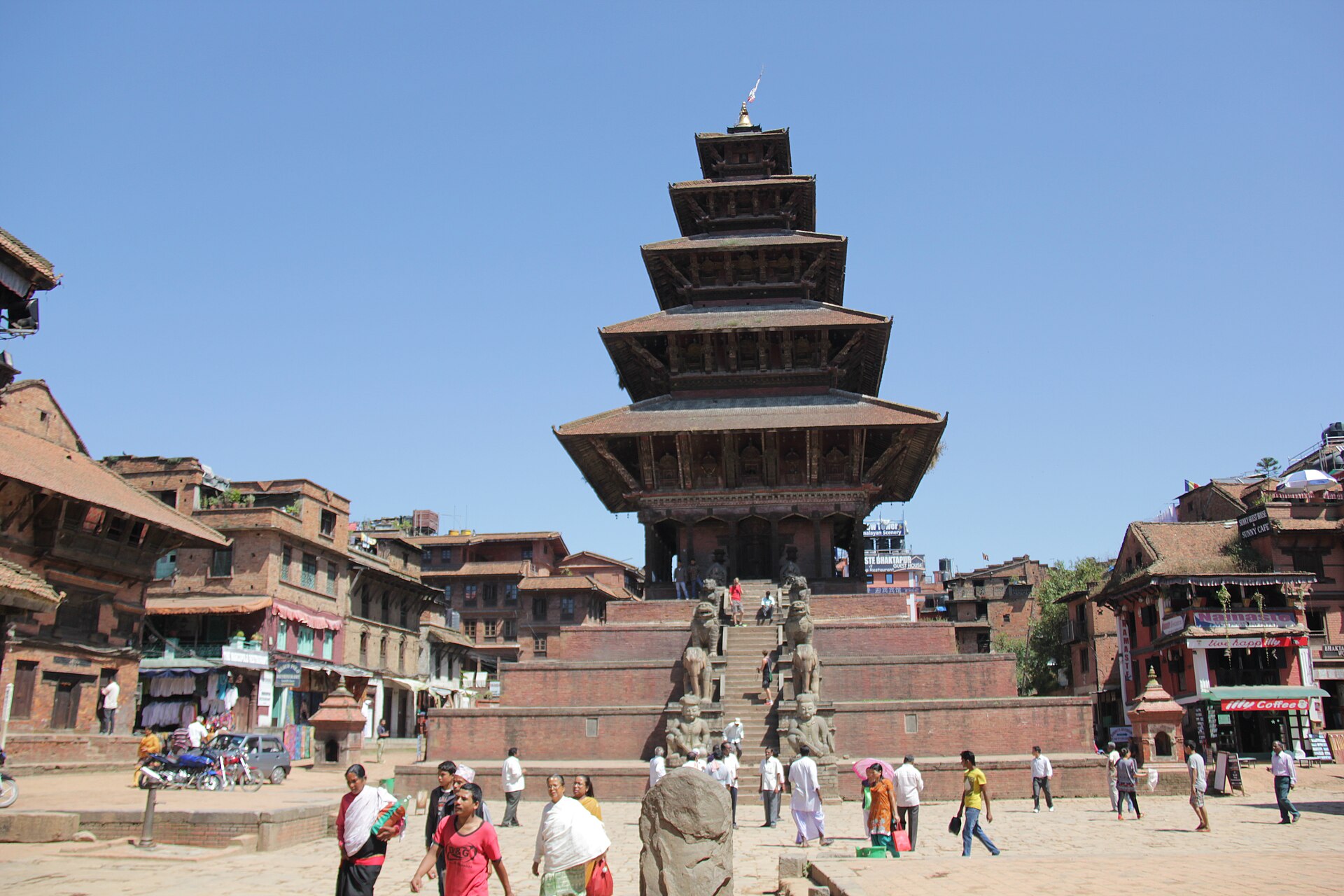
Nyatapola isn’t just a temple—it’s one of Nepal’s most striking architectural landmarks, standing as if frozen in time on Bhaktapur’s main square. The five-tiered pagoda rises from a stone plinth with a quiet grandeur, its proportions so precise that it seems to defy the centuries. The name itself means "five stories," each level representing one of the classical elements: earth, water, fire, air, and ether. Built in the early 18th century, Nyatapola wasn’t just a place of worship but a testament to the engineering skill of its time, a structure so ambitious that it still feels ahead of its era.
Dedicated to Siddhi Lakshmi, the goddess of prosperity and spiritual power, the temple is believed to protect Bhaktapur from misfortune. Locals say its construction demanded the labor of the entire city—stones were hauled from nearby hills, and massive beams were carved from single trunks of Himalayan cedar. Even now, after earthquakes that have shaken the Kathmandu Valley, the temple stands firm, its wooden joints and stone foundations barely showing the strain of time. There’s something almost defiant in its endurance, as if the builders knew it would outlast them.
The climb to the temple is part of the experience. A broad stone staircase, worn smooth by generations of footsteps, is flanked by statues of guardians and mythical creatures. Lions crouch at the base, symbolizing protection, while elephants represent strength. Higher up, griffins and deities watch over the ascent, their forms weathered but still imposing. The staircase itself is a marvel—each stone laid with such care that even after three hundred years, the surface remains remarkably intact. At the top, pilgrims leave offerings of flowers, rice, or oil for lamps, their quiet rituals adding to the sense of reverence.
Inside, the temple is spare but no less powerful. Unlike some Nepali shrines, which dazzle with gold and intricate murals, Nyatapola’s beauty lies in its restraint. The wooden columns supporting the roof are carved with scenes from Hindu mythology, their details sharp despite the passage of time. A small altar holds an image of the goddess, its surface darkened by the smoke of countless oil lamps. Visitors are welcome to step inside, though photography is discouraged—a reminder that this is still, first and foremost, a place of devotion.
Nyatapola is deeply woven into Bhaktapur’s history. The city was once one of the three independent kingdoms of the Kathmandu Valley, a center of craftsmanship where artisans perfected their trades. The temple is a showcase of that skill, from the delicate woodwork on its eaves to the precise joinery of its beams. It has survived earthquakes, including the devastating quake of 2015, with only minor damage—a fact locals attribute to divine favor. The craftsmanship is so precise that even the wooden pegs holding the structure together were carved to fit perfectly, a detail that speaks to the patience and care of its builders.
The square around Nyatapola is always alive with activity. In the mornings, the scent of incense and freshly baked bread fills the air, mingling with the sounds of street vendors and musicians playing traditional instruments. By evening, the glow of oil lamps casts a warm light over the stone, softening the edges of the old buildings. It’s a place where time moves differently—unhurried, almost suspended. Even in the busiest seasons, the atmosphere remains calm, as if the temple itself sets the pace.
For many travelers, Nyatapola offers a glimpse of Nepal as it once was. Unlike the crowded streets of Kathmandu, Bhaktapur feels like a living museum, where the past isn’t preserved behind glass but woven into daily life. The locals are reserved but welcoming, and if you take the time to ask about their traditions, they’ll often share stories or invite you for tea. It’s in these small moments that the temple reveals itself—not just as a monument, but as a thread in the fabric of the city, one that has been unbroken for centuries.
Climbing to one of the upper tiers of Nyatapola rewards you with a view of Bhaktapur that feels almost secret. From above, the city unfolds like a patchwork of red-tiled roofs and narrow alleys, framed by the green hills of the valley. On clear days, the snow-capped peaks of the Himalayas rise in the distance, a reminder of the landscape’s scale. The temple doesn’t dominate the view—it belongs to it, its tiers echoing the natural layers of the hills. From here, it’s easy to see why the builders chose this spot, where the man-made and the natural exist in such harmony.
Nyatapola doesn’t demand admiration. It doesn’t need grand gestures or loud praise. You can stand in the square, listen to the murmur of the city, and feel the weight of centuries in the stones beneath your feet. That’s its quiet power—the way it slows time, just for a moment, and lets you step into a rhythm older than the modern world. It’s not the tallest or the most ornate temple in Nepal, but it might be the one that lingers longest in memory, not for what it is, but for how it makes you feel.