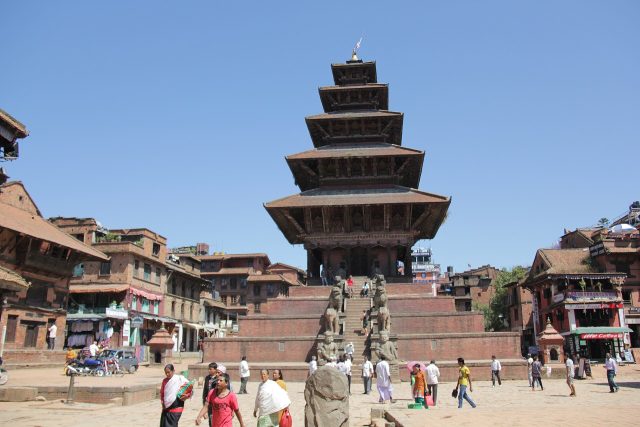
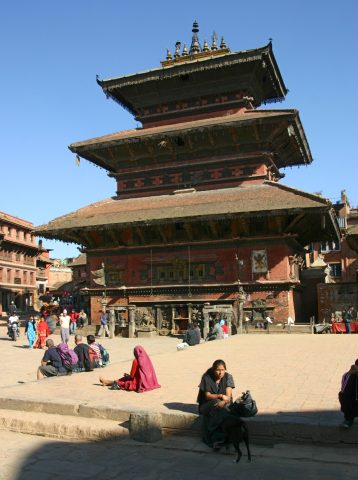
Dattatreya Temple sits quietly in the heart of Bhaktapur, a city where time seems to move at its own unhurried pace. Built in the late 15th century, it remains one of the most striking examples of medieval architecture in the Kathmandu Valley, a place where art and faith were once inseparable. The temple is dedicated to Dattatreya, a unique deity who embodies the three central figures of the Hindu pantheon—Brahma, Vishnu, and Shiva—merged into one. This rare fusion of divine aspects makes the temple significant not just for devotees but for anyone drawn to Nepal’s cultural and spiritual history.
The structure itself is a masterpiece of balance, combining grandeur with delicate craftsmanship. Rising from a high stone platform, the three-tiered pagoda is crowned with traditional terracotta tiles, its wooden beams and columns intricately carved with figures of gods, mythical creatures, and scenes from daily life. Every detail, from the ornate doorways to the latticed windows, reflects the skill of the artisans who built it. The windows, in particular, filter soft light into the interior, creating a serene atmosphere that lingers long after you step inside.
The square surrounding the temple was once the pulse of Bhaktapur’s public life. Centuries ago, it hosted religious ceremonies, civic gatherings, and even legal proceedings. Today, it retains a quieter purpose. Locals come to sit on the stone benches, watching the world go by, while visitors pause to admire the architecture or capture the scene in photographs. Early mornings are especially peaceful, with sunlight stretching across the cobblestones and the scent of incense drifting from nearby shrines.
Dattatreya Temple is more than a place of worship; it’s a living record of Bhaktapur’s past. It was commissioned by King Yash Malla, who ruled the city in the late 1400s when Bhaktapur was one of three independent kingdoms in the Kathmandu Valley. Like other rulers of the Malla dynasty, Yash Malla sought to leave a lasting legacy, and the temple became a symbol of both spiritual devotion and political power. Later, under the Shah dynasty, the temple underwent restorations, but its original character remained largely intact.
Inside, the temple feels intimate and unassuming. The air is thick with the scent of burning incense, and the only sounds are the murmur of prayers and the occasional rustle of footsteps on the woven mats covering the floor. The central altar holds a statue of Dattatreya, flanked by other deities, while thangkas—traditional painted scrolls—hang along the walls. There’s no opulence here, just a sense of quiet reverence. For many locals, the temple is a place to sit in silence, to reflect, or simply to escape the noise of everyday life.
Two stone pillars stand guard at the temple’s entrance, each topped with figures of mythical protectors. These sculptures, like much of the temple’s decoration, follow the artistic traditions of the Kathmandu Valley, blending religious symbolism with scenes from ordinary life. Carvings depict everything from hunting expeditions to festive dances, offering a glimpse into the world of the people who built and used the temple. This mix of the sacred and the mundane gives Dattatreya Temple a unique character, turning it into something like an open-air museum.
Bhaktapur itself feels like a city preserved in time, and Dattatreya Temple is one of its finest treasures. The narrow streets leading to it are lined with old brick houses, their wooden windows carved with the same care as the temple’s details. Small shrines dot the corners, and the absence of crowds—so common in Kathmandu—makes it easier to imagine what life here was like centuries ago. In the evenings, when oil lamps flicker at the temple’s entrance and musicians gather to play traditional instruments, the past feels almost tangible.
The temple isn’t just a relic; it’s still an active part of Bhaktapur’s spiritual life. Festivals like Maghe Sankranti draw crowds of devotees who come to honor their ancestors and seek blessings. On these days, the temple hums with activity—prayers, offerings, and the scent of flowers and spices filling the air. Even for those who don’t share the faith, the rituals offer a window into how deeply tradition is woven into Nepali culture.
Visiting Dattatreya Temple is less about ticking off a sight and more about stepping into a slower rhythm. There’s no rush here, no pressure to move on to the next attraction. The temple invites you to linger, to notice the way the light falls on the carvings or how the sound of a distant bell echoes through the square. It’s a place where history isn’t just remembered—it’s still alive, waiting in the quiet corners and the stories etched into the stone. For many, that’s what makes Bhaktapur, and this temple in particular, unforgettable.