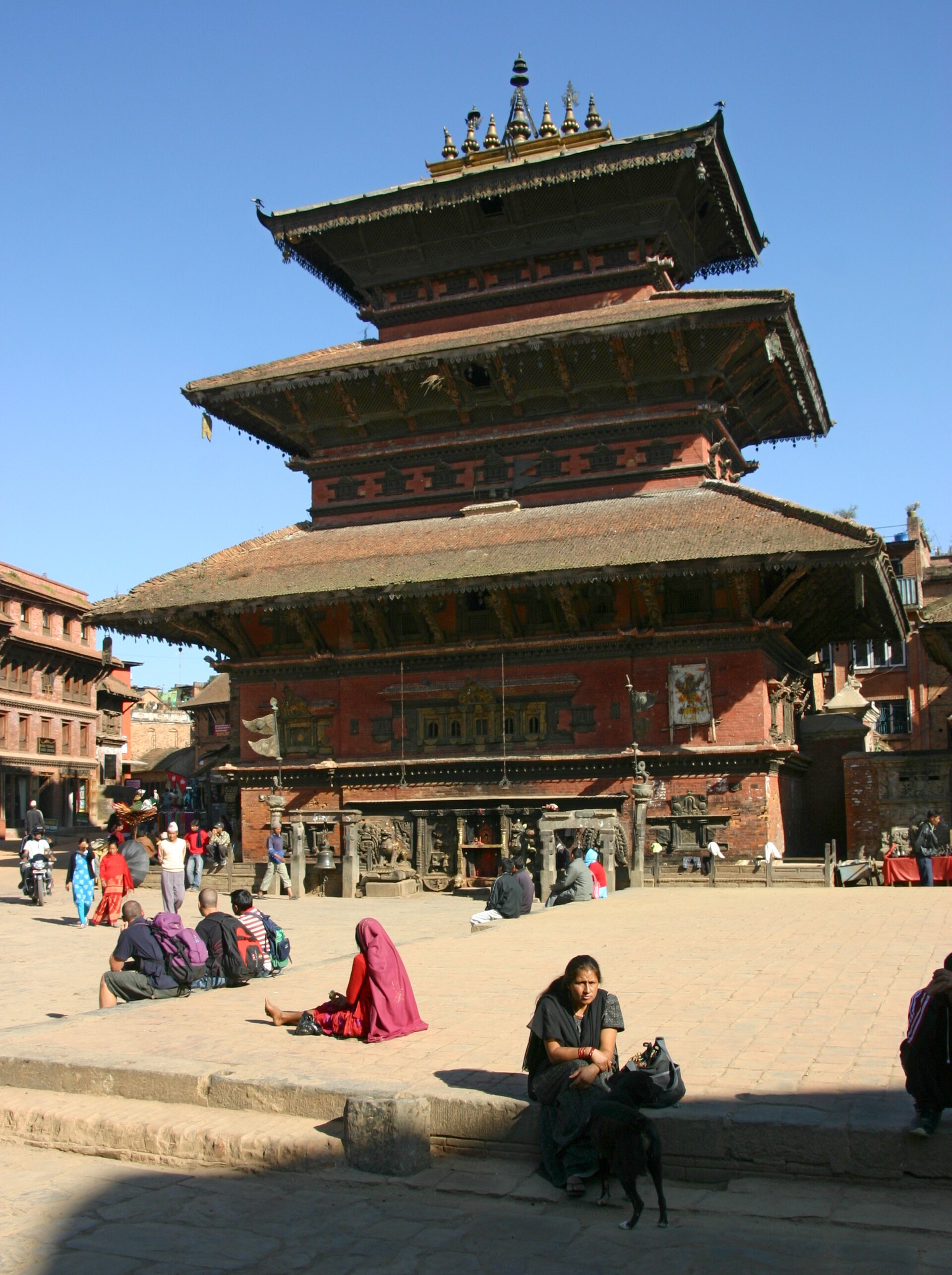
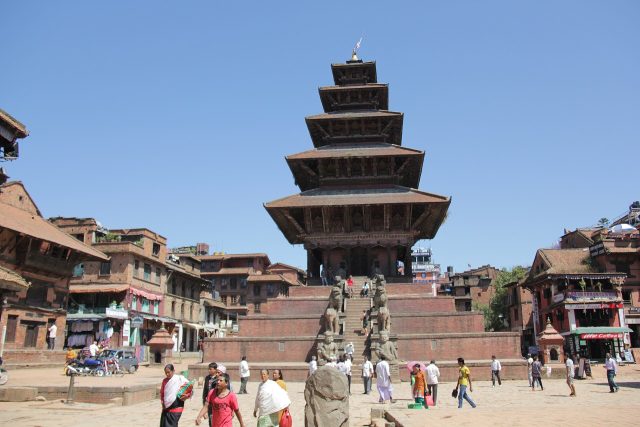
Bhaktapur’s Bhairavanath Temple is one of those rare places where the past and the present merge so seamlessly that time seems to slow, almost as if the city itself has paused to breathe. Tucked away in the heart of the old town, it doesn’t command attention with towering spires or ornate carvings like some of Nepal’s more famous shrines. Instead, its quiet presence is what makes it special. Dedicated to Bhairava, the fierce manifestation of Shiva, the temple may be modest in scale, but its role in the religious and cultural life of Bhaktapur is anything but small.
The structure itself is a three-tiered pavilion, its clay-tiled roof a classic example of Newari architecture, the traditional style of the Kathmandu Valley. The wooden windows and doors are intricately carved, their patterns familiar to anyone who has wandered through the valley’s ancient towns, yet here they feel particularly refined. Inside, a stone image of Bhairava stands as the focal point, surrounded by the quiet offerings of devotees—flowers, grains of rice, the occasional coin. Unlike the crowded temples of Kathmandu, this one remains a place of genuine reverence, where the absence of tourist crowds allows for a more intimate connection to the rituals unfolding within.
The temple’s history is woven into the fabric of Bhaktapur itself. Once the capital of a powerful Newari kingdom, the city was renowned for its artisans and its devotion to the divine, and Bhairavanath was built during the height of the Malla dynasty in the 16th to 18th centuries. Legends say that Bhairava was the protector of Bhaktapur’s rulers, his presence a safeguard against misfortune. Even today, the temple holds a special place in the hearts of locals, particularly during festivals, when its role in the city’s spiritual life becomes impossible to ignore.
What makes Bhairavanath truly remarkable isn’t its architecture, but how it fits into the rhythm of everyday life. The temple sits on a small square, surrounded by the red-brick houses that give Bhaktapur its distinctive character. Here, the pace of life is unhurried—women wash clothes at the communal taps, children dart between the stone steps, and elders sit on wooden benches, watching the world go by. Mornings are especially peaceful, the only sound the soft chime of bells hanging near the entrance. By evening, the square comes alive as oil lamps flicker to life, casting a warm glow over the temple and the people gathered around it.
The temple is at the heart of Bhaktapur’s most vibrant festival, Bisket Jatra, which marks the Nepali New Year. During the celebrations, the statue of Bhairava is carried out of the temple and placed on a massive chariot, which is then pulled through the streets by thousands of people. For a few days, the temple becomes the center of the city’s attention, drawing not just the devout but anyone who wants to be part of the spectacle. Bisket Jatra is more than a religious event—it’s a celebration of community, a reminder of the bonds that tie the city together.
Despite its religious significance, Bhairavanath doesn’t feel like a place set apart from the world. There are no strict rules for visitors, and foreigners are welcome to step inside, provided they do so with respect. Photography of the deity is discouraged, but no one will mind if you linger on the temple steps, watching the life of the square unfold. The locals are often happy to share stories about the temple’s traditions if you show genuine interest, their warmth making the experience all the more memorable.
Bhaktapur is a city where history is etched into every stone, and Bhairavanath is just one of its many treasures. Yet it’s here, in this unassuming temple, that you can sense the soul of old Nepal—the one that’s harder to find in the bustling streets of Kathmandu or the tourist hubs of Pokhara. The temple doesn’t try to impress; it simply exists, as it has for centuries, and that’s where its power lies. There are no grand vistas or flashy attractions here, just the quiet authenticity of a place that has witnessed generations of devotion, celebration, and everyday life. Sometimes, the most meaningful experiences are found not in the grand or the extraordinary, but in the quiet, unchanging rhythm of a place that has always been.