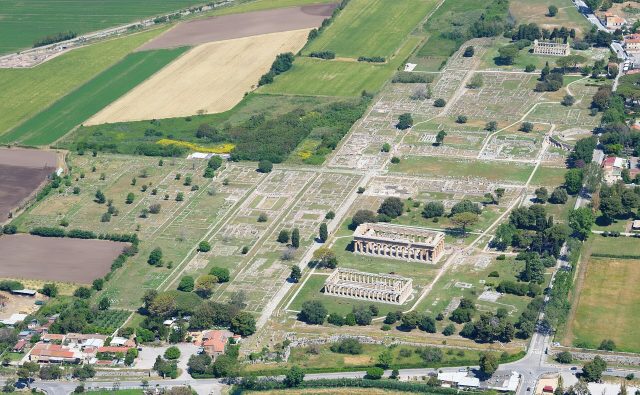
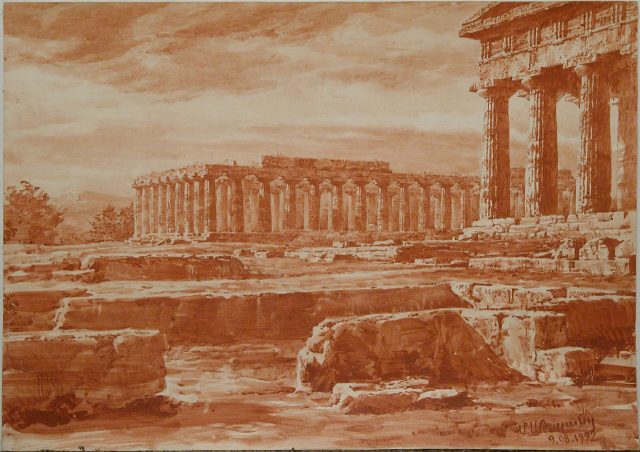
Paestum is one of those rare places where the past lingers, untouched by the rush of modern life. Tucked away in the southern Italian region of Campania, this quiet corner of the world was once a thriving Greek colony known as Poseidonia, founded in the 6th century BCE. Today, its most striking legacy stands in the form of three Doric temples, rising from the sunlit plains where wild grasses sway and olive trees stretch toward the horizon. Among them, the Temple of Neptune—or the Temple of Poseidon, as it’s sometimes called—commands attention as the most imposing and best-preserved of the three.
Built around 450 BCE, at the height of Greek architectural mastery, the temple embodies the austere beauty of the Doric order. Its thirty-six columns, sixteen along the longer sides and six on the shorter, stand without bases, tapering slightly as they rise, their simple capitals supporting a heavy entablature. Though dedicated to the god of the sea, the temple’s name is likely more symbolic than literal. Scholars still debate its exact purpose, suggesting it may have served other religious or civic functions in ancient times.
What makes the temple remarkable is not just its scale but the precision of its design. The columns, though massive, are subtly curved—a technique known as entasis—to create an illusion of lightness and movement. Even the steps of the stylobate, the platform on which the temple rests, are slightly raised in the center to counteract the optical effect of sagging. These refinements reveal an understanding of perception that went beyond mere construction. When the temple was new, its walls would have been coated in white stucco, and its pediments adorned with sculptures, though none of that survives today.
Inside, the temple once housed a sanctuary with a cult statue, long since vanished. Outside, the remains of an altar near the eastern facade hint at the rituals that took place here—offerings made to the gods, smoke rising from sacrificial fires. Unlike many ancient structures, the Temple of Neptune was never completely destroyed. Even as Paestum declined and was abandoned, its walls endured, standing through centuries of neglect. In the Middle Ages, locals simply called it the "great temple," unaware of its original significance. It wasn’t until the 18th century, when Europe’s fascination with antiquity was rekindled, that Paestum was rediscovered, and the temple became a subject of study and admiration.
Now, the temple sits in a landscape that feels almost timeless. Fields stretch around it, dotted with grazing buffalo, while the scent of wild herbs mingles with the salt air from the nearby sea. There’s no bustle of crowds here, just a quiet that invites reflection. Visitors come not just to see but to feel the weight of history—to imagine the people who once walked these stones, who built this place with such care and reverence. The Temple of Neptune isn’t just a relic; it’s a testament to the ideals of a civilization that sought perfection in stone.
Paestum itself was once far from the quiet ruin it is today. In its prime, it was a prosperous city with an acropolis, a theater, a marketplace, and bustling neighborhoods. The Greeks who founded it, and later the Romans who took control in the 3rd century BCE, left behind layers of history. But over time, the harbor silted up, trade dwindled, and the city faded into obscurity. Today, the archaeological park offers a vast expanse of ruins to explore, a place where you can wander and ponder how landscapes—and the fortunes of those who inhabit them—change over centuries.
The temple is at its most striking at sunset, when the light turns golden and the shadows lengthen across the columns. This is when the site feels most alive, yet most peaceful. Few visitors remain at this hour, leaving the space to those who linger, running their hands over the weathered stone and listening for echoes of the past. The voices of priests, the crackle of sacrificial fires, the murmur of ancient prayers—none of these remain, but the atmosphere carries a sense of continuity, as if the temple still holds the memory of those moments.
Paestum and its Temple of Neptune remind us that history doesn’t always vanish without a trace. Sometimes, it endures in the quiet persistence of stone, in the way the light falls just so, in the silence that settles over a place when the crowds have gone. There’s no need to rush here. The best way to experience it is to sit on one of the ancient steps, close your eyes, and let the wind carry the whispers of those who once built this temple, who walked these same paths, and who, like us, stood in awe of something greater than themselves.