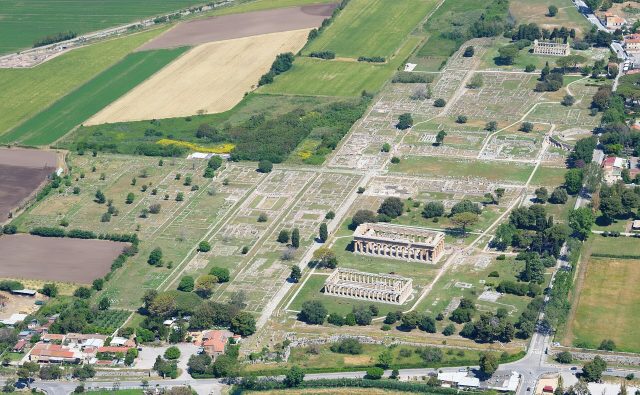
Paestum is one of those rare places in Italy where time seems to have stood still, preserving the traces of an ancient civilization almost untouched. Here, among wild grasses and olive groves, three majestic Doric temples rise from the earth, built by Greek settlers in the 6th and 5th centuries BCE. The oldest and most enigmatic of them is known today as the Basilica of Hera, though the name itself is something of a misnomer. Coined by 19th-century archaeologists, it suggests a Christian structure, but this was never a basilica in the modern sense. Instead, it was a temple dedicated to Hera, the Greek goddess of marriage and family, whose cult held deep significance in the Greek colonies of southern Italy.
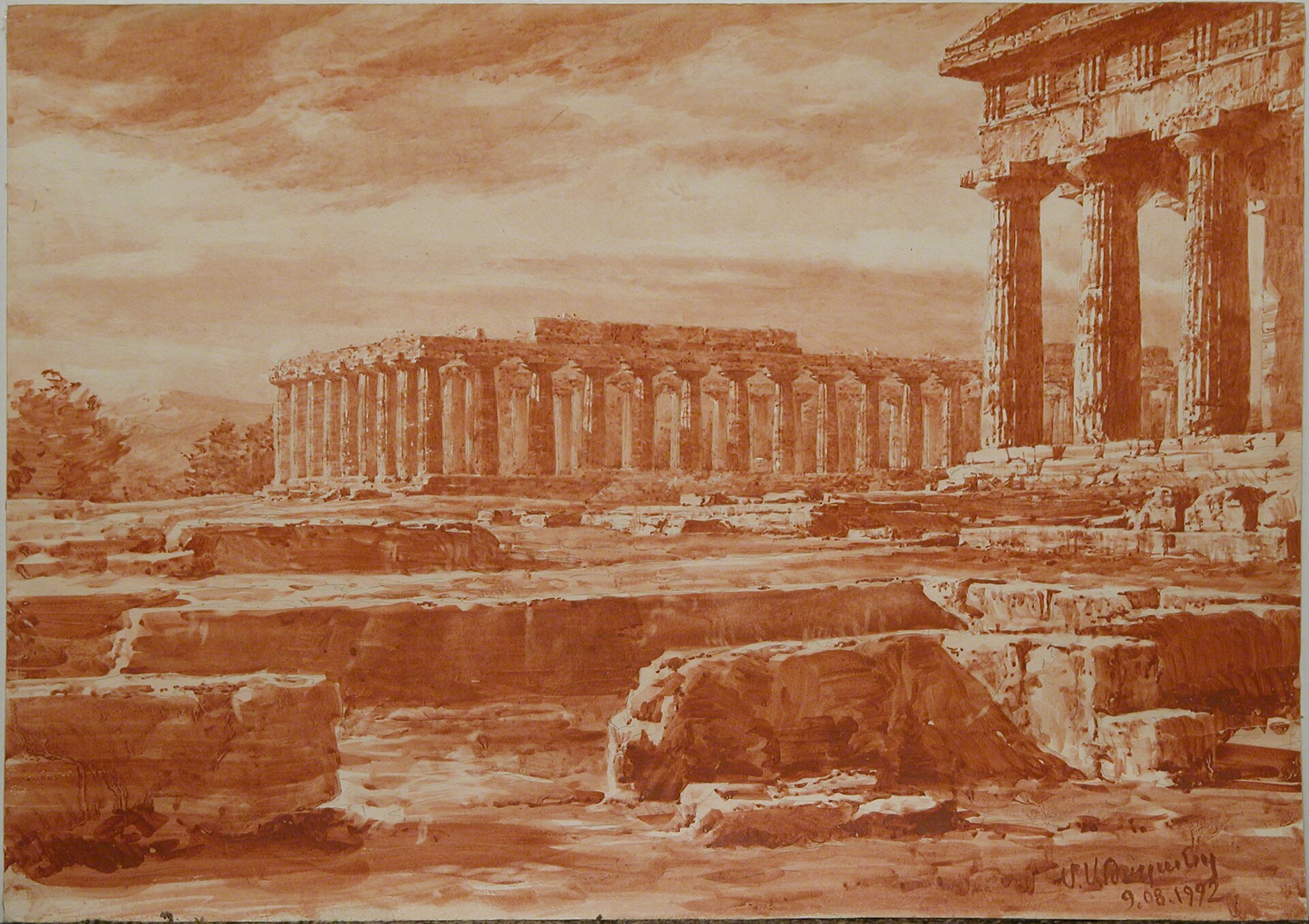
The Basilica of Hera is more than just an architectural relic—it’s a testament to how the Greeks shaped new lands, carrying their traditions and beliefs with them. Built around 550 BCE, when Paestum was still called Poseidonia, the temple marked the city’s emergence as a thriving trade and religious hub. Constructed from local limestone, the stone has weathered into a warm golden hue, contrasting sharply with the blue sky and the surrounding greenery. The Doric order here is expressed with striking clarity: sturdy columns tapering upward without bases, simple cushion-like capitals, and a heavy architrave. The effect is one of solidity and permanence, as if the builders intended it to last forever—and in many ways, it has.
What makes the Basilica of Hera unusual is its layout. Unlike a typical peripteral temple, surrounded by columns on all sides, this one has an interior divided by a row of columns, creating two unequal spaces where one might expect a single cella housing the statue of the deity. Archaeologists still debate its purpose—was it purely a temple, or did it serve other functions, like a meeting place or a repository for sacred offerings? The lack of written records from the period leaves many questions unanswered, adding to the temple’s mystique.
Approaching the Basilica today, it’s hard not to be struck by how well-preserved it remains. Though the roof is long gone and some decorative elements have been lost, the columns and parts of the pediment still stand firm. The temple is at its most atmospheric at sunset, when the stone takes on a rosy glow and the shadows of the columns stretch across the ground. In those moments, it’s easy to imagine processions of priests or townspeople gathering for a festival in Hera’s honor, as if the centuries between then and now have dissolved.
Beyond its architectural brilliance, the Basilica of Hera is a historical document in stone. It speaks of the Greeks who founded Poseidonia in the 7th century BCE and transformed it into a prosperous city-state. Paestum’s wealth and influence are evident not just in its temples but in the remnants of its city walls, agora, and residential quarters. Yet by the 4th century BCE, the city had fallen under Roman rule, and Greek culture gradually faded. The temples continued to be used for rituals for some time, but eventually, they were abandoned, buried beneath layers of earth and forgotten.
Paestum was rediscovered in the 18th century, when Europe’s renewed fascination with antiquity drew travelers and artists to its ruins. The Basilica of Hera, along with the other temples, became a source of inspiration for architects and painters. Its proportions and harmony influenced the Neoclassical movement, and its image appears in the works of artists like Piranesi and Canaletto. The temple’s austere beauty resonated with those who sought to revive the ideals of ancient Greece and Rome.
Today, Paestum remains a quiet place, far from the crowds of Rome or Pompeii. Visitors can wander among the ruins at their own pace, studying the details or simply sitting on the grass, listening to the hum of cicadas and breathing in the scent of wild herbs. The Basilica of Hera, along with the Temple of Neptune and the Temple of Ceres, stands surrounded by nature, which has become as much a part of the landscape as the temples themselves. The olive trees nearby seem as ancient as the ruins, and the distant mountains serve as a reminder of the many eras this land has witnessed.
Standing before the Basilica of Hera, it’s impossible not to feel the weight of history. This is no mere monument—it’s a living reminder of how fragile and yet enduring human culture can be. The temple has survived wars, invasions, and centuries of neglect, only to reclaim its place in the world. It doesn’t demand admiration or awe; it simply exists, as constant as the sky above and the earth below. And perhaps that’s its greatest power.