Baalbek is a place where time seems to stand still, a city where every stone carries the weight of empires and gods worshipped here thousands of years ago. Among its ancient ruins, the Temple of Jupiter stands as one of the most awe-inspiring structures of the ancient world, defying earthquakes, wars, and the passage of centuries. Even today, with only its towering columns and foundations remaining, the sheer scale of the temple leaves visitors speechless. Perched on a hill overlooking the Beqaa Valley, it once dominated the landscape, a testament to the ambition and skill of those who built it.
The history of this site stretches back far beyond the Roman era. Long before the legions arrived, Baalbek was a sacred center for the Phoenicians, who worshipped Baal, their god of storms and fertility. Later, under Hellenistic influence, the city became known as Heliopolis—the City of the Sun—and a temple dedicated to Zeus Heliopolitanus was erected here. When the Romans conquered the region in the first century BCE, they didn’t just adopt the existing traditions; they expanded upon them, constructing a monumental complex in honor of Jupiter. The temple took nearly two centuries to complete, and even in its ruined state, it’s easy to imagine the grandeur it once possessed.
The Temple of Jupiter was part of a vast religious complex that included multiple sanctuaries, altars, and terraces. The main structure was surrounded by a peristyle—a colonnade of twenty-four massive columns, only six of which still stand today. Each column, carved from local limestone, rises nearly twenty meters high and weighs hundreds of tons. Their proportions are so precise that even in their fragmented state, they convey a sense of harmony and power. What’s most remarkable is how they’ve endured: while many surrounding structures crumbled under the force of earthquakes, these columns remain, silent witnesses to the passage of time.
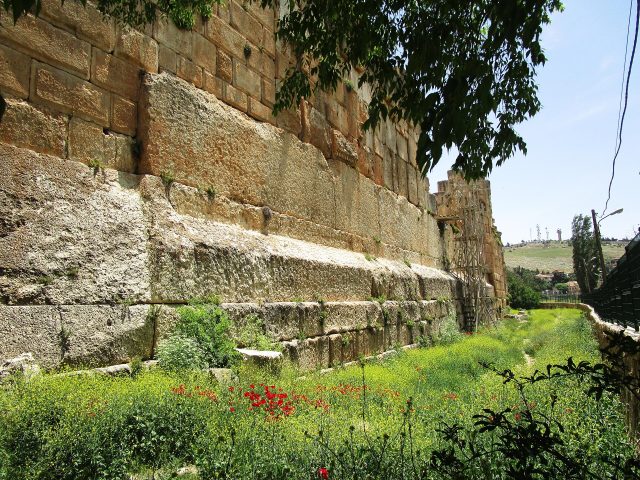
One of the most striking features of the temple is its podium, built from enormous stone blocks. Some of these megaliths weigh over eight hundred tons, and to this day, no one fully understands how ancient builders managed to lift and position them without modern machinery. Known as the Trilithon, these colossal stones have fascinated engineers and historians alike. Their sheer size and the precision with which they were fitted together have even fueled legends that the temple was built not by humans, but by giants or otherworldly beings.
The architecture of the temple blends Roman and Eastern influences. Corinthian capitals, a hallmark of classical Roman design, adorn the columns, while the reliefs on the walls depict scenes of sacrifice and mythology that would have resonated with the local population. Inside the temple, a colossal statue of Jupiter once stood, though nothing remains of it today. However, fragments of mosaics and frescoes offer glimpses into the opulence of its interior. The fusion of styles reflects the cultural exchanges that took place here, where Roman engineering met Eastern spirituality.
Over time, Baalbek’s significance as a religious center faded. With the rise of Christianity, parts of the temple were dismantled, its stones repurposed for new constructions. During the Byzantine era, a basilica was built on the site, and later, under Arab rule, the complex was fortified. Each successive civilization left its mark, turning the ruins into a layered record of history. By the Middle Ages, Baalbek had become a key stop for pilgrims and merchants, its fortress walls offering protection from raids. The city’s strategic location ensured its survival, even as empires rose and fell around it.
Today, the Temple of Jupiter is more than just an open-air museum; it’s a place where history feels tangible. Standing among the ancient stones, it’s easy to picture the rituals that once took place here—the processions of priests ascending the steps, the crowds of pilgrims gathering for festivals, the murmurs of prayers carried on the wind. The temple’s courtyards, once bustling with markets and travelers, are now quiet, save for the occasional gust of wind weaving between the columns. Yet this stillness is deceptive; it’s filled with the echoes of the past, waiting to be heard.
Baalbek lies in the Beqaa Valley, a region known for its vineyards and fertile lands. The modern city retains the charm of an Eastern bazaar, with narrow streets lined with spice shops and cafés serving strong coffee. But its true treasure is the ancient ruins, which draw not only tourists but also scholars still unraveling their mysteries. Why did the Romans choose this particular site for such a monumental temple? Was it the strategic location, the convergence of trade routes, or something deeper—perhaps the lingering sacredness of the place? The answers remain elusive, adding to the allure of Baalbek.
Visiting the Temple of Jupiter is less about ticking off a sightseeing box and more about stepping into history. You could spend hours here, tracing the details of the architecture, photographing the columns against the backdrop of the mountains, or simply sitting on the ancient stones, listening to the stories of guides. As the sun sets, casting a golden glow over the ruins, time seems to pause. Baalbek isn’t a place where the past has vanished; it’s a place where the past lingers, patiently waiting to be rediscovered.