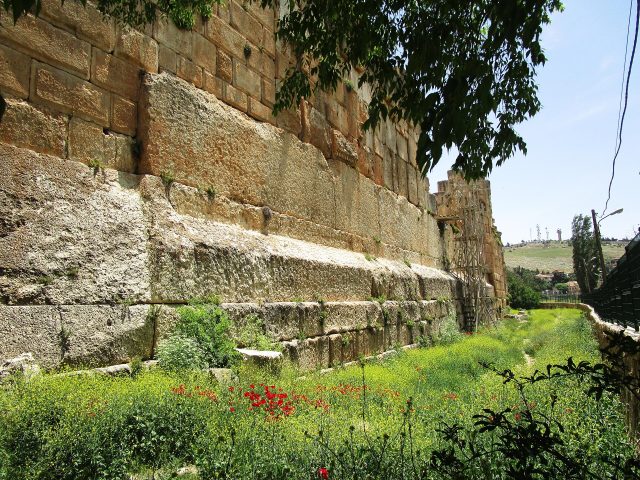
Baalbek is a place where time seems to stand still, a city where the echoes of ancient empires and forgotten gods linger in the very stones beneath your feet. Nestled in the Beqaa Valley, it holds one of antiquity’s most intriguing mysteries—the Southern Stone. This isn’t just a block of limestone; it’s a fragment of an unfinished vision, a silent witness to ambitions that never came to be.
The Southern Stone lies in a quarry not far from Baalbek’s temple complex, a colossal monolith hewn from the earth but never fully detached. It stretches nearly twenty meters in length, over four meters wide, and weighs an estimated thousand tons—roughly the mass of three modern passenger jets. Even today, moving something of this scale would be a monumental challenge. Yet here it remains, half-carved from the bedrock, as if the workers simply walked away one day, leaving behind a question that has puzzled historians for centuries.
No one knows for certain why the stone was abandoned. Some suggest the builders encountered insurmountable technical difficulties, while others speculate it was meant for something far grander than a mere wall—perhaps an altar or a pedestal for a deity whose name has long faded from memory. Theories abound, but the truth is lost to time. What remains is the stone itself, a tangible reminder of the limits of human ambition and the mysteries that even the most advanced civilizations couldn’t solve.
The temple complex of Baalbek, where the Southern Stone was likely destined to stand, is a masterpiece of Roman engineering built atop even older Phoenician sanctuaries. The Temple of Jupiter Heliopolitanus once dominated the site, its towering columns reaching twenty meters into the sky, a testament to Rome’s desire to awe and command. The Romans didn’t just build; they constructed monuments meant to endure, to proclaim their power across the empire. Yet the Southern Stone, left behind in the quarry, serves as a quiet counterpoint to that grandeur—a reminder that even the mightiest plans can falter.
Today, the Southern Stone rests in the quiet of the quarry, surrounded by fields and vineyards that stretch across the valley. The air carries the scent of dry earth and wild herbs, and the only sounds are the rustle of grass and the occasional call of a bird. Unlike the bustling temple complex above, this place sees few visitors. There are no crowds, no guided tours, just the stone and the space to stand beside it, to imagine what Baalbek might have looked like had the vision been completed. Time feels suspended here, as if the stone itself is holding its breath, waiting for an answer that will never come.
The people of Baalbek regard the Southern Stone with a mix of reverence and curiosity. Some believe it holds a special power, and they come to touch its rough surface, as if seeking a connection to the past. Local legends swirl around it—stories of curses that prevented its movement, or of a deliberate choice to leave it behind as a lesson in humility. Whether these tales hold any truth is beside the point; the stone has become part of the landscape, a symbol of the beauty that can exist in incompleteness.
Visiting the Southern Stone is less about sightseeing and more about stepping into a different rhythm of time. There are no explanatory plaques, no souvenir stalls, just the quiet and the wind whispering through the rocks. You can spend hours tracing the marks left by ancient tools, or simply sit nearby, listening to the silence. This isn’t a place for those seeking entertainment; it’s for those who want to touch something real, something that has endured beyond the rise and fall of empires.
Baalbek and its Southern Stone are a reminder that history isn’t just written in triumphs and completed monuments. Sometimes, it’s the unfinished projects, the unanswered questions, and the abandoned dreams that leave the deepest impression. The stone never made it to the temple, but in its own way, it became part of something greater—a fragment of a story that spans millennia, where the legacies of Phoenicians, Romans, and countless others intertwine. Here, time moves differently, and every stone has a tale to tell.