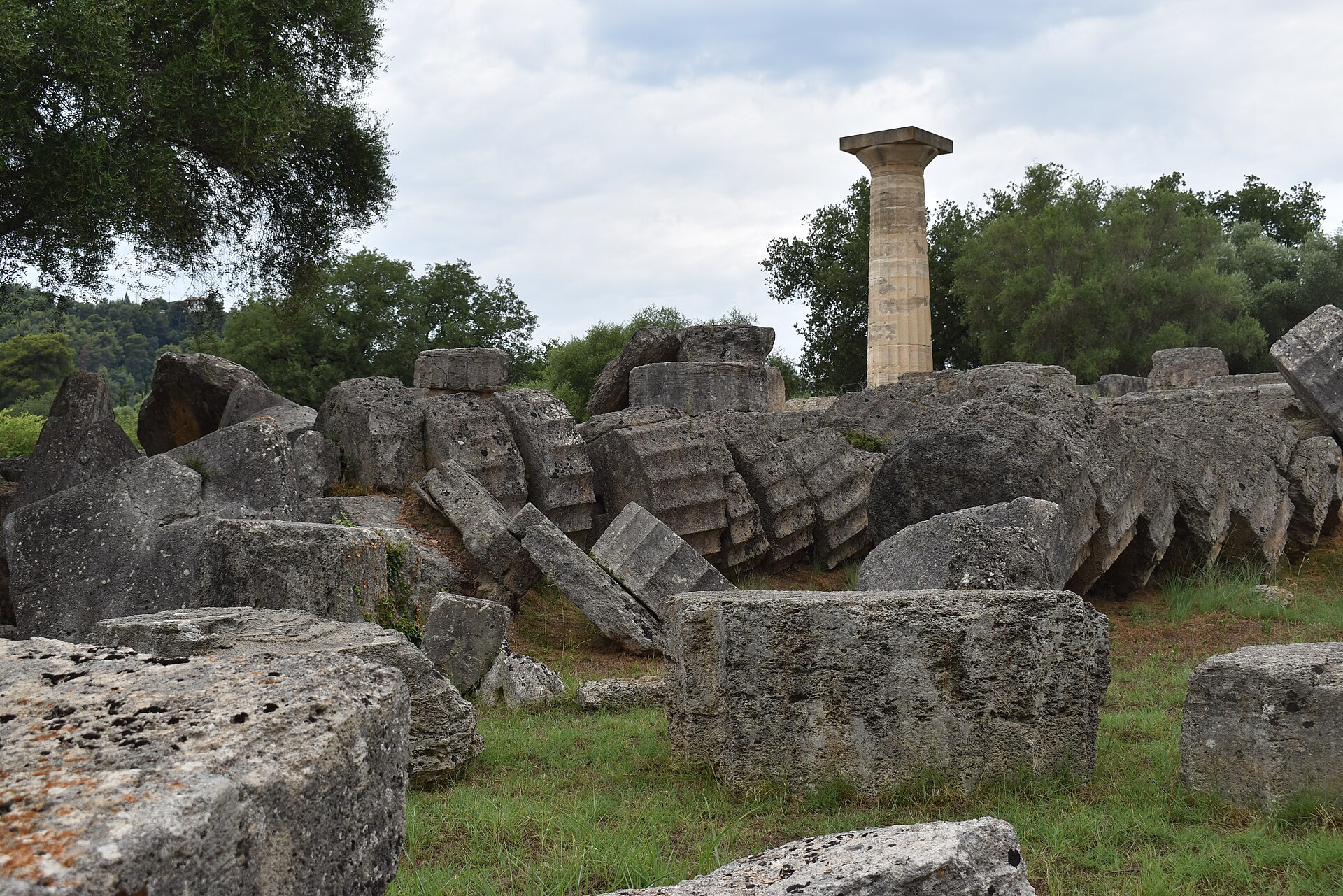
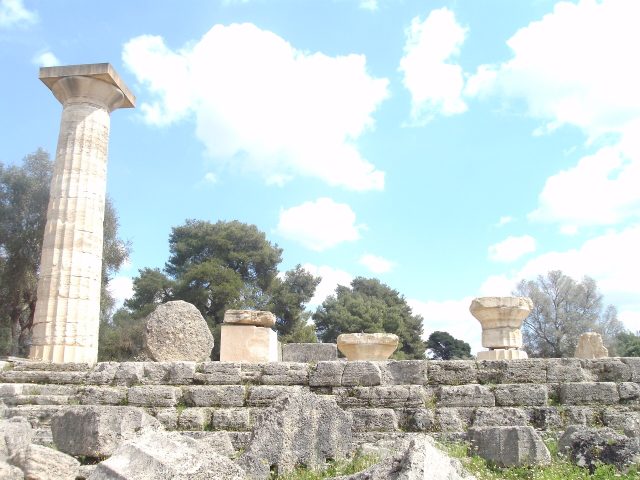
The Temple of Hera in Olympia is one of those rare places where the past doesn’t just linger—it breathes. Built in the 7th century BCE, it was among the first monumental temples in Greece dedicated to Hera, the wife of Zeus. What remains today are ruins, yet even in their fragmented state, they carry a quiet power. The columns, once supporting a roof, now stand exposed to the sky, their weathered stone a testament to the rituals and beliefs that once filled this sacred space. This was more than a temple; it was a stage for some of antiquity’s most significant moments, where religion, politics, and culture intersected.
The architecture of the temple reflects a transition in Greek design. It blends the simplicity of early Archaic styles with the emerging principles of what would later be called Doric order. The structure was long and rectangular, with six columns on the shorter sides and sixteen along the longer ones. Inside, two chambers—the pronaos and the cella—housed the statue of Hera. What makes this temple unusual is the lack of uniformity in its columns. Each one differs slightly in proportion and material, suggesting that construction spanned decades, perhaps even generations. Some were originally made of wood, only later replaced with stone, a detail that hints at the evolving techniques and resources of the time.
For centuries, the Temple of Hera was at the heart of Olympia’s life. It was here that the Olympic flame was first kindled, a tradition that endures to this day. In ancient times, the flame was lit using a concave mirror to focus the sun’s rays, a ritual performed before each Olympic Games. The ceremony symbolized the connection between mortals and the gods, a bridge between the earthly and the divine. Today, the modern Olympic flame is still lit here, against the backdrop of these ruins, a reminder of how deeply the past is woven into the present.
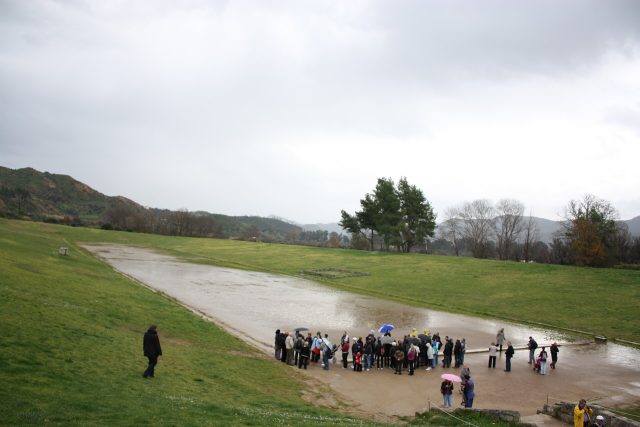
Olympia was never just a sporting venue. It was a religious sanctuary, a place where the gods of Mount Olympus were worshipped alongside the feats of human strength and skill. The Temple of Hera stood near other key structures—the Temple of Zeus, the workshop of Phidias, the stadium, and the gymnasium—forming a complex where art, athletics, and faith coexisted. During the Games, pilgrims, athletes, and spectators flocked here from across Greece. The temple became a focal point for sacrifices and prayers, a place where victory was sought and celebrated. Sacred objects, like the disc of Iphitos inscribed with the rules of the Olympics, were kept within its walls.
Over time, the temple’s significance faded. Earthquakes, invasions, and the slow march of centuries left it in ruins. By the early Common Era, it was little more than a memory. Yet even in decay, it retained a kind of presence. Rediscovered by archaeologists in the 19th century, the Temple of Hera became a symbol of Olympia’s enduring legacy. Today, it sits within an archaeological park, where visitors can walk among the stones and imagine the voices of priests, the crackle of sacred fires, and the anticipation of athletes preparing for competition.
Standing here, it’s impossible not to think of the generations who passed through this place. They came to pray, to compete, to witness history in the making. The temple was a silent witness to triumphs and defeats, to the birth of traditions that would shape the world. Even now, with only fragments remaining, it holds a strange allure. Perhaps because Olympia is more than an open-air museum—it’s a place where history feels alive, if you listen closely enough to the wind rustling through the ruins.
The temple is surrounded by olive groves, their silver leaves shimmering in the sunlight. These trees are said to date back to antiquity, another thread connecting the past to the present. Their fruit is still harvested, just as it was thousands of years ago. In Olympia, time moves differently. The modern world feels distant here, and even the most hurried visitor can’t help but slow down, drawn into the rhythm of a place that has seen so much.
If you come to Olympia, take your time. Pause by the Temple of Hera, run your fingers over the rough surface of the columns, feel the coolness of the stone. There’s no rush here, no crowds pressing in—just the quiet and the wind weaving between the ruins. It’s a place where you might begin to understand why Olympia was the heart of the ancient world. Not because of its grandeur, but because of the atmosphere that lingers, undiminished by the centuries.