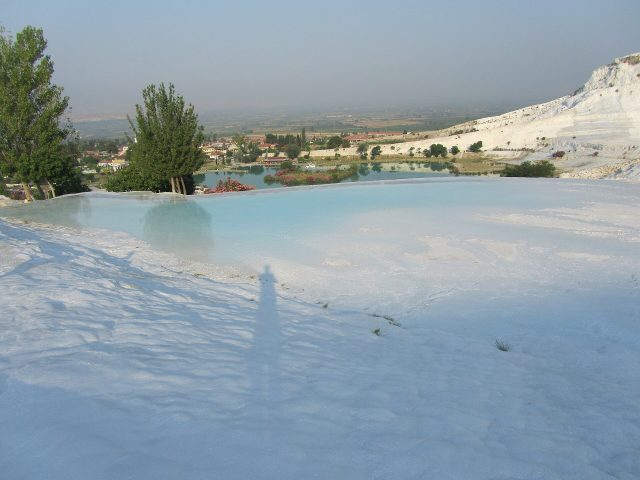
The ground beneath your feet here isn’t just stone—it’s a ledger of centuries. The Temple of Apollo clings to the edge of Hierapolis, where thermal springs still seep into Pamukkale’s travertine terraces. What’s left of it—jagged columns, cracked foundations—was once a place where people knelt to hear the future.
Hierapolis flourished in the Hellenistic era, and this temple was one of its first grand gestures. Erected in the 2nd century BCE, it may have supplanted an older shrine, though no one knows for sure. The city’s oracle made it rich. Traders, generals, and farmers journeyed here to ask Apollo’s priests for guidance, who read omens in rustling leaves or the gurgle of underground water. The temple wasn’t just sacred; it was a marketplace, a hub that turned faith into coin.
The design mixed Greek style with local hands. Doric columns, fragments of walls—what survives shows a building both standard and strange, tweaked to fit this land. The inner sanctum, the cella, was ringed by columns, with an altar outside. Inside stood Apollo’s statue, off-limits to all but priests. Now, only the base and a few pillars remain, but they sketch the temple’s ambition: a monument meant to awe.
Its perch made it special. From the plateau’s lip, it stared down at the Lycus River valley and the steaming springs below. The Greeks believed this was where Apollo touched earth. The oracle’s fame spread, its predictions steering wars, deals, and lives. For hundreds of years, it was a fixed point on the map, its reach crossing borders.
The Romans arrived, and Apollo’s star dimmed. Christianity took hold, and the temple’s stones were carted off for churches. Earthquakes shook the rest apart. The sacred site became a pile of rubble, its story nearly erased.
Today, it’s part of the Hierapolis ruins, a UNESCO site. People come for the quiet. Even in crowds, the place feels hushed, as if the wind through the columns carries old voices. The sun bleaches the stone, stretching shadows across the ground. You can almost see the pilgrims trudging up the path, their questions unanswered.
Hierapolis has other ruins: a theater, a necropolis, baths. But the temple feels different. It straddles the line between city and wilderness, between human hands and the land’s raw power. Or maybe it’s the sense of ritual that lingers—the idea that this was once a place where words changed things, where the divine felt near.
Go early or late, when the light is gentle. Bring water. The ruins don’t take long to see, but if you stay, you might spot things others overlook: faint carvings, the ghost of frescoes, the scorch marks of old fires. These details whisper of Hierapolis’s ups and downs, of moments when it almost vanished.
The temple isn’t just old stones. It’s a place where time feels thin. Empires fade, beliefs shift, but the rocks stay. No reconstructions, no displays—just sun, wind, and silence. And if you’re still enough, you might catch the echo of a time when gods spoke, and people listened.