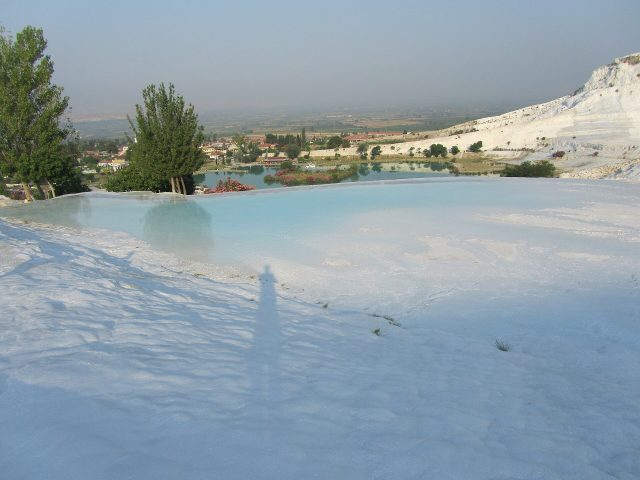
Pamukkale is one of those rare places where nature seems to have taken deliberate care in crafting something extraordinary. The white travertine terraces cascading down the hillside look like a frozen waterfall or a vast field of ice, though they are actually the result of thousands of years of mineral-rich spring water shaping the landscape. Among this natural wonder lies a spot steeped in legend and history—Cleopatra’s Pool. The story goes that the Egyptian queen herself once bathed here, and while there’s little evidence to support the claim, the pool’s atmosphere does feel like a step back into an era when water was revered for its healing powers and bathing in it was a privilege reserved for the few.
The pool sits at the heart of Pamukkale, next to the ancient ruins of Hierapolis, a city that thrived as a center of Roman culture and commerce. The water here is warm year-round, rich in calcium and other minerals that give it a faint bluish hue. The temperature hovers around 36 degrees Celsius, making it comfortable even in cooler months. But what truly sets the pool apart isn’t just the warmth—it’s what lies beneath the surface. Scattered across the bottom are fragments of ancient columns and building ruins, remnants of structures destroyed by a 7th-century earthquake. These stones, now coated in minerals, create the surreal sensation of swimming through the remains of a sunken city.
The history of Cleopatra’s Pool is deeply intertwined with that of Hierapolis. Founded in the 2nd century BCE, the city flourished thanks to its thermal springs, which drew pilgrims, the sick, and the curious from across the Roman Empire. The Romans built temples, theaters, baths, and even an expansive necropolis, much of which still stands today. Cleopatra’s Pool was likely part of one of these ancient complexes, perhaps even an imperial bath. After the earthquake that devastated Hierapolis, the springs continued to flow, gradually filling the depression left behind and forming the pool we see now.
The legend of Cleopatra adds a layer of romance to the place. According to the tale, Mark Antony, eager to please his beloved, tried to transport the waters of Pamukkale to Egypt. When that proved impossible, he gifted her the spring itself. Cleopatra is said to have visited to bathe in its waters, seeking their rejuvenating effects. Whether or not the story is true, the idea that one of history’s most famous figures once swam here lends the pool an undeniable allure. Even without the legend, though, the experience of floating among ancient ruins in warm, mineral-rich water is unforgettable.
Today, Cleopatra’s Pool remains one of Pamukkale’s most popular attractions, yet it retains a surprisingly tranquil atmosphere. The water is clear, allowing a full view of the submerged columns and stone blocks, some of which are now covered in algae. Trees surround the pool, offering shade during the hottest hours, and loungers line the edges for those who want to relax. Swimming is possible year-round, though the water feels especially inviting in the summer heat. Many visitors come not just to bathe but to sit by the water’s edge, watching the sunlight dance across the surface and listening to the gentle sound of the fountains.
It’s worth remembering that the pool isn’t just a tourist attraction—it’s an active thermal spring with genuine therapeutic properties. The mineral-rich water is believed to help with skin conditions, joint pain, and even nervous system disorders. Locals and visitors alike often come here as much for its healing benefits as for enjoyment. Even if you’re skeptical of the health claims, the sensation of immersing yourself in warm, silky water amid ancient stones is reason enough to spend an hour or two here.
A visit to Cleopatra’s Pool pairs naturally with exploring the ruins of Hierapolis. The city was once vast, and even now, its remnants are impressive. The well-preserved Roman theater still hosts performances, while the massive Arch of Domitian marks the entrance to the ancient city. The necropolis, with its hundreds of tombs—some adorned with intricate carvings and inscriptions—offers a haunting glimpse into the past. Nearby, the Antique Pool, fed by water bubbling up from beneath the Temple of Apollo, adds another layer to the experience. Together, these sites create the feeling of wandering through a city that has only just been abandoned.
Pamukkale and Cleopatra’s Pool exist where history and nature blur into one another. The white terraces, the ancient ruins, the warm water, and the legends of Cleopatra combine to create an atmosphere that lingers in the memory. A full day here might begin with a swim in the pool, followed by a walk through Hierapolis, and end with a quiet evening by the water, watching the sunset turn the travertine terraces golden. This is a place meant to be savored, not rushed—a chance to pause, breathe in the mineral-scented air, and feel connected to something far greater than just a journey.