The Hichon Revolutionary Museum stands apart from the usual tourist trails in North Korea. It offers a distilled version of the country’s official history. Located in the provincial city of Hichon, far from the capital’s attractions, the museum presents a carefully constructed narrative. Every exhibit, caption, and display reinforces one idea: the Korean people’s struggle for independence and the building of socialism under Kim Il Sung and his successors. There are no accidental details—only a deliberate story of resistance, sacrifice, and triumph.
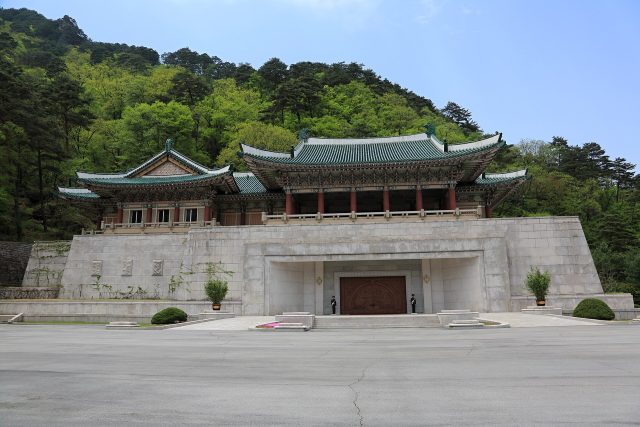
The building is mid-20th-century North Korean architecture. Its symmetrical design, broad staircases, and towering columns signal its importance. Inside, visitors move through halls, each dedicated to a different chapter of the nation’s past. The exhibits cover the anti-Japanese guerrilla resistance and post-war reconstruction. Photographs of leaders, battle maps, propaganda posters, and personal artifacts leave no doubt about the heroes of this story.
The sections on the Japanese occupation are direct. North Korea’s official history portrays this period as brutal oppression met with defiance. The museum displays partisan weapons, personal belongings of fighters, and reconstructed guerrilla camps. Kim Il Sung’s leadership is presented as the driving force behind Korea’s liberation, a claim that predates Soviet involvement. For North Koreans, this is the foundation of their national identity. The museum reinforces it, turning past struggles into a legacy visitors carry forward.
The post-war exhibits focus on reconstruction and industrialization. Models of factories, power plants, and housing complexes built quickly dominate the displays. Photographs show workers honored for their labor. The narrative emphasizes a nation rising from the ashes through determination. Science and technology, including the nuclear program, are framed as essential to sovereignty. The message is clear: progress came from collective effort, with every citizen contributing to a national mission.
A separate hall covers ideological struggles and foreign policy. Documents outline North Korea’s relationships with the Soviet Union and China, as well as its stance toward the United States and South Korea. The Soviet Union’s role in Korea’s liberation is downplayed. The emphasis is on North Korea’s self-reliance. For outsiders, such omissions may seem like distortions. Within the museum’s logic, they serve a purpose: shaping a worldview where the leadership is the sole architect of the nation’s destiny.
Visiting the Hichon Revolutionary Museum is a ritual. Schoolchildren, workers, and soldiers come regularly, not as passive observers but as participants. The exhibits are symbols of duty, reminders of what the country expects. For foreigners, the experience feels like stepping into a different reality. History here is tightly controlled, and alternative perspectives are absent. That’s what makes the museum intriguing—it shows how a society constructs its collective memory.
Hichon is an unremarkable city by North Korean standards. Wide streets, uniform apartment blocks, and industrial sites give it a typical provincial feel. Yet here, away from the capital, the state’s ideological influence is clear. The museum is not just a tourist attraction but part of a larger system shaping how citizens see their past, present, and future. For those used to open historical narratives, the experience can be unsettling. That discomfort is why it’s worth understanding.
The Hichon Revolutionary Museum reveals how history can be molded. It reshapes the past to fit a narrative that serves the present. For North Koreans, this is normal. For outsiders, it’s a reminder of how effectively propaganda works when it aligns with core beliefs. The museum doesn’t just tell a story—it shows how a state wants events to be remembered. In that sense, it offers insight into how a nation sees itself.