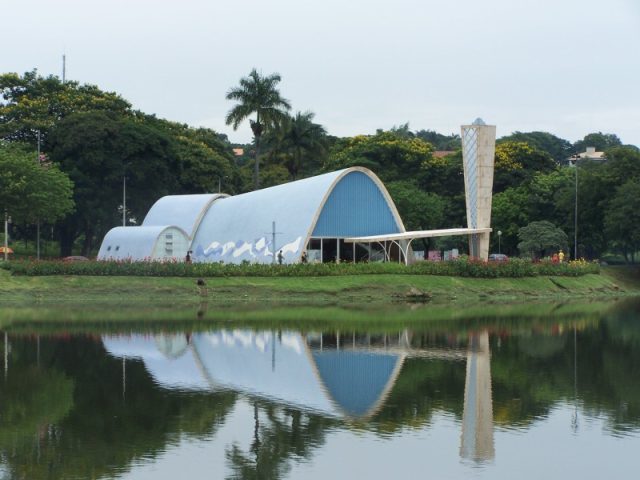
Pampulha is often celebrated for its mid-century modernist architecture and the serene artificial lake designed by Oscar Niemeyer, a landmark that draws visitors from around the world. Yet beyond the postcard-perfect views, the district holds another side of Belo Horizonte—one that pulses with the energy of commerce, innovation, and everyday urban life. At the heart of this dynamic landscape stands Expominas, a convention and exhibition center that has quietly shaped the city’s economic and cultural identity for decades.
Built in the late 1980s, Expominas emerged as part of a broader strategy to diversify the economy of Minas Gerais, a state long defined by its industrial and mining sectors. Belo Horizonte, the state capital, was evolving beyond its role as a manufacturing hub, seeking ways to attract investment, technology, and global partnerships. The exhibition center was conceived as a versatile solution—a space that could host everything from international trade fairs to academic conferences and cultural festivals. Its location in Pampulha was no accident. The district sat at the intersection of major highways, close to the airport and the city’s primary hotel zones, making it an ideal hub for business travelers and event organizers.
The architecture of Expominas is unassuming, designed more for function than for spectacle. The complex consists of several interconnected pavilions, their concrete and glass facades giving them a clean, utilitarian appearance. Inside, vast halls with high ceilings can be easily adapted to suit different needs—whether it’s housing massive mining equipment displays, setting up stages for performances, or creating intimate networking areas. The lack of ornate details is offset by a well-thought-out infrastructure: advanced climate control, lighting, and security systems ensure that events of any scale run smoothly. It’s a space that prioritizes efficiency over aesthetics, a reflection of its purpose as a working venue rather than a monument.
Over the years, Expominas has become more than just a venue; it’s a barometer of the region’s shifting economic and cultural currents. The center hosts some of the largest mining and industrial exhibitions in Latin America, a nod to Minas Gerais’ status as one of Brazil’s most important mining states. Yet alongside these heavyweight events, the complex also plays host to a diverse array of gatherings—book fairs, tech expos, culinary festivals—that mirror the state’s gradual move away from its reliance on extractive industries. This duality speaks to a broader transformation, one where tradition and innovation coexist, sometimes uneasily, within the same space.
For locals, Expominas is more than a place of business. Between major events, the center often serves as a community hub, hosting craft fairs, concerts by regional musicians, and even sporting events. On weekends, families stroll through the grounds, stopping at the cafes that dot the complex or simply enjoying the open spaces. This blend of commerce and everyday life is emblematic of Pampulha itself, a district where office buildings stand alongside residential neighborhoods and parks. The center’s ability to adapt to different roles—corporate, cultural, social—has made it a fixture in the area, a place where the rhythms of work and leisure intersect.
Logistically, Expominas is one of the most convenient venues for large-scale events in Belo Horizonte. The airport is a thirty-minute drive away, and most of the city’s major hotels are within a ten-minute radius. The complex offers ample parking, and public transportation lines run nearby, making it easy for attendees to navigate. For organizers and delegates, this means fewer headaches when it comes to planning. Yet this very efficiency has also drawn criticism. Some argue that the center’s focus on practicality comes at the expense of atmosphere—that it lacks the character or charm that makes other convention spaces memorable. It’s a fair point, but perhaps also a reflection of its purpose: Expominas was built to serve, not to impress.
Still, its role in the city’s life is undeniable. Beyond the business it generates, the center has become a platform for dialogue between industries, academia, and the arts. It’s a place where the old and the new collide—where mining executives rub shoulders with tech entrepreneurs, where traditional crafts are displayed alongside cutting-edge innovations. For visitors who venture beyond Belo Horizonte’s architectural landmarks, Expominas offers a glimpse into the country’s present: a Brazil that is still rooted in its industrial past but increasingly looking toward the future.
What makes Expominas particularly interesting is how it embodies the contradictions of modern Brazil. It’s a space of global ambition, where international deals are brokered and ideas are exchanged, yet it’s also deeply local, tied to the rhythms of Minas Gerais and its people. It doesn’t have the grandeur of Niemeyer’s designs or the natural beauty of the surrounding landscape, but it has something just as valuable: a sense of relevance. Whether you’re here for a trade show, a concert, or just a quiet coffee, the center offers a snapshot of a city—and a country—in motion. It’s not the kind of place that makes it onto postcards, but for those who take the time to look, it tells a story just as compelling.