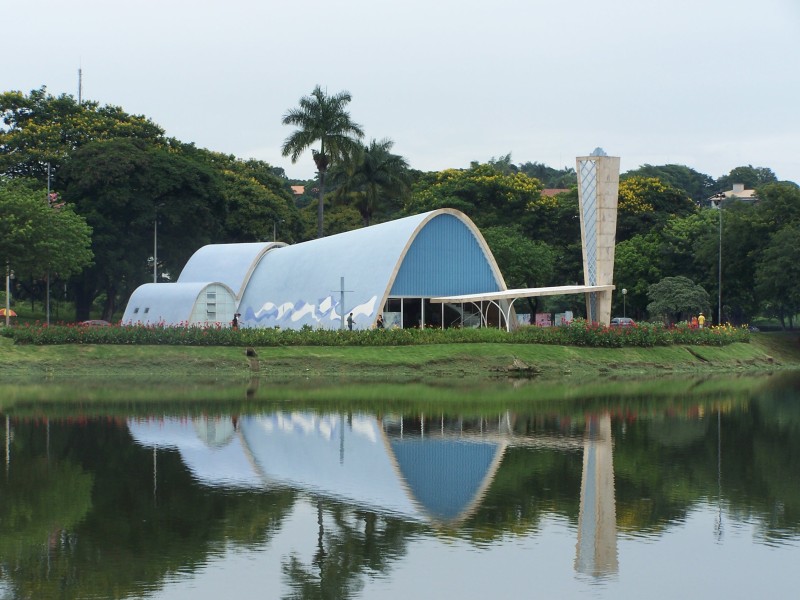
The Church of Saint Francis of Assisi in Pampulha is one of those places that reveals itself slowly. It doesn’t resemble the grand cathedrals with towering spires or ornate facades that dot Brazil’s landscape. There’s no soaring Gothic architecture or lavish Baroque flourishes here. Instead, what stands before you is something light, almost playful—a building that seems to have sprung from an artist’s sketchbook, where form and line take precedence over tradition. Built in the mid-20th century, the church feels timeless, a quiet reminder of how architecture can be both modern and poetic at once.
The design came from Oscar Niemeyer, one of Brazil’s most celebrated architects, whose name is forever tied to the bold vision of Brasília. But while his work in the capital often embraced rigid geometric shapes, here he allowed himself a rare freedom. The Church of Saint Francis of Assisi became an experiment in turning concrete and glass into sculpture. The structure appears to float above the ground, supported by slender columns, its curved lines evoking waves or the wings of a bird. Inside, the space is just as unconventional—no rows of pews or dimly lit naves, just an airy openness flooded with natural light from high windows.
Pampulha itself is a district of Belo Horizonte, the capital of Minas Gerais. In the first half of the 20th century, this area was little more than the outskirts of the city. But under the ambitious leadership of then-mayor Juscelino Kubitschek—who would later become Brazil’s president—it was transformed into a cultural and recreational hub. Kubitschek brought together Niemeyer, landscape architect Roberto Burle Marx, and artist Candido Portinari to create something entirely new. The church was one of the centerpieces of this vision, standing alongside a museum, a casino, and a yacht club. Today, Pampulha remains a peaceful corner of the city, where you can stroll along the artificial lake surrounded by rolling green hills.
When the church first appeared, it wasn’t immediately embraced. Its bold, unconventional forms struck many as a challenge to tradition. The absence of familiar religious symbols on the facade puzzled some, and even the Vatican initially refused to consecrate it, deeming it insufficiently reverent. Over time, though, the church became an integral part of Pampulha, a symbol of how modern art and spirituality could coexist. Today, it draws not only tourists but also worshippers who appreciate its serene, contemplative atmosphere—one that feels far removed from the grandeur of more traditional places of worship.
The interior is as striking as the exterior. The walls and ceiling are adorned with murals by Candido Portinari, one of Brazil’s most important 20th-century artists. His vibrant, expressive works depict the life of Saint Francis of Assisi, blending bold imagery with the raw texture of the concrete. Portinari used an unusual technique, mixing paint with cement to ensure the murals harmonized with the building’s material. The scenes are alive with movement—birds, fish, and plants intertwine with the saint’s story, creating a sense of unity between humanity and nature, a core tenet of Franciscan philosophy.
Surrounding the church is a park designed by Roberto Burle Marx, where tropical plants, water features, and winding paths form a seamless composition. Walking through it, you can see how Niemeyer’s architecture and Burle Marx’s natural forms complement each other. The church seems to rise organically from the greenery, its curves echoing the contours of the hills and the shoreline of Lake Pampulha. The park is a favorite spot for locals—some come for a morning run, others to sit on a bench and enjoy the quiet.
The Church of Saint Francis of Assisi is more than just an architectural landmark; it’s a testament to a particular moment in Brazil’s history. The mid-20th century was a time of rapid change, and Pampulha became a symbol of the country’s aspirations. It was a place where ambition, modernity, and beauty converged, creating something that would inspire future generations. Decades later, the church hasn’t lost its relevance. It still surprises, still makes you pause and consider how art can reshape our understanding of space and faith.
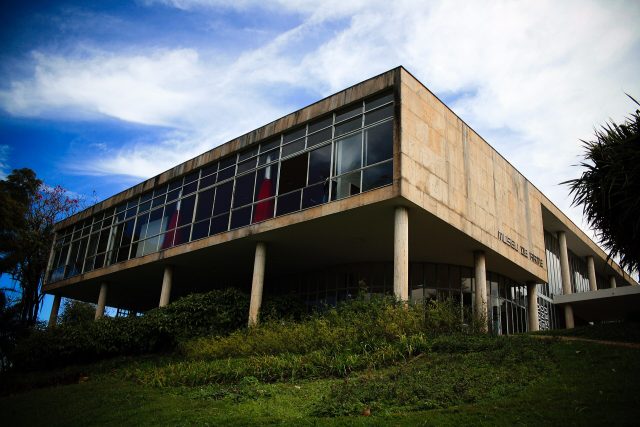
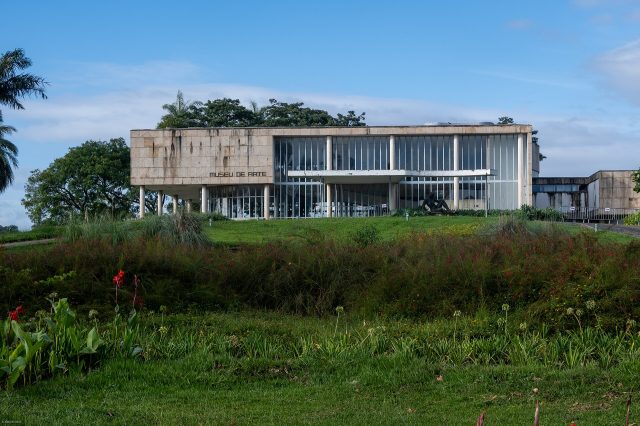
Visiting the church is best combined with a walk through Pampulha. The area is picturesque year-round, but especially striking during the dry season, when the skies are clear and the air is filled with the scent of blooming trees. You might start at the nearby Museum of Art, then follow the lake’s edge, stopping at one of the lakeside cafés. In the evening, the church is particularly enchanting—its illuminated silhouette reflected in the water, creating a scene that feels almost magical. Unlike the crowded streets of Rio or Salvador, Pampulha offers a quieter experience, where you can take your time without the rush of tourism.
The Church of Saint Francis of Assisi doesn’t leave visitors indifferent. Some see it as a masterpiece of modernism, others as a symbol of spiritual exploration, and still others simply find peace sitting on a bench in the park. It doesn’t conform to the usual expectations of a church, and that’s precisely what makes it special. There are no rigid traditions here, just the freedom of thought and creativity that give it a unique, enduring appeal. Perhaps that’s why, decades after its construction, it continues to draw people in—it reminds us that beauty can take many forms, and sometimes the most unexpected ones are the most profound.