Vyšehrad is one of those rare places in Prague where the city reveals itself differently—not through crowds or souvenir stalls, but through quiet corners, layers of history, and a view that makes the entire capital feel within reach. Perched on a high bluff above the Vltava, this ancient fortress complex was once a rival to Prague Castle, and today it remains a pocket of the city where time moves at its own pace. The paths here are narrow, winding between old walls, shaded walkways, and the sense that the Prague below is only part of something much larger.
The story of Vyšehrad begins in the 9th century, when archaeological evidence shows the first settlements. The earliest written records date to the 10th century, when the fortress served as a residence for the Přemyslid princes, the first rulers of the Czech lands. In the 11th century, Prince Vratislav II moved his court here, built the Basilica of St. Peter and St. Paul, and added the first Romanesque rotunda. For a time, Vyšehrad was a symbol of power, competing with Prague Castle. But by the 12th century, the political center shifted back to the Castle, and Vyšehrad’s role faded, leaving behind crumbling walls and a few surviving structures.
Passing through the Špicka Gate feels like stepping into another era. The narrow streets lead past old barracks now converted into apartments, past the cemetery where some of the country’s most celebrated figures rest, and finally to the basilica, Vyšehrad’s most recognizable landmark. The Church of St. Peter and St. Paul has been rebuilt many times—from its Romanesque origins to the Neo-Gothic style of the 19th century. Inside, the crypt holds fragments of the original rotunda.
One of Vyšehrad’s most striking features is the Slavín Cemetery. Here lie composers Bedřich Smetana and Antonín Dvořák, writer Karel Čapek, artists Alfons Mucha and Mikoláš Aleš. The graves are nestled among trees, their monuments ranging from simple headstones to elaborate sculptures. Each grave tells a story.
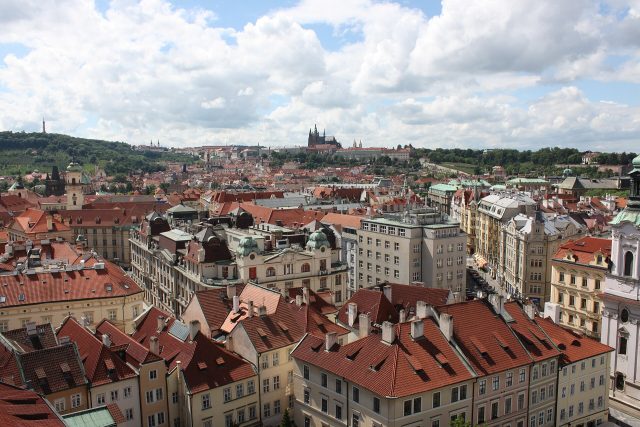
From the fortress walls, Prague unfolds in one of its most expansive views. The Vltava winds between hills, bridges stretch across the water, and the spires of churches and rooftops create the city’s silhouette. Sunset is particularly striking here, when the light gilds the domes and towers. On clear days, the horizon stretches far beyond Prague. In summer, locals gather on the viewing platforms with bottles of wine; in winter, the wind sweeps across the empty spaces.
Vyšehrad isn’t just about history or architecture. There are no crowds jostling for photos on Charles Bridge, no tourist traps. Instead, there are quiet paths, benches overlooking the river, old trees. In summer, open-air concerts take place in the park; in winter, snow dusts the fortress walls; in spring, chestnut trees bloom. Locals come here to walk their dogs, jog in the mornings, or sit on the grass with a book.
Climbing the basilica’s tower offers a broader perspective. From here, you can see how the Vltava curves around Vyšehrad, how the hills of Petřín and Letná rise across the river. Below, the Podolí district stretches out with its mix of old villas and repurposed industrial buildings. This is the Prague that doesn’t appear on postcards—a city that’s alive and changing but still rooted in its past.
Vyšehrad doesn’t dazzle with royal palaces or golden decorations. There are no legends of golems or medieval dungeons here. Instead, there’s silence, a history that lingers in every stone. You could spend an hour here or an entire day—sitting in a café by the fortress walls, wandering through the cemetery, climbing the tower, or strolling down to the river. Vyšehrad doesn’t demand your attention; it exists on its own terms, away from the usual tourist routes.