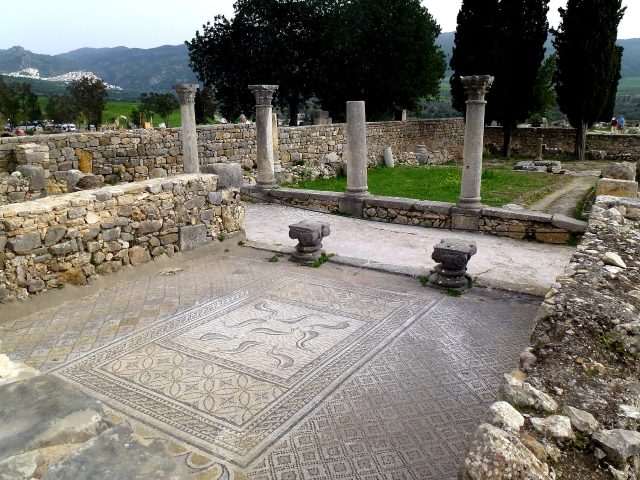
Volubilis is one of those rare places where the past doesn’t just linger in stone—it feels alive. Tucked into the foothills of the Atlas Mountains, not far from Meknes, this ancient Roman city was once the thriving capital of Mauretania Tingitana, a province on the empire’s distant frontier. Today, its ruins tell a story of a place that hummed with life: where merchants traded goods from across the Mediterranean, wealthy families walked across intricate mosaic floors in their villas, and aqueducts carried water to public baths that were the heart of daily life.
The archaeological site sprawls across a wide area, revealing the remains of a forum, a basilica, bathhouses, a triumphal arch, and dozens of residential buildings. The mosaics are what truly stand out—vibrant, detailed, and remarkably well-preserved. One depicts the twelve labors of Hercules, another shows hunting scenes, and a third features sea deities. These weren’t just decorations; they were status symbols, storytelling devices, and evidence of the deep cultural ties between Rome and North Africa. Walking among them, it’s easy to imagine the artisans who laid each tiny tile, carefully crafting images that would last for centuries.
Volubilis wasn’t always Roman. The city was founded in the 3rd century BCE by Berber tribes, but its golden age came under Roman rule, when it became a key administrative and commercial hub. Caravans laden with goods from the Sahara passed through here on their way to the Mediterranean, while local olive oil—produced in vast quantities—was exported across the empire. Even after Rome’s fall, the city endured under Vandal, Byzantine, and early Islamic rule until an earthquake in the 8th century left it in ruins. For centuries, it lay buried, forgotten, until archaeologists began uncovering its secrets in the 19th century.
What makes Volubilis special is the sense of continuity it offers. Unlike more famous ruins, where the past feels distant and untouchable, here you can almost hear the echoes of daily life—the shouts of vendors in the marketplace, the clatter of tools in workshops, the murmur of conversations in the forum. The best time to visit is at sunset, when the light softens the stones, turning them gold, and the shadows stretch long across the ground. It’s as if time itself slows down, allowing you to step into the rhythm of a city that once was.
The architecture of Volubilis reflects the blending of cultures that defined this region. Roman engineering met local traditions in the layout of the city. Many houses were built around central courtyards, a feature common in Berber architecture, while public buildings followed Roman design principles. The Arch of Caracalla, erected in the 3rd century to honor the emperor and his mother, still dominates the landscape, though it’s now missing some of its original grandeur. Nearby, the remains of the basilica—where justice was once administered—and the forum, the social heart of the city, offer glimpses into how this place functioned.
Unlike Pompeii or Herculaneum, Volubilis doesn’t draw crowds. That’s part of its charm. There’s space to wander, to sit on a low wall and take in the quiet, to let the weight of history settle in without the distraction of tour groups. If you’re lucky, a local guide might share stories about the excavations—how coins were found hidden in walls, how mosaics were painstakingly restored, or what might still lie buried beneath the earth, waiting to be discovered.
Volubilis isn’t just a relic of the past; it’s woven into the fabric of modern Morocco. Locals treat it with reverence, seeing it as part of their heritage. You might spot shepherds grazing their flocks among the ruins or children playing on ancient stones, a reminder that this place hasn’t been abandoned so much as repurposed. The city has adapted, shifting from a center of Roman power to a quiet, almost forgotten site, yet it still holds a kind of vitality.
For travelers who seek more than just postcard views, Volubilis is a revelation. It’s a place where history isn’t just observed—it’s felt. Every stone, every mosaic, every crumbling wall carries the memory of the people who lived here, worked here, and shaped this corner of the world. And in the silence of the ruins, you can almost hear their voices.