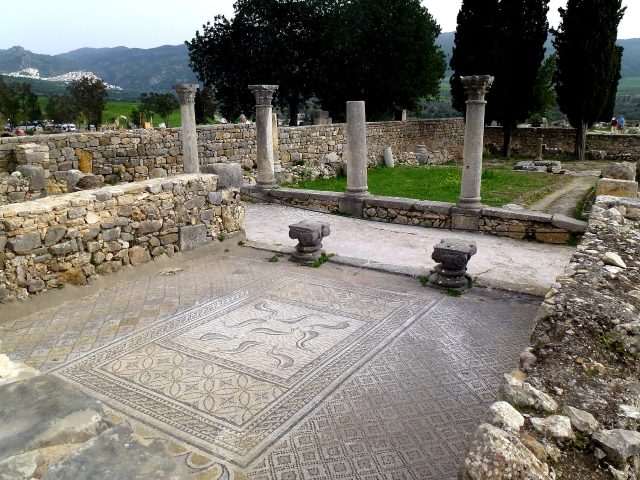
Volubilis is one of those rare places where history doesn’t just lie beneath your feet—it breathes through the stones. These ruins were once a thriving Roman city, the capital of the province of Mauretania Tingitana, and today they stand as one of the best-preserved archaeological sites in North Africa. Unlike the crowded ruins of Pompeii or Herculaneum, Volubilis offers something quieter: the hush of the wind and the sense that time has paused somewhere between the second and third centuries.
Long before the Romans arrived, this land was settled by Phoenicians and Carthaginians in the third century BCE, drawn by its fertile soil and strategic position between the Atlantic and the interior of Morocco. But it was the Romans who transformed Volubilis into a true city. They laid out streets in a precise grid, built aqueducts, baths, temples, and a forum, and adorned the city with mosaics that still astonish with their craftsmanship. Even after Rome’s fall, the city didn’t vanish overnight. Byzantines and later Arabs used it as a fortress and trading post, though Volubilis gradually faded into the hills and olive groves, forgotten for centuries.
Today, the ruins sprawl across forty hectares, and even a quick glance reveals the scale of what once was. The main street, Decumanus Maximus, paved with stone, leads from the Arch of Caracalla toward the forum—the heart of the city. The arch, built in honor of the emperor and his mother, still stands nearly intact, though its upper portion is gone. Nearby lie the remains of the basilica, where justice was once administered, and the Capitolium, dedicated to Jupiter, Juno, and Minerva. The stones here tell stories more vividly than any textbook, showing how life shifted over time, how one era’s order gave way to another’s chaos.
The real treasures of Volubilis, though, are its mosaics. Preserved in several houses, each one is a masterpiece. In the House of Bacchus, scenes from the god’s myths unfold: maenads dancing among vines, Bacchus himself riding a panther. The House of Orpheus holds a mosaic of the musician surrounded by wild animals, enchanted by his lyre. And in the House of Venus, a scene of sea deities—tritons and nereids—seems to ripple from the blue and green waves. These works are so finely crafted that it’s easy to imagine the artists finishing them only yesterday. Many were uncovered only in the twentieth century, when systematic excavations began.
Volubilis isn’t just an open-air museum; it’s a place where history feels alive. You can wander for hours, imagining the merchants, soldiers, and patricians who once walked these streets, hearing the mix of Latin and Berber tongues, smelling the olive oil and spices in the markets. The city wasn’t just an administrative center—it was an economic hub. Caravans passed through carrying gold, ivory, and slaves from the Sahara, while local artisans were known for their bronze and pottery. The olive groves nearby may well be descendants of the same trees that fed Volubilis two thousand years ago.
From the hill where the ruins lie, the view stretches across the Oued Khoumane valley and the surrounding fields. On clear days, the snow-capped peaks of the Middle Atlas are visible in the distance. This panorama reminds you that Volubilis was never just a city—it was part of a vast world connecting the Mediterranean to Africa. The Romans chose this spot for a reason: it was where trade routes intersected, where water and fertile land could sustain a population. The valley looks much the same today, though now Berber houses dot the hillsides instead of Roman villas.
Visiting Volubilis is also a glimpse into modern Morocco. Nearby villages are home to the descendants of the Berbers who lived here long before the Romans arrived. They tend olive groves, herd sheep, and live much as their ancestors did. Sometimes, children play among the columns while elders sit on the stones, watching visitors pass. For them, Volubilis isn’t just a tourist site—it’s a living part of their history, where the stories of different peoples and eras intertwine.
Volubilis may not be as famous as Rome or Athens, but that’s part of its charm. There are no crowds, no pushy guides, no endless lines. You can arrive in the early morning, when the sun just begins to warm the stones, and spend hours alone, listening to the wind and tracing the secrets of the ancient walls. Or come at sunset, when the ruins glow gold and the shadows stretch long and mysterious. In those moments, it feels as if the city still has a life of its own—one we don’t always notice.