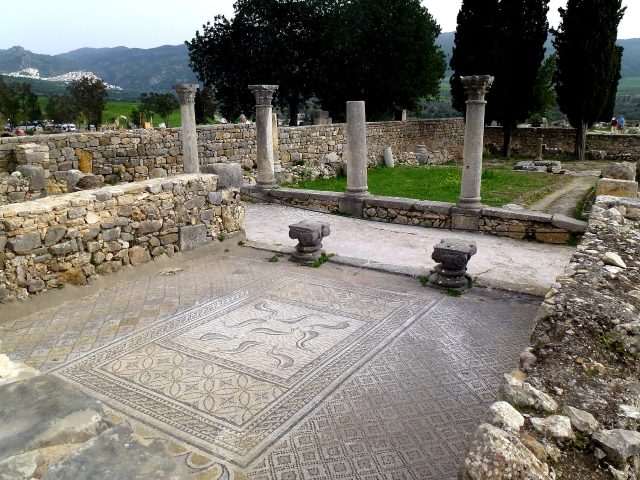
Perched on the gentle slopes of northern Morocco, where the Mediterranean breeze still rustles through the wild grasses, Volubilis feels like a place where time has paused to catch its breath. The ruins of this ancient city lie scattered across the landscape, their stones worn smooth by centuries, yet still holding the echoes of lives lived long ago. Among them, the Triumphal Arch stands as a quiet sentinel, a remnant of Rome’s far-reaching influence in this corner of Africa. It may not rival the grandeur of the arches in Rome or Palmyra, but there’s something deeply moving about its understated presence—less a monument to human ambition, more a silent witness to an empire that once stretched across continents.
Built in the early third century, the arch was likely dedicated to Emperor Caracalla and his mother, Julia Domna, though its exact purpose remains a matter of speculation. Some believe it marked the entrance to the city, while others suggest it was part of a major thoroughfare. In its heyday, Volubilis was a thriving hub of the Roman province of Mauretania Tingitana, a crossroads where Mediterranean trade met the vast interior of Africa. The city’s inhabitants—a mix of Berber descendants and Roman settlers—lived in houses adorned with intricate mosaics, bathed in public thermal baths, and gathered in the forum to discuss the affairs of the day. The arch, though modest in scale, would have been a familiar sight to merchants, soldiers, and travelers passing through.
Architecturally, the arch is a fine example of Roman provincial design, crafted from local limestone that has mellowed into a warm, golden hue over the centuries. Its proportions are carefully balanced: not so wide as to feel imposing, nor so narrow as to seem fragile. The passage beneath is just over four meters across, enough for carts and processions to pass through. Above, the remnants of the attic—the upper section where an inscription or sculptural relief once stood—are still visible, though time has worn them down to faint traces. Flanking the arch were columns, now reduced to their bases, but even these fragments hint at the structure’s original elegance.
Volubilis was never truly abandoned. After the Romans withdrew, the city saw waves of Vandals, Byzantines, and later Arabs, who knew it as Walili. By the Middle Ages, however, its fortunes had waned, and its stones were repurposed for buildings in nearby settlements. The arch survived, perhaps because it stood apart from the main ruins, spared the fate of being dismantled for construction material. It wasn’t until the 19th century that European archaeologists took an interest in Volubilis, and excavations have continued ever since. Today, it’s one of the best-preserved Roman sites in North Africa, though it sees far fewer visitors than Pompeii or Ephesus.
Walking through Volubilis is less about ticking off sights and more about stepping into a landscape where history feels tangible. The arch stands on a slight rise, offering a view of the surrounding fields and olive groves, their silver-green leaves shimmering in the sunlight. On clear days, the distant peaks of the Atlas Mountains emerge on the horizon, adding another layer to the scene. There are no crowds here, no souvenir stalls or tour guides shouting into megaphones—just the quiet hum of insects, the occasional call of a bird, and the whisper of the wind through the grass. It’s a place that invites you to slow down, to look around, and to wonder about the countless people who have walked these paths over the centuries.
Despite its age, the arch doesn’t feel fragile. If anything, it seems remarkably sturdy, as if it could stand for another thousand years. The stones are weathered, their edges softened by time, but the structure itself remains intact. There’s a certain comfort in that—even as empires rise and fall, and cities crumble into dust, some fragments endure, bearing witness to the passage of time.
Beyond the arch, Volubilis is a sprawl of ruins waiting to be explored. The remains of the forum, the basilica, and the public baths offer glimpses into daily life in a Roman city. The mosaics, in particular, are stunning—especially those depicting mythological scenes or marine motifs, which once graced the floors of wealthy villas. They’re remarkably well-preserved, a testament to the skill of the artisans who created them. Yet it’s the arch, standing alone on the edge of the site, that lingers in the memory. Perhaps because it’s simpler, more direct—a single, elegant curve bridging past and present.
If you find yourself in Morocco and want to escape the well-trodden tourist paths, Volubilis is a perfect detour. It’s an easy trip from Fez or Meknes, but the atmosphere here is entirely different. The locals you might encounter are more likely to be shepherds or farmers going about their day than vendors hawking trinkets. To them, the ruins are just part of the landscape, unremarkable in their familiarity. But for visitors, Volubilis can feel like a revelation—a place where the past isn’t just remembered, but felt.
There are no detailed plaques or audio guides here to explain what you’re seeing. Volubilis doesn’t hand you its story; it asks you to meet it halfway. If you take the time to stand beneath the arch, to run your fingers over its stones, to gaze out at the rolling hills beyond, you might begin to sense something of what the people who once passed through here felt. It’s a place that doesn’t demand admiration, only attention. And in that quiet exchange, it offers something rare—a connection to history that feels personal, unscripted, and entirely your own.