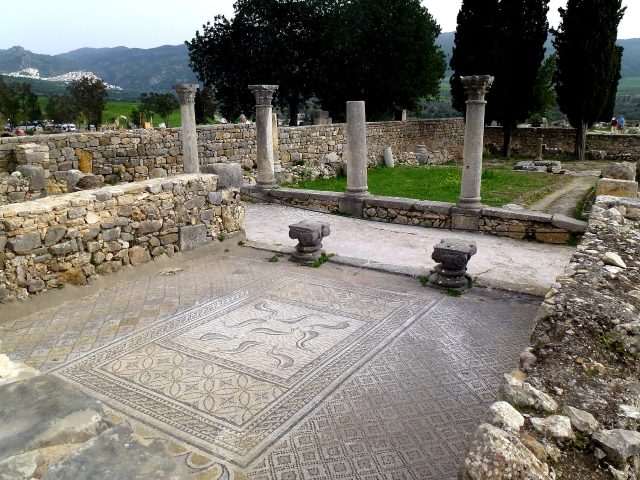
Volubilis sits quietly in the foothills of the Atlas Mountains, a place where the past doesn’t just linger in stone but feels alive, as if the ancient city still breathes beneath the sun. Just a short drive from Meknes, these Roman ruins appear almost out of place in the North African landscape, a reminder of how far the empire once stretched. More than two thousand years ago, Rome planted its flag here, turning Volubilis into a thriving hub of Mauretania Tingitana. Today, the site isn’t just an archaeological relic—it’s an open-air classroom where the streets once walked by merchants, officials, and craftsmen still echo with the weight of history.
The city’s origins trace back to the 3rd century BCE as a Carthaginian settlement, but its golden age came under Roman rule. By the 1st century CE, Volubilis had become part of the empire, and construction boomed—temples, baths, an aqueduct, and grand public buildings rose from the earth. The city flourished thanks to the fertile plains around it, where olive groves and wheat fields fed both its people and its trade with other Roman provinces. In the 3rd century, Volubilis earned the status of a municipium, granting its citizens Roman rights and self-governance. But by the 5th century, after Rome’s fall, the city began to fade, later suffering a devastating earthquake that scattered its stones.
What remains today is more than just scattered ruins—it’s a preserved urban layout, a ghost of a city frozen in time. The main thoroughfare, the Decumanus Maximus, cuts through the site, connecting the most important public spaces. On either side, the foundations of wealthy homes still hint at their former grandeur, their floors once adorned with intricate mosaics. Some of these mosaics remain in place, though the finest have been moved to museums in Rabat and Tetouan. Among the most striking are scenes from mythology—Hercules in his labors, sea gods riding dolphins—fragments of stories that once decorated the villas of the elite.
The basilica, built in the 2nd century, was one of Volubilis’s most significant structures. Though only columns and partial walls stand today, they offer a glimpse into the scale of Roman civic architecture. This wasn’t just a courthouse; it was the heart of the city’s administrative life, where legal matters, public debates, and civic decisions unfolded. Nearby, the forum would have been the bustling center of daily life—where markets hummed, speeches rang out, and religious ceremonies took place. Now, only the bases of columns and the remnants of a triumphal arch remain, but it’s easy to imagine the crowds that once filled this space.
The baths of Volubilis reveal another layer of Roman life. More than just places to wash, they were social hubs where people gathered to talk, negotiate, or simply pass the time. The remains of the hypocaust system—a network of underground channels that heated the floors—show the ingenuity of Roman engineering. Water flowed in from an aqueduct that stretched for miles, a marvel of its time. Today, only fragments of the aqueduct survive, but they speak to the city’s once-sophisticated infrastructure.
The residential quarters offer a window into how both the wealthy and the ordinary lived. The homes of the elite were designed like Roman villas, with inner courtyards and colonnades, their floors covered in mosaics that told stories of gods and heroes. The House of Orpheus still holds a mosaic of the musician playing his lyre, while the House of Bacchus depicts scenes of wine and revelry. These weren’t just decorations; they were snapshots of daily life, beliefs, and cultural values.
Volubilis wasn’t just a Roman city. After the empire’s decline, it continued under Berber and Arab rule. In the 8th century, it even minted its own coins, and in later centuries, it served as a fortified outpost between Fez and Meknes. But over time, its stones were repurposed for new constructions, and the city faded into obscurity. It wasn’t until the 20th century that archaeologists began uncovering its secrets, revealing a site that had been lost to time.
Today, Volubilis is one of Morocco’s most visited historical sites, yet it retains a sense of quiet solitude. Unlike crowded tourist hotspots, it’s a place where you can wander for hours without seeing another soul. Early mornings and late afternoons are especially magical, when the light softens the stones into gold. There are no crowds, no noise—just the wind rustling through the grass and the occasional cry of a bird.
Visiting Volubilis isn’t just about seeing ruins; it’s about stepping into the past. You can almost hear the murmur of voices in the forum, smell the olive oil in the market, feel the rumble of chariots on the cobblestones. The site doesn’t just tell history—it lets you live it, if only for a moment. The stones may be worn, but they still hold the stories of those who walked here two thousand years ago.