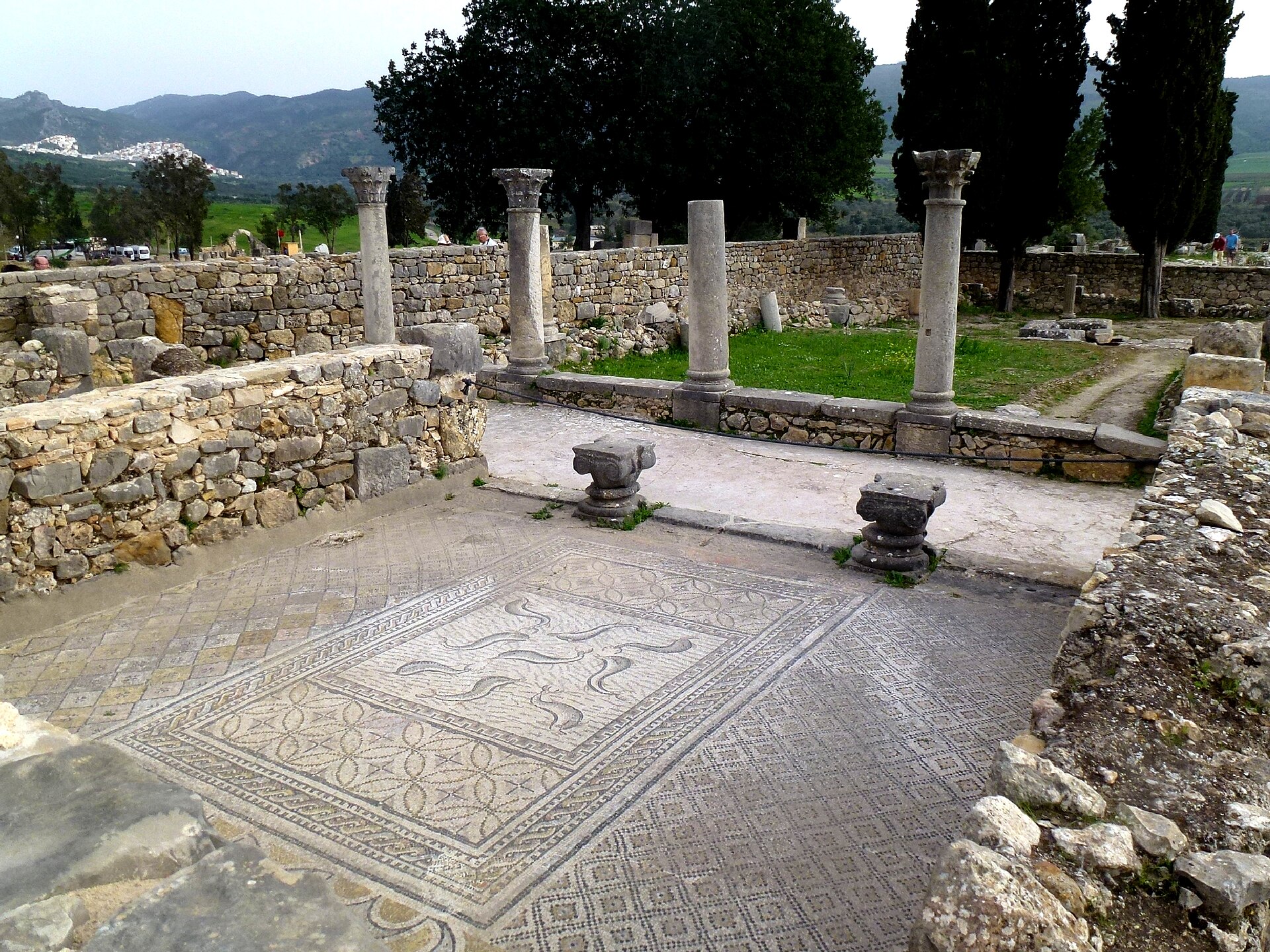
Volubilis sits quietly among the rolling hills of northern Morocco, where the foothills of the Atlas Mountains begin their slow rise toward the sky. This ancient city, once a thriving Roman outpost, now lies in ruins, its stones holding the weight of centuries. Unlike the crowded tourist sites of more famous historical places, Volubilis feels almost forgotten, as if time itself has paused here. The only sounds are the wind rustling through the wild grasses and the occasional bleat of sheep grazing between the columns and mosaics. It’s a place where the past isn’t just remembered—it’s still present, waiting to be discovered.
Among the most striking remnants of Volubilis is the House of Orpheus, a residence that offers a glimpse into how Roman culture merged with local traditions. The house takes its name from a remarkable mosaic depicting Orpheus, the mythical musician, surrounded by wild animals captivated by his music. The artwork has survived remarkably well, its details still sharp after nearly two thousand years. The folds of Orpheus’s robes, the patterns on the animals’ fur, and the expressions on their faces are all visible, as if the artist had only just stepped away. This wasn’t merely decoration; it was a story told in stone, a testament to the power of art to tame even the wildest of creatures.
The architecture of the House of Orpheus follows the typical layout of a Roman villa, though with subtle local influences. A spacious atrium with an impluvium—a shallow pool for collecting rainwater—serves as the heart of the home, around which the living quarters are arranged. Many of the rooms are adorned with intricate mosaics, some depicting geometric patterns, others illustrating scenes from mythology or daily life. One of the most impressive shows the nine Muses, each representing a different art form, their figures rendered with such skill that they seem almost alive. While some mosaics have been moved to museums, others remain in place, their colors still vibrant against the worn stone.
Volubilis was originally founded by the Berbers in the third century BCE, but its golden age came under Roman rule, when it became the administrative center of the region. The city thrived as a hub of trade, producing olive oil and grain that were shipped across the empire. Temples, baths, and a forum were built, and coins were minted here. But in the third century CE, an earthquake struck, leaving much of the city in ruins. Over time, Volubilis was abandoned, its stones repurposed for construction in nearby cities like Fes and Meknes. What remains today is a haunting reminder of how even the mightiest civilizations can fade, though the beauty they left behind endures.
Walking through the House of Orpheus, it’s easy to imagine the life that once filled these spaces. The kitchen where meals were prepared, the triclinium where guests gathered for feasts, the inner courtyard where children played—all of it comes to life in the mind’s eye. The mosaics weren’t just for show; they were part of the daily rhythm of life, telling stories of gods and heroes that shaped Roman identity. Even now, with only foundations and fragments of walls remaining, the house feels lived-in, a place where luxury and simplicity coexisted.
Visiting Volubilis is like stepping into another era. There are no modern distractions here, no towering hotels or souvenir shops to pull you back to the present. The surrounding hills are dotted with wildflowers and herbs, their scents mingling in the warm air. In the distance, the Atlas Mountains stand as they have for millennia, once marking the edge of the Roman world. As you wander the streets, you’ll pass the remains of baths, the forum, and even public latrines—small details that make the past feel tangible. The House of Orpheus is just one piece of this larger story, but it’s the one that lingers in the memory, a quiet testament to the people who once called this place home.
What makes Volubilis special is its honesty. There are no reconstructions here, no attempts to dress up the past in a way that feels artificial. The ruins stand as they are, unadorned and unapologetic. This isn’t a place for those who want a polished, theme-park version of history. It’s for those who want to feel the weight of time, to stand where others stood centuries ago and wonder about the lives they lived. When you look at the mosaic of Orpheus, it’s almost possible to hear the music, to see the animals stirring as if brought to life by the melody. That sense of connection is what draws people here—the chance to touch something eternal, if only for a moment.
Time moves differently in Volubilis. In the early morning, when the sun is still low, the ruins take on an almost mystical quality. Shadows stretch long across the ground, and the mosaics seem to deepen in color and texture. By midday, the heat becomes intense, and it’s best to find shade under one of the remaining porticos. As the sun sets, the stones glow golden, and for a brief moment, the city feels alive again, as if the voices of its ancient inhabitants might rise from the silence. But they don’t. What remains is the quiet, the stillness, and the echoes of a world that once was.
The House of Orpheus and the other ruins of Volubilis aren’t just relics—they’re living pieces of history, each stone holding a story. Spending time here is a chance to reflect on how much has changed, and yet how much remains the same. It’s a place that doesn’t need grand descriptions or flashy promotions. It simply exists, timeless and unshaken, a quiet reminder that beauty, once created, never truly fades.