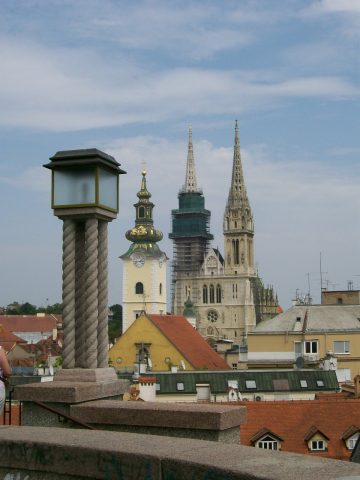
Zagreb’s Upper Town is where the city first took shape. Perched on the hill of Gradec, this was the site of the earliest settlement in the 13th century, the seed from which Croatia’s capital would grow. Back then, Zagreb was split between two distinct towns: Gradec, ruled by secular authorities, and Kaptol, under the church’s control. Their rivalry often flared into conflict, but today the two have merged into one, though the Upper Town still carries a quiet, almost timeless charm. The cobblestone streets and low-slung houses feel like a world apart from the bustling avenues below, as if time moves just a little slower here.
The architecture tells the story of centuries. Narrow houses with terracotta roofs, painted in soft pastels, stand shoulder to shoulder, their facades worn smooth by time. Many date back to the 17th and 18th centuries, rebuilt after fires and earthquakes reshaped the city. Among them, the Vranyczany Palace stands out with its grand Baroque columns and intricate stonework. But the most recognizable landmark is St. Mark’s Church, its roof a mosaic of Croatia’s historic coats of arms. The building isn’t just a symbol of Zagreb—it’s a piece of the country’s identity, its details drawing the eye of anyone who passes by.
One of the Upper Town’s defining features is the Lotrščak Tower, built in the 13th century to guard the city gates. Today, it offers one of the best views over Zagreb: the red rooftops of the old town, the green expanses of parks, and in the distance, the forested slopes of Medvednica Mountain. Every day at noon, a cannon fires from the tower, a tradition that began in the 19th century as a way for residents to set their clocks. Now, it’s simply part of the city’s rhythm. Nearby, the funicular—a short but charming ride—connects the Upper Town to the lower city, its vintage cars gliding down the hillside like a relic from another era.
What makes the Upper Town special isn’t just its history, but the way life unfolds here. Even in peak season, the streets feel unhurried. Locals linger in small cafés, sipping strong coffee or sharing slices of homemade cake. In the evenings, musicians gather on the steps of museums, their melodies drifting through the warm air. In winter, the area transforms into a fairy-tale scene, with Christmas lights reflecting off the old stone buildings and the scent of mulled wine filling the square. It’s a place where the past and present coexist without fuss.
The Upper Town is also home to some of Zagreb’s most intriguing museums. The Museum of Broken Relationships, born from a private collection, has become one of the city’s most visited spots. Its exhibits—gifts from former lovers around the world—come with handwritten notes about love and loss. Nearby, the Museum of Naïve Art showcases vibrant, imaginative works by self-taught painters. And in the former Atlas Palace, a striking Art Nouveau building, the Gallery of Contemporary Art displays 20th-century Croatian masterpieces. Each space offers a different lens on the city’s creative spirit.
Wandering the Upper Town’s streets, you’ll stumble upon small shops selling handmade goods. Artisans craft ceramics with traditional Croatian patterns, while leatherworkers stitch bags using old techniques. In one workshop, marionettes—once a staple of Zagreb’s fairs—are still made by hand. Bakeries serve rafioli, flaky pastries filled with nuts, their recipes passed down through generations. These details make the Upper Town feel lived-in, not just preserved.
Yet the Upper Town isn’t frozen in time. It’s a place where old and new blend seamlessly. A centuries-old church might stand next to a modern art gallery, while a historic café shares the street with a trendy bar. In one alley, you might find a pop-up exhibition; in another, a bookstore selling rare Croatian literature. Even a casual walk can turn into a discovery—a hidden courtyard, a street musician’s impromptu performance, or a faded fresco on a building you’ve passed a dozen times before.
More than anything, the Upper Town feels like the soul of Zagreb. It’s easy to imagine merchants, priests, and craftsmen walking these same streets centuries ago, the sound of church bells mingling with the shouts of market vendors. Today, the area remains the city’s heart, a place where history isn’t just remembered but still alive. Zagreb has long since outgrown its original hill, but here, in its oldest quarter, you can sense the city’s true character: unhurried, a little old-fashioned, but warm and welcoming all the same.