The Great Mosque of al-Nuri stands as one of the most enduring symbols of Mosul, a city where layers of history are woven into the fabric of everyday life. Its most recognizable feature, the leaning minaret known as al-Hadba, has watched over the Tigris for nearly nine centuries, bearing witness to the rise and fall of empires, the ebb and flow of trade, and the quiet resilience of the people who call this place home. The mosque itself is a testament to the architectural ingenuity of the Seljuk period, though its origins stretch back even further, to a time when Mosul was a thriving center of learning and commerce under the Abbasids.
The story of the mosque begins in the 12th century, when Nur al-Din Zangi, a ruler whose name would later lend itself to the structure, ordered its construction. Nur al-Din was a figure of contradictions—a warrior who expanded his territories through conquest, yet also a patron of religious scholarship and public works. The mosque was meant to serve not just as a place of worship, but as a statement of his vision for a unified Islamic world. The minaret, with its distinctive tilt, was added later, though the exact reason for its lean remains a subject of local lore. Some say it was built that way intentionally, a nod to the imperfections of human creation; others claim it was the result of centuries of settling into the soft earth beneath. Whatever the truth, the minaret became a defining feature of Mosul’s skyline, a landmark that travelers and locals alike would use to orient themselves in the maze of the old city.
The architecture of the Great Mosque reflects the cultural crossroads that Mosul has always been. The prayer hall, with its high vaulted ceilings and intricate stucco work, blends elements of Seljuk, Abbasid, and later Ottoman design. The mihrab, the niche indicating the direction of Mecca, is adorned with geometric patterns and calligraphic inscriptions, a reminder of the Islamic world’s golden age of art and science. The courtyard, once a bustling space where scholars debated theology and merchants haggled over goods, retains a sense of openness despite the weight of history pressing in around it. Even in its later years, the mosque remained a living space, not just a relic. Generations of worshippers added their own touches—repairs, renovations, small embellishments—that kept the structure relevant, even as the world outside changed.
For centuries, the mosque was more than just a religious site. It was a gathering place, a refuge, and a symbol of continuity in a region that has seen more than its share of upheaval. During the Ottoman era, it served as a hub for Sufi orders, whose mystic traditions added another layer to Mosul’s spiritual landscape. In the 20th century, as Iraq modernized and the old city began to shrink under the pressure of new development, the mosque remained a constant, a thread connecting the past to the present. Locals would tell stories of how the minaret’s shadow fell across the market at certain times of day, or how the call to prayer echoed differently depending on the season. These were the small, human details that made the place feel alive, not just a monument frozen in time.
The mosque’s significance took on a darker dimension in the 21st century, when Mosul became a battleground in the fight against extremism. In 2014, the city fell under the control of a group that sought to erase the very history the mosque represented. For three years, the Great Mosque of al-Nuri stood as a silent witness to the destruction around it, its minaret looming over a city that had become unrecognizable. Then, in 2017, as Iraqi forces reclaimed Mosul, the minaret was brought down in an explosion, its collapse broadcast around the world. The loss was felt deeply, not just as an architectural tragedy, but as a wound to the collective memory of the city. Yet even in that moment, the mosque’s story was not over.
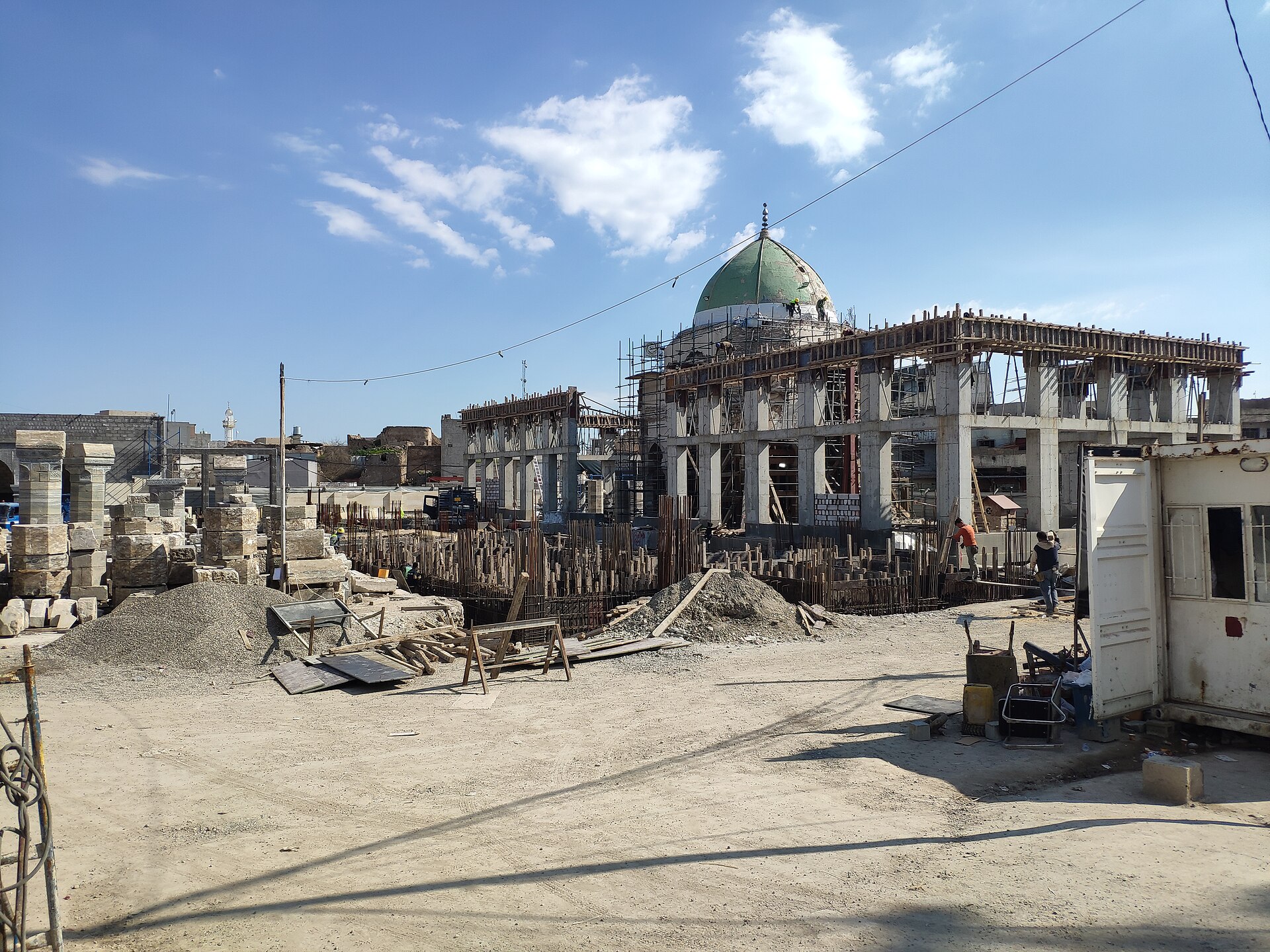
In the years since, efforts to rebuild the Great Mosque have become a symbol of Mosul’s determination to reclaim its identity. The reconstruction is a painstaking process, one that seeks to balance historical accuracy with the realities of modern engineering. Architects and historians have pored over old photographs, texts, and oral histories to ensure that the new structure honors the spirit of the original, even as it adapts to the needs of a new era. The work is slow, deliberate, and often frustrating, but it is also a reminder that places like this are never truly lost. They exist in the memories of those who knew them, in the stories passed down through generations, and in the quiet hope that one day, the call to prayer will once again rise from al-Hadba’s heights.
Visiting the site today, it’s impossible not to feel the weight of what has been lost, but also the quiet resilience of what remains. The ruins of the minaret still stand, a jagged silhouette against the sky, while the foundations of the mosque have been carefully preserved. Around them, the old city is slowly coming back to life, its streets filling once more with the sounds of commerce and conversation. The Great Mosque of al-Nuri was never just a building; it was a living part of Mosul’s identity, a place where history, faith, and daily life intersected. Its reconstruction is not just about bricks and mortar, but about rebuilding a sense of belonging, of continuity, of home.
For those who come to Mosul, the mosque offers a chance to reflect on the layers of history that shape this region. It is a place where the past is not just remembered, but actively reclaimed. The stories of the people who built it, who prayed within its walls, who fought to preserve it—these are the threads that weave together the fabric of the city. The Great Mosque of al-Nuri stands as a reminder that even in the face of destruction, history is not so easily erased. It endures in the stones beneath your feet, in the air that carries the echoes of the past, and in the quiet determination of those who refuse to let it fade away.