The Umayyad Mosque in Mosul stands as one of the oldest and most historically significant religious sites in Mesopotamia. Its origins trace back to the 7th century, when the city was a thriving center of early Islamic civilization. The mosque was built during the Umayyad Caliphate, a period marked by rapid expansion and architectural innovation, and it reflects the distinctive style of that era. Over the centuries, it has witnessed the rise and fall of empires, surviving wars, invasions, and reconstructions, each layer of its history etched into its walls.
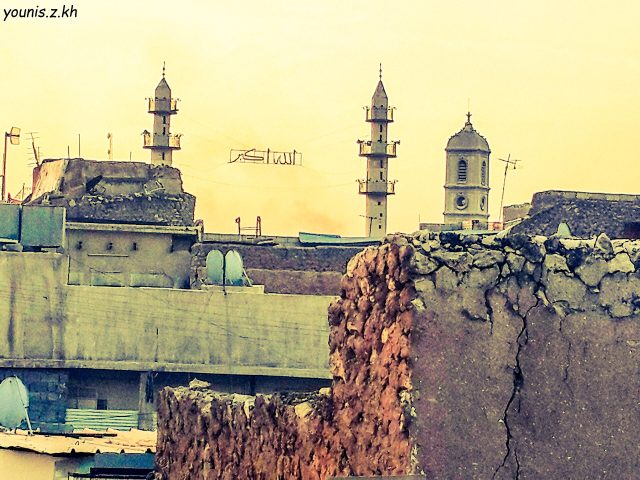
The architecture of the Umayyad Mosque is a testament to the skill and vision of its builders. The structure follows the traditional hypostyle plan, with a large courtyard surrounded by arcades supported by columns. The prayer hall, with its high ceilings and rows of arches, creates a sense of spaciousness and reverence. The minaret, though partially damaged in recent conflicts, once dominated the skyline, serving as both a spiritual beacon and a landmark for travelers. The use of brick and stone, along with intricate geometric patterns, reflects the aesthetic principles of early Islamic art, blending functionality with beauty.
Beyond its architectural significance, the mosque has long been a cultural and religious hub for Mosul’s diverse communities. For centuries, it served as a place of worship, learning, and gathering, where scholars, merchants, and ordinary citizens would come together. The mosque’s library, though no longer intact, was once renowned for its collection of manuscripts, preserving knowledge across generations. Even in times of turmoil, the site remained a symbol of resilience, a place where people could find solace and continuity amid the chaos of history.
The mosque’s location in the heart of Mosul places it at the crossroads of the city’s rich past. Mosul itself has been a melting pot of cultures, from the Assyrians and Babylonians to the Abbasids and Ottomans, each leaving their mark on the region. The Umayyad Mosque, with its deep roots in the Islamic world, stands as a bridge between these layers of history. Walking through its courtyard, one can almost hear the echoes of the past—the call to prayer, the murmur of scholars debating theology, the footsteps of traders from distant lands.
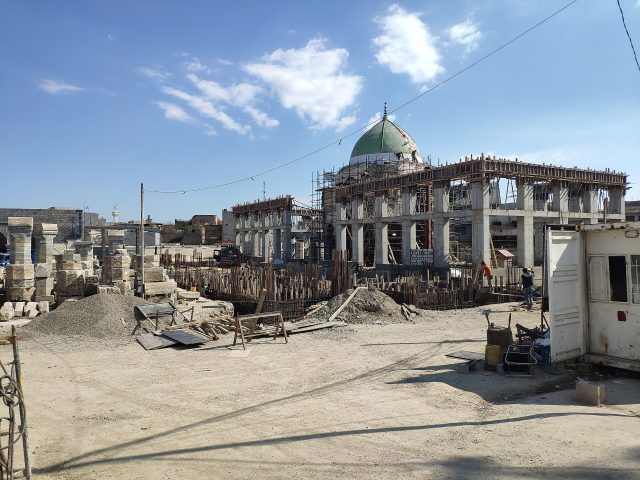
In recent decades, the mosque has faced immense challenges. Like much of Mosul, it suffered damage during periods of conflict, its walls bearing the scars of war. Yet, even in its current state, the site retains a quiet dignity. Restoration efforts have been slow but steady, with local and international organizations working to preserve what remains. The process is not just about rebuilding stone and mortar; it’s about reclaiming a piece of history, ensuring that future generations can connect with the legacy of those who came before.
Visiting the Umayyad Mosque today is a humbling experience. The air is thick with the weight of centuries, and the silence speaks volumes. The courtyard, once bustling with activity, now offers a moment of reflection. The remnants of the minaret, though no longer towering, still command attention, a reminder of the mosque’s former grandeur. For those who take the time to explore, the site reveals stories of faith, endurance, and the enduring power of place.
The mosque’s significance extends beyond its physical structure. It is a symbol of Mosul’s identity, a city that has weathered storms yet remains unbroken. The people of Mosul, despite the hardships they have faced, continue to view the Umayyad Mosque as a source of pride. It is not just a relic of the past but a living part of their community, a place where history and modernity intersect. In its quiet corners, one can still sense the spirit of those who built it, who prayed within its walls, and who fought to keep it standing.
For travelers, the Umayyad Mosque offers a rare glimpse into the soul of Mesopotamia. It is not a place of grand spectacle but of quiet contemplation, where the layers of history unfold gradually. The mosque invites visitors to step back in time, to imagine the city as it once was—a thriving center of culture, faith, and learning. In a region often defined by its conflicts, the site serves as a reminder of the deeper currents that have shaped it: the pursuit of knowledge, the search for meaning, and the enduring human desire to leave something lasting behind.
The future of the Umayyad Mosque remains uncertain, as does the future of Mosul itself. Yet, there is hope in the efforts to restore and preserve it. The mosque is more than just a building; it is a testament to the resilience of the human spirit. As long as it stands, it will continue to tell its story, a story of faith, survival, and the unbreakable bond between a place and its people. For those who visit, it offers not just a lesson in history, but a moment of connection—to the past, to the present, and to the enduring legacy of Mesopotamia.