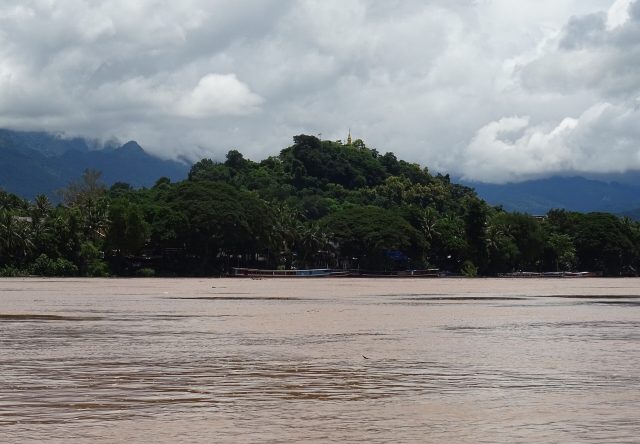
Wat Visoun stands quietly along the banks of the Mekong, a testament to Luang Prabang’s layered past. Built in the early 16th century under King Visounarat, it was more than a place of worship—it was the spiritual core of the Lan Xang kingdom, a flourishing Lao state when Luang Prabang served as its capital. Here, sacred texts were preserved, and royal ceremonies unfolded, shaping the city’s identity. Though time and conflict have left their marks, the temple remains a living piece of history, its walls holding stories of devotion and resilience.
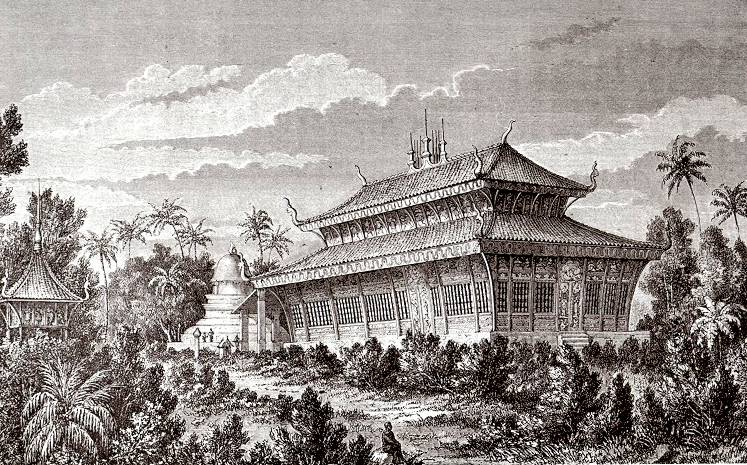
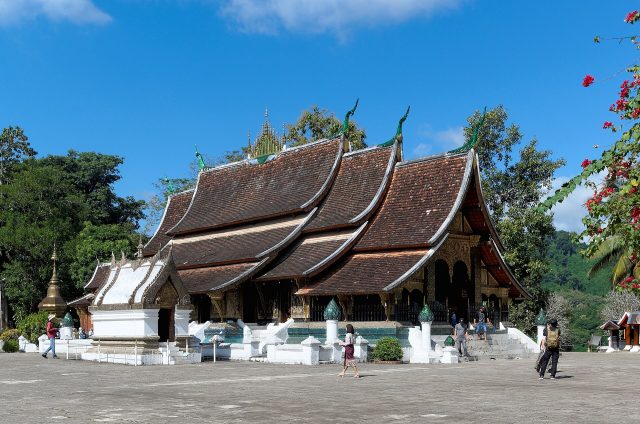
The architecture of Wat Visoun sets it apart from other Lao temples. Its main sim, or prayer hall, rises on a sturdy stone foundation, its sweeping roof nearly touching the ground in a gesture of shelter. Inside, faded murals depict scenes from Buddhist lore, their details softened by centuries of humidity and neglect. The most striking feature is the massive bronze bell, cast in the 1500s and said to be one of the largest in Southeast Asia. Once, its deep resonance marked the rhythms of daily life—dawn, dusk, and moments of collective significance.
Beside the prayer hall, the modest stupa That Makhat stands as a memorial to King Visounarat. Unlike the grand That Luang in Vientiane, it carries a quiet dignity, its low walls enclosing the king’s remains. Nearby, a small library once housed sacred palm-leaf manuscripts, while the monks’ quarters still hum with the routines of monastic life. The temple complex feels like a village within a village, where the past and present coexist without fanfare.
Wat Visoun has endured its share of upheaval. In the 19th century, Chinese Haw bandits looted and burned parts of the temple, leaving scars that remain visible. Later, French colonial restorers pieced some of it back together, though not everything could be saved. What survives is a sense of stillness, a place untouched by the crowds that flock to Wat Xieng Thong or Wat Mai. Here, the weight of history isn’t announced—it’s felt in the worn stones and the hush of the courtyard.
Mornings at Wat Visoun offer a glimpse into one of Laos’ most enduring traditions. As the sun rises, monks in saffron robes walk barefoot through the streets during tak bat, the alms-giving ritual. Locals line up with offerings of rice, fruit, and flowers, receiving blessings in return. For visitors, it’s often a first encounter with Lao Buddhism, but it’s not a performance—it’s an ordinary act of faith, woven into the fabric of daily life.
In recent years, the temple has drawn the attention of historians and conservationists. Restoration work proceeds carefully, mindful of the temple’s dual role as both a monument and a living place of worship. Every cracked tile, every faded mural, every weathered beam carries the imprint of those who built, prayed, and walked these grounds over centuries. Wat Visoun isn’t frozen in time—it breathes, slowly, with the same rhythms that have defined it for generations.
There’s no grand spectacle here, no polished tourist experience. Instead, Wat Visoun offers something rarer: a sense of continuity. The air is thick with the scent of incense and damp earth, the only sounds the rustle of leaves and the distant murmur of prayers. It’s a place that doesn’t demand attention but rewards those who pause to listen. In a city changing as quickly as Luang Prabang, the temple stands as a reminder of what endures—faith, memory, and the quiet persistence of the past.