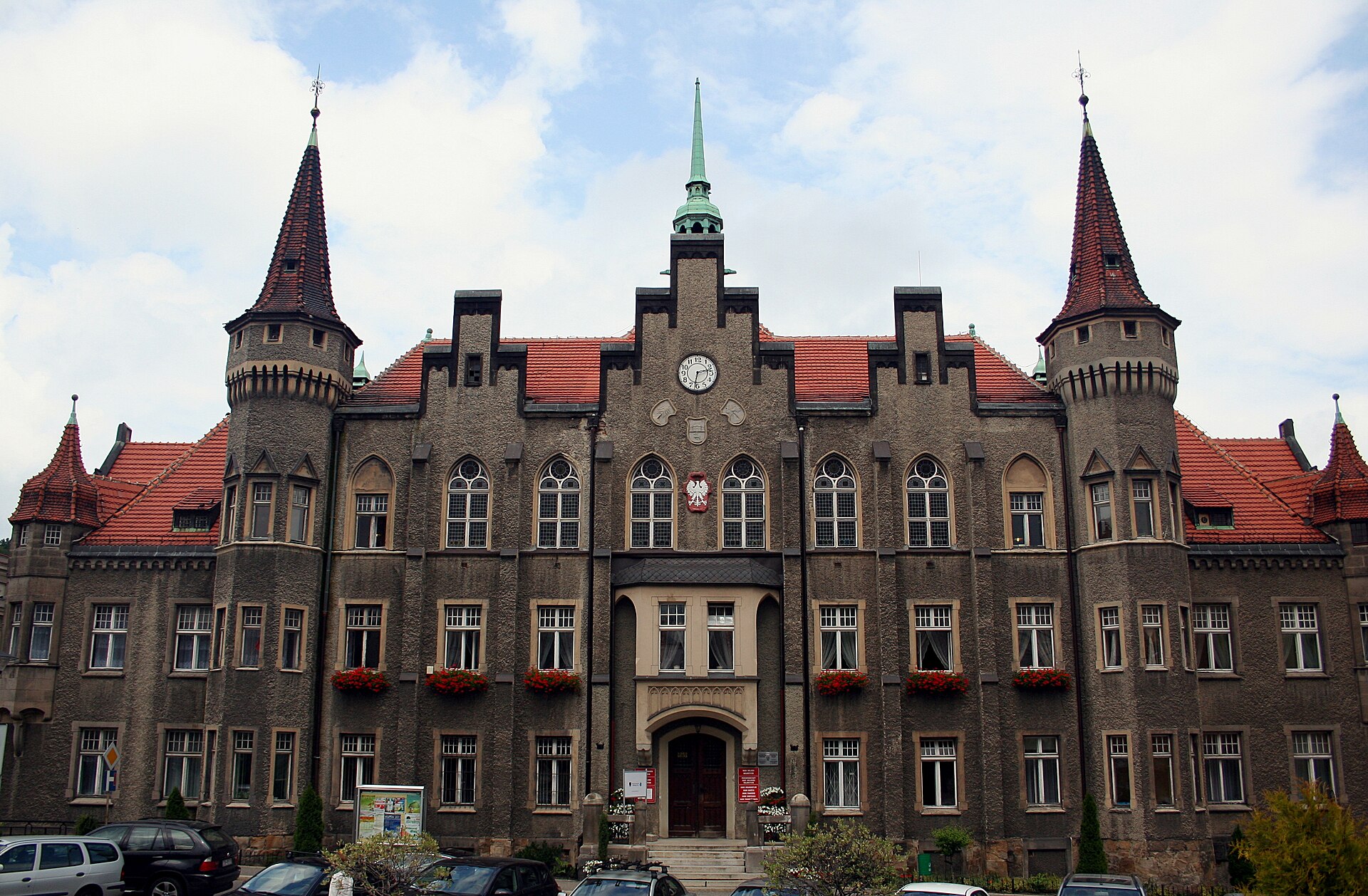
Wałbrzych Town Hall stands as a quiet witness to the city’s transformations, a building that has seen prosperity, war, and renewal without ever losing its place at the heart of the community. Built in the late 19th century, it reflects an era when Wałbrzych was booming, its fortunes tied to the coal mines that turned this once-small settlement into a key industrial hub of Lower Silesia. The architecture blends neo-Renaissance and neo-Gothic styles, a common choice for public buildings of the time, meant to convey both grandeur and civic pride. The façade is rich with decorative details—turrets, arched windows, and intricate stonework—while the central clock tower, crowned with the city’s coat of arms, serves as a reminder of the building’s original purpose as the seat of local governance.
The story of the town hall is inseparable from Wałbrzych’s own rise. For centuries, the area was little more than a cluster of villages, but the discovery of coal in the 18th century changed everything. By the late 1800s, the city had become a powerhouse of industry, and the new town hall was designed to match its ambitions. Construction began in 1896 under the direction of architect Karl Grosse, who had already left his mark on similar projects in the region. The building wasn’t just an administrative center; it was a gathering place for citizens, a symbol of progress, and a promise of what the future might hold. For the people of Wałbrzych, it represented stability in a time of rapid change.
Inside, the town hall retains much of its original character. The interiors are a mix of elegance and functionality, with high ceilings, marble staircases, and ornate plasterwork that speak to the craftsmanship of the era. The main council chamber, where city officials once debated local affairs, still feels imposing, its heavy doors and detailed woodwork evoking a sense of history. Some rooms display old maps of Wałbrzych and photographs documenting the city’s evolution, offering a glimpse into how it grew from a mining town into the place it is today. While the building no longer serves its original functions in full, parts of it remain open to visitors, allowing them to step into the past without the formality of a museum.
The town hall has endured more than its share of upheavals. It survived two world wars, including significant damage during the Second World War, and was later restored in the postwar years. Under socialist rule, it housed various government offices, and after 1989, it regained its role as a symbol of local democracy. Today, it functions as both an administrative building and a cultural space, hosting exhibitions, concerts, and public events. For residents, it’s more than just a landmark—it’s a familiar presence, a place where the past and present intersect naturally.
The square in front of the town hall is one of the liveliest spots in Wałbrzych. Throughout the year, it hosts markets, festivals, and seasonal celebrations. In summer, outdoor cafés spill onto the pavement, serving coffee and traditional Silesian dishes, while in winter, the square transforms into an ice rink, drawing families and skaters. The surrounding streets are lined with other historic buildings, creating a sense of stepping back in time. It’s easy to imagine the scene a century ago—trams rattling past, miners heading to their shifts, and the hum of a city on the rise.
What makes Wałbrzych Town Hall special is how seamlessly it fits into modern life. It doesn’t feel like a relic or a tourist attraction cordoned off from the city. Instead, it remains a working part of Wałbrzych, its halls still used for meetings, its steps a place where people gather. Visitors might come for the architecture or the history, but what stays with them is the sense of continuity—the way the building has adapted without losing its identity. There’s no forced grandeur here, no attempt to romanticize the past. It simply exists, as much a part of the city’s rhythm as the streets outside.
If you find yourself in Wałbrzych, the town hall is worth a visit, even if only for a short while. You don’t need to be a history buff to appreciate the atmosphere—the quiet dignity of the building, the way light filters through the tall windows, the echoes of footsteps in the corridors. You can wander the halls, peek into the council chamber, or just sit on a bench outside, watching the city go by. In a place like this, history isn’t something distant or abstract; it’s alive in the details, in the way the past and present coexist without fuss. That’s what makes Wałbrzych Town Hall more than just a landmark—it’s a place where the city’s story is still being written.