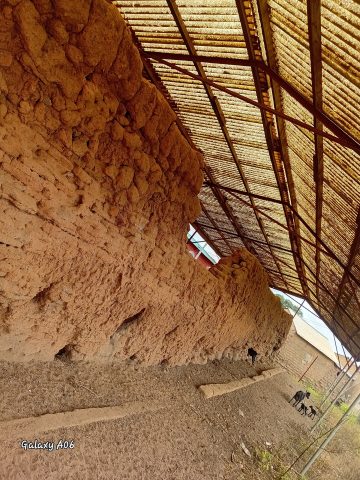
Wa Naa’s Palace isn’t the kind of place you visit to check a box on a tourist itinerary. It sits at the heart of Wa, the capital of Ghana’s Upper West Region, where the past isn’t confined to glass cases or plaques but woven into the daily rhythm of the city. This isn’t a relic frozen in time—it’s a working seat of power, where the Wa Naa, the traditional ruler of the Wala people, still holds court, settling disputes, overseeing ceremonies, and shaping the community’s future. The palace doesn’t look like the castles of Europe, with their towering stone walls and grand halls. Instead, its strength lies in its simplicity, a reflection of the Wala way of life, where form follows function and every detail has meaning.
Built in the traditional style of northern Ghana, the palace is a masterclass in practicality and symbolism. Its thick mud walls, packed tight and smooth, keep the interior cool even when the sun blazes outside. The roof, thatched or layered with clay, rests on heavy wooden beams that do more than support the structure—they tell stories. Carved into the beams and the walls are geometric patterns, not just for decoration but as a language of their own, speaking of lineage, beliefs, and history. The entrance is unassuming, but step inside, and you’ll find a spacious courtyard where the real life of the palace unfolds. This is where elders gather to debate, where women cook over open fires, and where ceremonies mark the passage of time.
The palace’s history is inseparable from that of Wa itself. For centuries, the city has been a crossroads, a place where trade routes from the savannas of West Africa met the forested south. The Wala people, who migrated here from the north, established their kingdom with the palace at its core. Over time, Wa became a melting pot of cultures, a hub where goods, ideas, and people flowed in and out. The palace has been rebuilt and expanded, but its purpose has never wavered: it’s where alliances were forged, disputes resolved, and leadership passed down through generations. Even during the colonial era, when Ghana was under British rule, the Wa Naa remained a powerful figure, and the palace continued to serve as the center of traditional authority.
Today, the palace is open to visitors, but it’s not a museum in the conventional sense. There are no roped-off exhibits or guided tours with rehearsed scripts. Instead, you’ll find the courtyard alive with activity—elders in flowing robes debating under the shade of a tree, children playing nearby, women stirring pots of *tuo zaafi* or *fufu* over open flames. The people you meet aren’t tour guides; they’re residents who might invite you to sit, offer a cup of *pito* (a local millet beer), and share stories about their lives. Some parts of the palace remain off-limits, as they still serve their original purpose, but the openness of the space makes it feel less like a historical site and more like a living room for the community.
What makes the palace’s architecture so striking is how it embodies the Wala worldview. Every element, from the materials to the layout, is deliberate. The mud walls aren’t just practical—they’re a connection to the earth, a nod to the land that sustains the people. The wooden beams, often carved with intricate patterns, are passed down through generations, each design a chapter in the Wala story. Some motifs represent the ruler’s lineage; others depict important events or serve as protective symbols. Even the palace’s location isn’t accidental. Built on a slight elevation, it overlooks the city, a silent reminder of its authority and a beacon visible from afar.
Visiting the palace is an opportunity to see tradition in action. There are no rigid rules here, no "do not touch" signs. You can wander into the courtyard, sit on the same wooden benches where elders hold their meetings, and listen to the cadence of the Wala language. If you’re lucky, you might witness a small ceremony—a naming ritual, a dance, or a gathering of chiefs—or hear the rhythmic beat of drums signaling an event. The locals are often eager to show visitors around, pulling out handwoven baskets, clay pots, or looms to demonstrate how these everyday objects are made. These aren’t artifacts behind glass; they’re tools still in use, a bridge between past and present.
The palace isn’t just a building; it’s a living entity that evolves alongside the city. Wa, like much of Ghana, is changing rapidly. New roads, modern houses, and bustling markets are transforming the landscape, but the palace remains a constant, a symbol of continuity. It’s where the old and the new intersect—where young people learn from their elders, where traditional governance adapts to contemporary challenges, and where the community gathers to celebrate and mourn. For many in Wa, the palace isn’t just the ruler’s residence; it’s a part of their identity, a place that feels like home.
For travelers, the palace offers a rare glimpse into a culture that often goes unnoticed in guidebooks. This isn’t a place for a quick photo op. It’s an invitation to slow down, to spend a few hours watching the ebb and flow of daily life. After visiting the palace, you might wander through the surrounding streets, where older homes built in the same mud-and-thatch style still stand. Or you could head to the market, where vendors sell ingredients for the same dishes that have been cooked here for generations. The sense of timelessness is palpable, as if the palace isn’t just preserving history but actively shaping it.
In a world where so many historical sites feel like stage sets for tourists, Wa Naa’s Palace stands apart. It’s not about spectacle; it’s about substance. Here, history isn’t something you observe from a distance—it’s something you feel in the cool shade of the courtyard, in the warmth of a stranger’s smile, in the stories that unfold around you. For those willing to listen, the palace doesn’t just tell the story of the Wala people. It lets you be a part of it, if only for a little while.