Photo: Tommy.In, CC BY-SA 3.0
Taroko Gorge
out of 5 0 ratingsTaroko Gorge is one of those rare places where the land feels alive, speaking in the language of rushing water and towering stone. Stretching nearly nineteen kilometers along the Liwu River in eastern Taiwan, near the city of Hualien, the gorge is a dramatic collision of nature’s raw power and quiet resilience. Sheer cliffs rise hundreds of meters into the sky, their faces carved by time and water into jagged, almost surreal formations. The river below churns through the narrow passage, its currents swift and unpredictable, while narrow trails wind along the edges, offering glimpses of dense forests clinging to the rock. There’s a sense of timelessness here, as if the gorge exists outside the usual rhythms of the world, governed instead by the slow, relentless work of wind and water.
The history of Taroko is as layered as the rock that defines it. Long before it became a destination for travelers, this land was home to the Truku people, one of Taiwan’s indigenous groups, whose name eventually lent itself to the gorge. For the Truku, the canyon was more than just a place to live—it was sacred ground, a living connection to ancestors and spirits. The first road through the gorge was carved during the Japanese colonial period in the early 20th century, a feat of engineering that linked Taiwan’s rugged east coast with the rest of the island. The construction was treacherous, with workers battling landslides and unstable terrain, but the result was a route that remains one of the most breathtaking drives in the world. Later, under the Nationalist government, the road was widened and improved, opening the gorge to visitors while preserving much of its wild character.
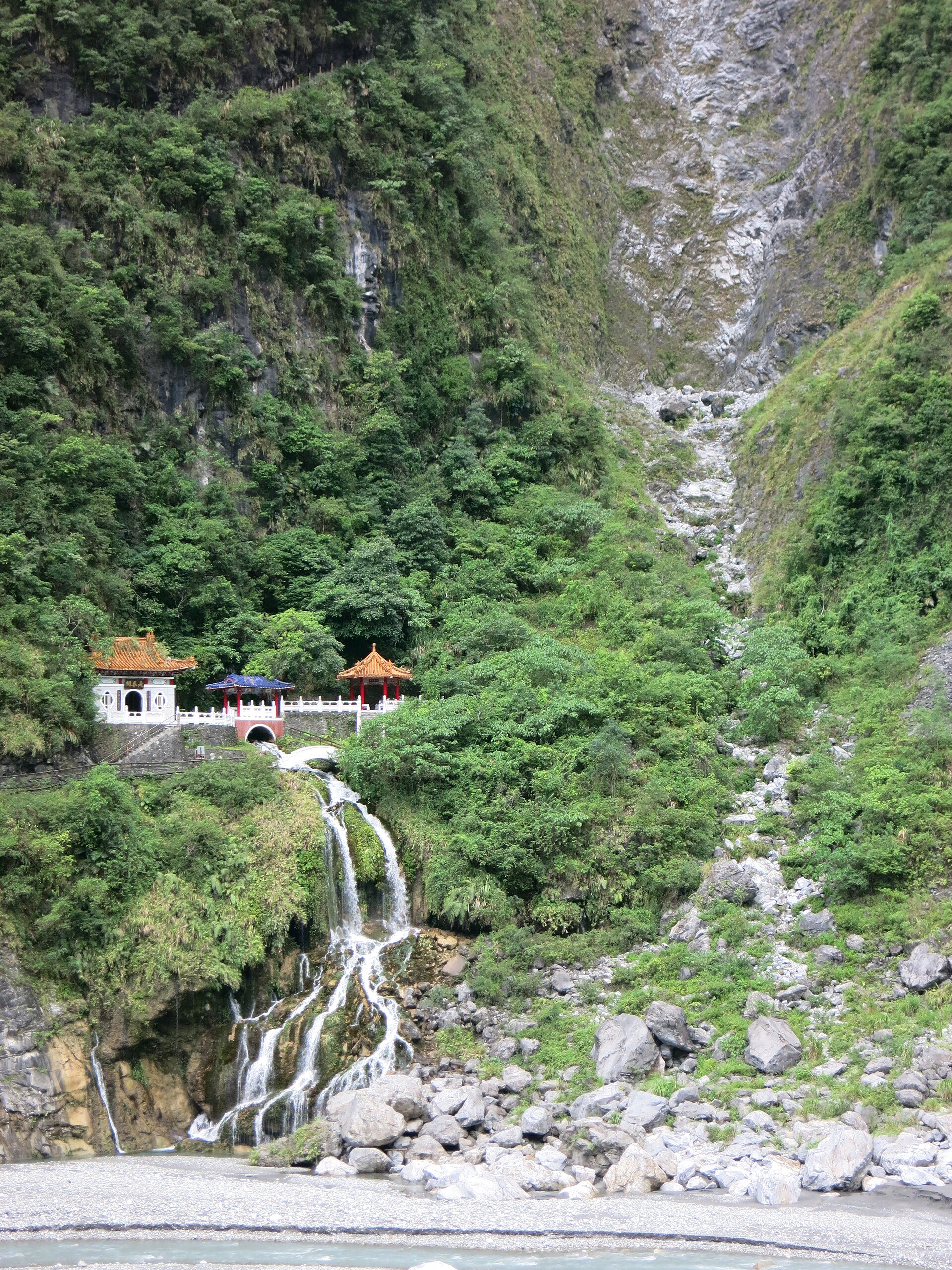
There are no grand cathedrals or palaces in Taroko—here, the most striking architecture is the work of nature itself. Yet a few human-made structures have found their place within the landscape, blending so seamlessly that they feel like natural extensions of the gorge. The most famous is the Eternity Shrine, a Buddhist temple carved directly into the cliffside. The shrine’s entrance is modest, almost hidden among the rocks, and stepping inside feels like entering another world. The air is cool and still, the light filtering through narrow stone windows, casting soft shadows on the Buddha statues that seem to emerge from the rock itself. Another notable landmark is the Mother’s Bridge, a simple yet elegant arch spanning the river. Its reflection in the water below creates a near-perfect mirror image, a quiet moment of symmetry in an otherwise untamed place.
Visiting Taroko is less about ticking off sights and more about surrendering to the experience. The main road through the gorge twists and turns, sometimes hugging the cliffside so closely that the rock looms overhead like a ceiling, other times descending to the river’s edge where the water roars just a few meters away. Along the way, viewpoints offer places to pause—some perched high above the canyon, others tucked into quiet corners where the river’s rush is the only sound. One of the most photographed spots is the Swallow Grotto, where the road narrows dramatically, and the cliffs seem to press in from both sides. Nearby, the Bridal Veil Falls cascades down a sheer rock face, its thin curtain of water shimmering in the sunlight like a bride’s veil caught in the wind.
Beyond the cliffs and the river, Taroko is also a place of deep forests and hidden corners. Pockets of old-growth woodland survive here, their towering trees draped in moss and ferns, the air thick with the scent of damp earth and pine. The gorge is home to wildlife that moves quietly through the undergrowth—macaques chattering in the branches, small deer darting between the trees, and, if you’re very lucky, the rare Formosan black bear. Birds are everywhere, their calls weaving into the constant hum of the river. Some trails lead away from the main road, winding through the forest to secluded waterfalls or caves where the temperature drops and the light takes on a greenish hue. These are the places where time seems to slow, where the only sounds are the rustle of leaves and the distant rush of water.
For those who want to explore beyond the road, Taroko offers hiking trails that range from gentle walks to challenging climbs. The Shakadang Trail is one of the most popular, following the river through lush forest to a series of small waterfalls. The path is well-maintained, with signs explaining the gorge’s geology and history, and it’s an easy way to experience the landscape up close. For more adventurous hikers, the Baiyang Trail leads to a series of caves and tunnels carved into the rock, while the Zhuilu Old Trail, a remnant of the original Japanese-era path, offers dizzying views from a cliffside ledge hundreds of meters above the river. The most demanding route is the Batongguan Trail, which climbs to nearly three thousand meters, rewarding those who make the journey with sweeping vistas of the gorge and the surrounding mountains. These trails aren’t just about the destination—they’re about the quiet moments along the way, the unexpected views, and the sense of being fully present in a place that feels both ancient and alive.
Taroko changes with the seasons, each one revealing a different side of the gorge. In spring, the forests burst into color, the river runs high with meltwater, and the air is filled with the scent of blooming flowers. Summer brings heat, but the shade of the cliffs and trees offers relief, and the waterfalls are at their most powerful. Autumn is perhaps the most striking time to visit, when the light becomes clearer and the mountains take on golden hues, the contrast between the blue of the sky and the green of the forest sharpening with each passing day. Winter is quieter, with fewer visitors, and in the higher elevations, a dusting of snow can transform the gorge into something almost otherworldly. But the weather here is unpredictable—sunshine can give way to rain in minutes, and fog can roll in suddenly, obscuring the cliffs and muting the colors of the landscape.
What makes Taroko special isn’t just its beauty, but the way it makes you feel. There’s a humility that comes with standing in a place like this, where the scale of the landscape dwarfs everything human. It’s a reminder that the world is vast and wild, and that some things exist beyond our control or understanding. At the same time, there’s a sense of peace here, a quiet invitation to slow down and pay attention. The gorge doesn’t demand anything from its visitors—no tickets, no guided tours, no scripted experiences. It simply exists, as it has for millennia, shaped by forces far greater than any of us.
That’s not to say Taroko is untouched by the modern world. The road through the gorge is well-traveled, and on busy days, the viewpoints can feel crowded. Yet even then, it’s possible to find moments of solitude—on a side trail, by the river’s edge, or in the quiet of the Eternity Shrine. The key is to approach the gorge with a sense of openness, to let the place reveal itself rather than trying to impose expectations on it. Whether you spend an hour here or a day, whether you drive through or hike deep into the forest, Taroko has a way of staying with you. It’s the kind of place that lingers in the memory, not just as a series of images, but as a feeling—of awe, of stillness, of having touched something real.
Day around this place
Where else to go on the same day
Building the day…
Where it is
24.21344, 121.49030