Uplistsikhe is one of those places that lingers in the mind long after you’ve left. Tucked into a rocky cliff above the Mtkvari River, just ten kilometers east of Gori, it feels like stepping into a different era—one where time moves slower, where the past isn’t just remembered but still somehow alive. Unlike the grand ruins of ancient cities or the imposing fortresses that dot the Caucasus, Uplistsikhe doesn’t announce itself with towering columns or ornate facades. Instead, it reveals itself quietly, carved directly into the soft sandstone, as if the mountain itself had been hollowed out by generations of human hands.
The site dates back to the late Bronze Age, around three thousand years ago, when it first emerged as a sacred and strategic hub in the kingdom of Iberia. Its name translates to the Fortress of the Lord, a title that hints at its significance—not just as a settlement, but as a place where trade routes converged, where pilgrims sought blessings, and where rulers asserted their power. The caves here served as temples, homes, storerooms, and even prisons, their functions shifting with the tides of history. Over the centuries, the rock walls absorbed the beliefs of those who passed through: Zoroastrian fire altars gave way to Christian chapels, while older pagan shrines were repurposed or left to fade into the stone. The layers of history aren’t just visible—they’re tangible, as if the very air carries the weight of the rituals once performed here.
From the highest terraces of Uplistsikhe, the view stretches across the Mtkvari Valley, where the river winds between rolling hills before disappearing into the distance, framed by the snow-capped peaks of the Greater Caucasus. The cliff itself resembles a massive ship run aground, its jagged edges softened by time. The entrance to the caves begins with a narrow gorge, where stone steps now replace the ancient gates that once stood guard. The first chamber you encounter is the Hall of Queen Tamar, a vast space supported by rough-hewn columns, its walls adorned with niches and faded carvings. At its center, a stone altar remains, its purpose still debated—was it used for sacrifices, ceremonies, or something else entirely? The lack of clear answers only deepens the mystery.
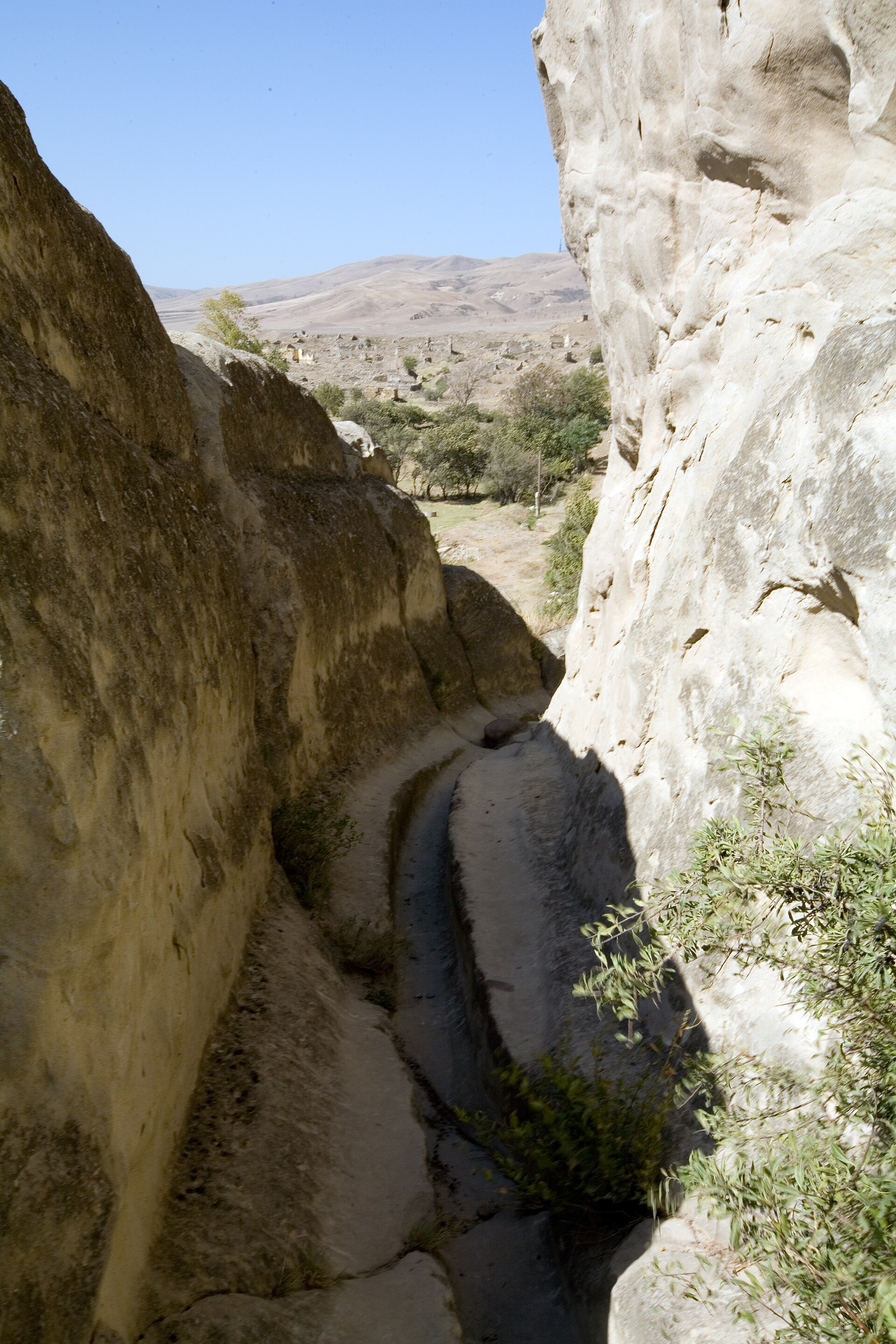
What makes Uplistsikhe so striking is its lack of order. Unlike the carefully planned grids of Roman cities or the symmetrical grandeur of Persian palaces, the caves here seem to have grown organically, shaped by necessity rather than design. Some chambers are connected by tight passageways, others open onto terraces where sentries once kept watch. In one cave, a rudimentary aqueduct channels water through the rock; in another, massive stone vats hint at the region’s long tradition of winemaking. Local legends claim these were used to ferment wine for royal feasts, though the truth is lost to time. What remains is the quiet certainty that this place was once alive with activity—merchants haggling, priests chanting, families gathering around hearths.
By the Middle Ages, Uplistsikhe’s influence had waned. As Christianity took hold in Georgia and political power shifted to Mtskheta and Tbilisi, the cave city became less central to daily life. It wasn’t abandoned entirely—people still lived here, adapted the spaces to new needs—but the grandeur of its early years faded. Earthquakes and erosion took their toll, collapsing some caves while leaving others remarkably intact. The upper tiers, where residential quarters once thrived, offer the most intimate glimpse into the past. Here, you can still see the remnants of stone benches, fire pits, and even small balconies carved into the rock, their purpose now left to the imagination. Faint traces of frescoes cling to the walls in a few places, though the colors have long since dulled, leaving only ghostly outlines behind.
Today, Uplistsikhe feels less like a museum and more like a place where history is still unfolding. Walking through its narrow paths, it’s easy to imagine the clatter of hooves as a caravan approaches, or the murmur of voices rising from the chambers below. The wind sweeps through the empty halls, carrying with it the scent of dry grass and sun-warmed stone. Below, the Mtkvari River rushes past, a constant reminder that life here never truly stopped. Even during Georgia’s darkest periods—under foreign rule, during invasions, or in times of upheaval—Uplistsikhe endured. It was a refuge, a hiding place, a silent witness to the ebb and flow of empires.
The best time to visit is early morning or late afternoon, when the light is soft and the crowds thin. The golden hues of sunrise or sunset cast long shadows across the rock, deepening the sense of timelessness. Without the distraction of tour groups, it’s easier to lose yourself in the quiet rhythm of the place. You might find yourself running your fingers along the grooves in the stone, wondering about the hands that shaped them. Who were these people? A priest lighting a fire in the temple? A merchant storing goods in the storerooms? A farmer returning from the fields with a basket of grapes? Uplistsikhe holds their stories, not in grand monuments or elaborate inscriptions, but in the very fabric of the rock.
If you find yourself in Gori, it’s worth looking beyond the more obvious attractions. Uplistsikhe isn’t a place you simply observe—it’s one you experience. There are no lengthy plaques to explain every detail, and that’s part of its charm. You’re left to wander, to touch the walls, to listen to the echoes of the past. It’s a rare kind of history, one that doesn’t just tell you about the people who lived here but makes you feel their presence. They couldn’t have known their work would endure for millennia, yet here it stands—a testament to human ingenuity, carved into the earth itself. Uplistsikhe isn’t just a relic; it’s a conversation between the past and the present, one that continues with every visitor who steps into its silent, sunlit chambers.