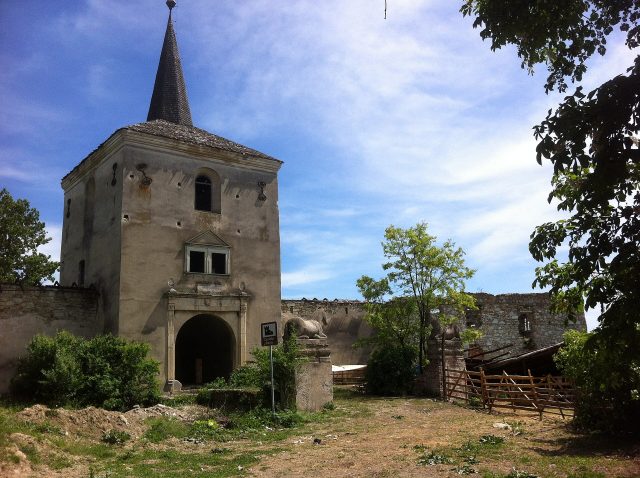
Perched on a gentle hill above the quiet village of Batin, the ruins of Unguraș Fortress stand as a quiet witness to centuries of Transylvanian history. Unlike the region’s more famous castles, this place has escaped the crowds and commercialization, offering instead a sense of raw, unfiltered time. The stones here are worn smooth by weather and neglect, yet they still hold the echoes of medieval life—of soldiers keeping watch, merchants passing through, and villagers seeking shelter behind thick walls. To visit Unguraș is to step into a landscape where history feels tangible, not just preserved but lingering in the air like the scent of damp earth after rain.
The fortress first appears in written records in 1269, though its origins likely stretch back further. Built during a time when Transylvania was a contested frontier of the Hungarian Kingdom, Unguraș served as both a military outpost and a symbol of control over the surrounding lands. Its position on the hill wasn’t accidental—from here, defenders could spot approaching threats long before they reached the walls. The design was practical, typical of medieval Transylvanian fortifications: thick stone walls, defensive towers, and an inner courtyard where supplies and soldiers were housed. Over the centuries, the fortress was expanded and reinforced, though its core purpose remained the same—to protect and endure.
Life within these walls was never easy. Transylvania in the Middle Ages was a land of shifting borders and frequent conflict. Unguraș changed hands multiple times, enduring sieges and reconstructions as power dynamics shifted between Hungarian nobles, Ottoman forces, and later, Habsburg rulers. By the 16th century, the fortress had lost much of its strategic importance, and its slow decline began. Locals, in need of building materials, gradually dismantled parts of the structure, repurposing its stones for homes and barns. What remains today are fragments—crumbling walls, the stubs of towers, and the faint outlines of where buildings once stood—but even these are enough to imagine the fortress in its prime.
The 18th and 19th centuries brought a different kind of attention to Unguraș. As Transylvania became part of the Austrian Empire, the Romantic era’s fascination with ruins and legends breathed new life into the site. Artists and writers were drawn to its melancholic beauty, and local folklore wove tales of hidden treasures and ghostly knights into its history. When Romania gained independence in the 20th century, archaeologists took an interest in the fortress, conducting minor excavations and stabilization efforts. Yet unlike more prominent sites, Unguraș was never fully restored. Instead, it was left in a state of arrested decay, a deliberate choice that preserves its authenticity.
Reaching Unguraș requires a bit of effort. The journey takes you off the main roads, winding through rural landscapes where time seems to move slower. Fields stretch out in all directions, dotted with grazing cattle and clusters of traditional houses with steep, tiled roofs. The final approach is on foot, up a gentle slope where wildflowers grow between the stones. There are no signs pointing the way, no ticket booths or guided tours—just the quiet invitation of the ruins themselves. This remoteness is part of the fortress’s charm. It feels like a secret, a place where the past hasn’t been polished for tourists but left to speak for itself.
The atmosphere here is one of quiet grandeur. On a clear day, sunlight catches the rough texture of the stones, highlighting the layers of time embedded in them. In the rain, the ruins take on a more somber tone, their outlines softened by mist. There’s a sense of stillness, broken only by the wind rustling through the grass or the occasional call of a bird. Locals pass by without fanfare, treating the fortress as a familiar landmark rather than a relic. For them, it’s simply part of the land, a silent companion to the changing seasons.
Unguraș doesn’t offer the dramatic interiors of Bran Castle or the meticulously restored halls of Corvin. There are no gift shops, no costumed actors, no grand narratives about vampires or royal intrigue. What it does offer is something rarer—a sense of unmediated history. The stones here haven’t been scrubbed clean or rearranged for effect. They’re rough, uneven, and sometimes overgrown, just as they’ve been for centuries. This isn’t a place for those who want history neatly packaged. It’s for those who prefer it in its raw, imperfect form, where the past isn’t just remembered but felt.
Sitting among the ruins, it’s easy to imagine the fortress as it once was. The clatter of hooves on cobblestones, the murmur of voices in the courtyard, the glow of torches against the night sky. These aren’t just scenes from a history book; they’re impressions that linger in the silence. Unguraș isn’t a monument to be admired from a distance. It’s a place to be experienced—to touch the stones, to listen to the wind, to let the weight of centuries settle around you. The fortress may be in ruins, but its story isn’t over. It’s still being told, one visitor at a time, to those willing to listen.