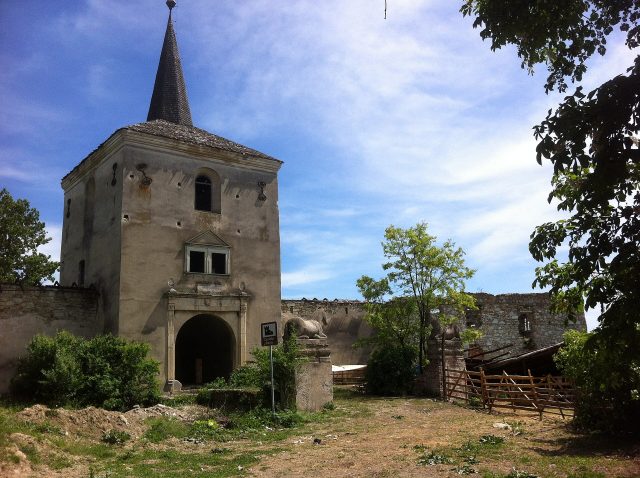
The town hall of Unguraș is one of those quiet, unassuming buildings that hold the memory of a place in their walls. Standing at the heart of the village, it overlooks the main square, where the bustle of old markets has long since faded into the occasional murmur of passersby and the hum of passing cars. There’s nothing grand about its appearance—no ornate facades or towering spires—but that’s precisely what makes it feel so fitting. It belongs here, as if it has always been part of the landscape, blending seamlessly into the everyday rhythm of life in a Transylvanian village.
The architecture is typical of early 20th-century administrative buildings across Romania, with clean lines, a symmetrical facade, and tall windows topped with arched frames. The design carries the subtle influence of the Austro-Hungarian era, a reminder of the region’s layered history. The two-story structure is solid and unpretentious, its tiled roof slightly weathered by time. Above the entrance, a small canopy supported by two columns gives it a touch of formality, though nothing about it feels overly imposing. It’s the kind of building that serves its purpose without drawing attention to itself.
Unguraș itself has roots stretching back to the 16th century, but its role as an administrative center came much later, after Transylvania became part of Romania. The town hall likely dates to the interwar period, a time when many Romanian villages were establishing their own local governments. Back then, the building wasn’t just an office—it was a hub of community life. Important decisions were made within its walls, disputes were settled, and on occasion, it even hosted small gatherings or celebrations. For decades, it has been where the practical business of running a village takes place.
Today, the town hall continues to function much as it always has. Inside, the atmosphere is one of quiet efficiency: long corridors, wooden furniture in the offices, and walls lined with old photographs of the village and portraits of past mayors. There’s no frills, no modern renovations—just a sense of steady, unhurried work. Every document processed here, every decision made, has a direct impact on the lives of the people in Unguraș. It’s a place where bureaucracy feels personal, not distant.
For most travelers, the town hall won’t be a highlight of their visit. There are no guided tours, no grand exhibits, no dramatic stories to tell. But for those who take an interest in the quieter side of Romanian life, it offers something rare: a glimpse into the unvarnished reality of a small village. There’s no performance here, no attempt to impress outsiders. The building simply exists, as it has for generations, a silent witness to the slow, steady pulse of life in Unguraș.
The square in front of the town hall is where the village gathers. In summer, benches appear, and in winter, the space is sometimes turned into an ice rink. It’s where people come to run errands, meet neighbors, or just pass the time. On warm days, you might see elderly men playing chess or children darting around the fountain. The square isn’t large, but it serves its purpose—an open space where different generations cross paths, where conversations start and end, where the village feels like a community.
Unguraș isn’t a place that draws crowds. There’s no tourist infrastructure, no souvenir shops, no carefully curated attractions. That’s part of its charm. The village moves at its own pace, untroubled by the expectations of visitors. The town hall, like everything else here, exists for the people who live in Unguraș, not for those passing through. And yet, for anyone who takes the time to stop, it offers a chance to see Romania as it really is—a country where even the smallest villages have their own stories, their own rhythms, their own quiet dignity.
If you ever find yourself in this part of Transylvania, take a walk through Unguraș. Visit the local church, linger in a small café, and pause for a moment in front of the town hall. It won’t demand your attention, but if you look closely, you might sense the weight of its history. The past here isn’t loud or dramatic; it’s woven into the fabric of everyday life, subtle but unmistakable. And that, in the end, is what makes places like this worth noticing.