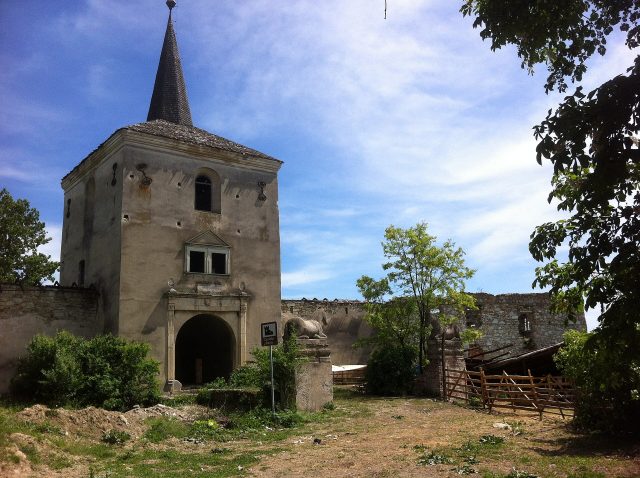
Unguraș Park is the kind of place that doesn’t announce itself with fanfare but lingers in your thoughts long after you’ve left. Tucked away in a small Romanian village of the same name, far from the well-trodden paths of tourists and the hum of cities, it feels like a secret kept just for those who stumble upon it. There are no crowds here, no flashy attractions or neon signs—just quiet, broken only by the rustle of leaves and the occasional song of a bird. Wide, unhurried paths lead beneath the canopies of old trees, their branches heavy with the weight of years, as if holding onto memories of the past.
The park’s story is woven into the fabric of the village itself. Unguraș has been mentioned in records since the 16th century, though the park likely came later, when these lands were owned by local landowners. Many of Romania’s estate parks were designed in the European style, with manicured walkways, ponds, and ornamental plantings. But here, far from the capitals, things are simpler. There are no grand fountains or marble statues, just a quiet authenticity, as if time has paused somewhere between two centuries.
The architecture of the park isn’t grand or imposing. Most of it is a natural landscape, gently shaped by human hands. Old lindens and oaks line the paths, offering shade even on the hottest days. At the heart of the park lies a small pond, ringed by willows whose branches dip toward the water. Locals say it once teemed with fish, and children would come with fishing rods, but now it’s more like a still mirror reflecting the sky. A few gazebos, built in the early 20th century, stand here and there—simple wooden structures where you can take shelter from the rain or sit with a book.
This isn’t an open-air museum, but history lingers in the air. Perhaps the estate’s owners once strolled these paths, or later, the peasants who worked the land. After nationalization in the mid-20th century, many such estates fell into disrepair, their parks overgrown. Unguraș survived, though not unchanged. Today, it has a slightly neglected charm, with no perfectly trimmed lawns or sculpted hedges. Instead, there’s a wild beauty that doesn’t need human intervention to feel alive.
For the villagers, the park is a place of everyday life. In summer, families gather here, elderly men play chess on benches, and in the evenings, young people spread out picnics. Winter transforms it into something out of a fairy tale: snow blankets the branches, the pond freezes over, and children skate across its surface. In these moments, Unguraș isn’t just a green space—it’s a part of the village’s rhythm, a place where everyone finds something of their own.
Despite its modesty, the park plays a quiet role in preserving local culture. Small festivals tied to rural traditions take place here—fairs, folk music concerts, craft exhibitions. Sometimes the sound of a violin or cimbalom drifts through the air, and the park comes alive, as if stepping back into a time when music and dance were woven into the fabric of village life.
For travelers who wander this way by chance, Unguraș might feel like an unexpected discovery. There are no guides, no informational plaques, no souvenir stalls—just the park itself, existing at its own unhurried pace. It doesn’t try to impress; it simply is. You could spend hours wandering the paths, listening to the whisper of leaves, or sitting by the pond, watching clouds drift lazily overhead.
Romania has no shortage of landmarks—castles, churches, mountain resorts—but some of its most genuine beauty lies off the beaten path, in quiet corners where time moves to its own rhythm. Unguraș Park is one of those places. It won’t tell you grand stories of kings or battles, but it might teach you to appreciate the small things: the shade of an old tree, the scent of rain-soaked grass, the kind of silence you only find far from the noise of cities. And perhaps that’s what stays with you the longest.