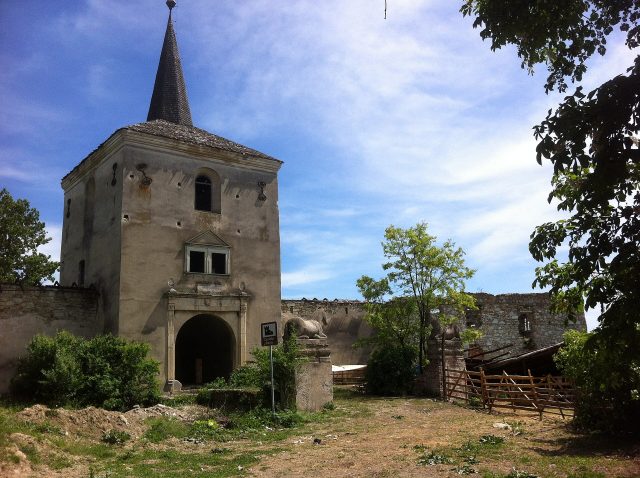
In the quiet Transylvanian village of Unguraș, nestled among gentle hills and golden wheat fields, a modest yet deeply moving monument stands. It honors those who never returned from the First World War—soldiers whose names are now etched into a simple stone slab. The memorial doesn’t demand attention at first glance; there are no grand sculptures or elaborate inscriptions, just a plain stele enclosed by a low fence. Yet it’s this very simplicity that makes it so powerful. There’s no pomp here, only memory—quiet, unshakable, and enduring.
The monument was erected in the early 1920s, a time when Romania, like much of Europe, was coming to terms with the staggering losses of the war. Unguraș, like countless other villages, had sent its men to fight, and not all of them came home. The authorities at the time likely weren’t aiming for grandeur but rather for a place where the community could gather to honor the fallen. The stone was probably sourced locally, as was common for such memorials—built without excess, using materials from the land itself.
The design is unassuming: a rectangular slab, slightly tapered at the top, bearing the names and dates of the dead. The inscriptions are carved in a straightforward, unadorned font, as if time itself had softened the sharp edges of grief. At the top of the stele, a relief cross stands—a symbol familiar to the predominantly Orthodox population of the region. Visitors sometimes leave flowers, wreaths, or lit candles, especially on days of remembrance. These small gestures speak louder than any formal speech ever could.
Unguraș isn’t a tourist destination, and this monument isn’t listed in guidebooks. Few outsiders stumble upon it, save for those passing through on their way to Cluj or taking a wrong turn on the backroads. But for the locals, this place holds deep significance. It’s where memorial services are held, where children are brought to learn about the war and how it touched every family in the village. In Romania, where 20th-century history was particularly turbulent, such memorials are more than just stones with names—they’re a living link between generations.
What’s striking about Unguraș is how the memory of the First World War intertwines with older traditions. The village, like many in Transylvania, still observes customs tied to honoring the dead, and the monument has become part of that ritual. In autumn, when the fields are harvested and the air carries the scent of fallen leaves, villagers come here not only to remember the soldiers but also those who passed before them. In this way, the memorial isn’t just a tribute to the past—it’s woven into the fabric of daily life.
Standing before the stele, it’s impossible not to wonder about the lives behind those names. Who were these men? What did they dream of, what did they leave behind when they went to war? No one can answer those questions now. But the fact that they’re remembered—that their names haven’t faded—means something. In a world where conflicts never seem to end, places like this serve as a reminder of the very real cost of peace.
This isn’t a museum piece or a tourist attraction. It wasn’t built for photographs or travel blogs. It exists so that people don’t forget. And perhaps that’s why it still stands here, among the quiet streets and old houses of Unguraș—a silent witness to the fact that even the smallest villages carry their own stories, their own sorrows, and their own memories.