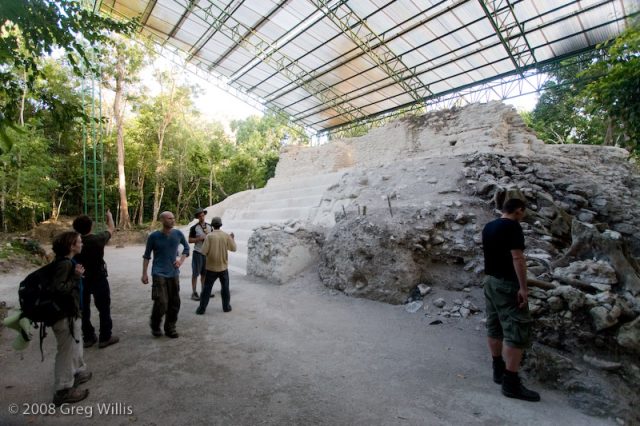
Uaxactún feels like a place where time has quietly settled into the earth. Tucked away in Guatemala’s Petén department, not far from the small town of Santa Elena de la Cruz, it remains one of the lesser-known Maya sites, overshadowed by the fame of Tikal or Yaxhá. Yet its historical weight is undeniable. This was one of the first major Maya cities where archaeologists uncovered early evidence of writing, astronomy, and monumental architecture. Walking through its ruins today, with the jungle humming around you, it’s easy to imagine the days when this was a thriving center of political and cultural life.
The city emerged around the 3rd century BCE and flourished during the Classic period, between the 3rd and 9th centuries CE. Uaxactún served as a key religious and administrative hub, controlling trade routes and exerting influence over neighboring settlements. Its name, which roughly translates to "eight stones" in the Maya language, is tied to local legends, though scholars still debate its exact meaning. Unlike many other Maya cities that were abruptly abandoned, Uaxactún’s decline was gradual, stretching over centuries, with the last inhabitants leaving sometime in the Postclassic period.
What makes Uaxactún’s architecture stand out is its understated practicality. There are no towering pyramids like those in Tikal, but the structures that remain tell a different kind of story—one of daily life and ritual. The most intriguing is Group E, a complex of three temples built on a single platform. This arrangement wasn’t just for show; it functioned as an astronomical observatory. Priests used it to track the sun’s movements, marking the solstices and equinoxes with precision. During the equinoxes, the sun rises directly over the central temple, an alignment that likely held deep spiritual significance for the city’s inhabitants.
The stelae scattered across the site are another highlight. Carved from limestone, many have weathered badly over time, but some still bear faint traces of rulers’ portraits and hieroglyphic inscriptions. These stelae acted as the city’s chronicles, recording wars, royal marriages, and religious ceremonies. One of the most notable, Stela 5, depicts a ruler named Chak Tok Ich’aak, believed to be one of Uaxactún’s early great leaders. Much of the text remains undeciphered, leaving room for future discoveries.
Today, Uaxactún is as much a natural wonder as it is an archaeological one. The jungle has reclaimed much of the site, with roots twisting around stone blocks and vines draping over ancient walls. Exploring the ruins feels less like visiting a museum and more like stepping into another era. Howler monkeys call in the distance, leaves rustle underfoot, and the air is thick with the sounds of a living forest. During the rainy season, the paths turn slick, and the ruins take on an even more mysterious air, as if the jungle is reminding visitors who truly rules here.
Getting to Uaxactún isn’t straightforward. The roads in this part of Petén are rough, so most travelers arrive by four-wheel drive or on foot. The best time to visit is during the dry season, from November to April, when the trails are more manageable and mosquitoes are less relentless. Local guides, many of whom are descendants of the Maya, offer insights that go beyond the usual historical facts. They share legends, point out lesser-known details like fragments of pottery or remnants of ancient causeways, and bring a personal touch to the experience.
This isn’t a place for those seeking crowds or Instagram-worthy backdrops. There are no souvenir stalls, cafes, or neatly labeled signs. Instead, Uaxactún offers something quieter—a chance to connect with the past in a way that feels almost intimate. The silence of the jungle, the crumbling temples, and the worn stones make it easy to picture the rituals, prayers, and decisions that once unfolded here. It’s a reminder that history isn’t just something preserved in ruins; it’s something that lingers, waiting to be noticed by those who take the time to look.