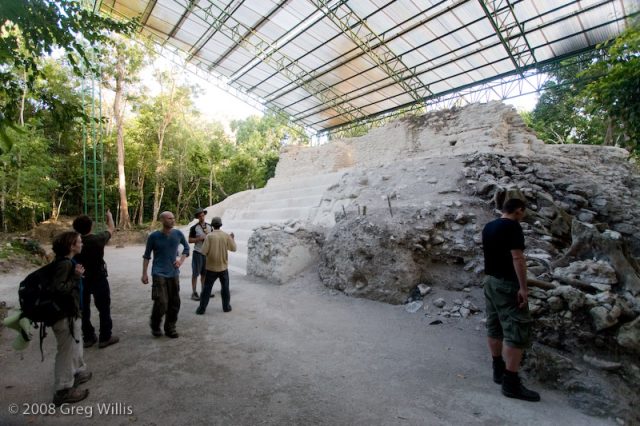
Tikal is one of those rare places where time seems to stand still. Deep in the Guatemalan jungle, this ancient Maya city feels suspended between past and present, its towering pyramids and crumbling palaces rising from the dense greenery as if they’ve always been part of the landscape. The jungle hums with life—howler monkeys roar in the distance, toucans dart between the trees, and the air is thick with the scent of damp earth and tropical flowers—but the ruins themselves carry a quiet, almost solemn presence. Walking through Tikal is like stepping into another era, where the stones beneath your feet once bore the weight of a civilization at its peak.
The city’s origins stretch back to the 6th century BCE, but its golden age came much later, between the 3rd and 9th centuries CE, when Tikal was one of the most powerful and sophisticated cities in the Maya world. At its height, it was home to tens of thousands of people, a bustling metropolis of political intrigue, religious ceremony, and architectural ambition. Rulers waged wars, forged alliances, and commissioned grand monuments to assert their dominance, many of which still stand today. What remains of Tikal is only a fraction of its former self—much of the city lies buried beneath centuries of jungle growth—but even in its ruined state, the scale of its ambition is impossible to ignore.
The most striking structures are the towering pyramids, particularly the Temple of the Great Jaguar and the Temple of the Masks. The first, standing nearly 50 meters tall, was built as a tomb for one of Tikal’s rulers and remains one of the most imposing monuments in the Maya world. Climbing its steep, narrow steps is a test of endurance, but the view from the top is worth it: the jungle stretches endlessly in every direction, a sea of green broken only by the peaks of other temples. The Temple of the Masks, slightly smaller, is named for the giant stone faces of gods that adorn its facade, their expressions still sharp after more than a thousand years. At sunrise, when mist clings to the treetops and the first light catches the stone, the effect is almost otherworldly.
Yet Tikal was far more than just its pyramids. The city sprawled across a vast area, with palaces, plazas, ball courts, and reservoirs that reveal how carefully its inhabitants planned their world. The Central Acropolis, once the heart of royal life, is a maze of narrow corridors and open courtyards where rulers held court, priests performed rituals, and merchants traded goods. Today, the spaces feel intimate, almost secret, as if the walls could whisper stories of the people who once filled them. Elsewhere, the Great Plaza was the stage for public ceremonies, its wide-open expanse framed by temples and stelae carved with the likenesses of kings. Even the ball courts, where a ritual game was played with a heavy rubber ball, hint at the complex social and religious life of the city.
The jungle itself is as much a part of Tikal as the ruins. Before archaeologists began uncovering the site in the 20th century, the city had been swallowed by the forest, its structures hidden beneath layers of vines and roots. Even now, nature is slowly reclaiming what was once cleared—fig trees split ancient stones with their roots, and howler monkeys swing through the branches above the temples. The sounds of the jungle are constant: the chatter of parrots, the rustle of leaves, the distant call of a toucan. It’s easy to forget you’re standing in the middle of one of the most important archaeological sites in the world when the air is thick with the scent of orchids and the ground is soft underfoot.
Tikal’s significance extends beyond its physical remains. It was a city of immense power, a center of trade, religion, and political influence that shaped the Maya world for centuries. Its rulers were among the most ambitious in Mesoamerica, and their legacy is etched into every stone. But what makes Tikal special today is its atmosphere—unlike some ancient sites, which feel overrun by tourists, this one retains a sense of solitude. There are no crowds here, no vendors hawking souvenirs, just the quiet persistence of history and the ever-present hum of the jungle.
Visiting Tikal is less about checking off a landmark and more about immersing yourself in a place that still feels alive. The best time to experience it is at dawn, when the first light filters through the trees and the mist rises from the ground like a ghostly veil. The air is cool, the jungle is just waking up, and the temples seem to glow in the soft morning light. By midday, the heat is intense, and the site takes on a different mood—quieter, slower, as if even the birds are seeking shade. As the sun begins to set, the stones absorb the last of the light, their surfaces shifting from gold to deep amber before fading into shadow.
Today, Tikal is a UNESCO World Heritage Site and a protected national park, drawing researchers, historians, and travelers who come to walk in the footsteps of the Maya. But despite its fame, it remains a place of quiet reflection. There’s no rush here, no need to hurry from one monument to the next. You can sit on the steps of a temple, listen to the wind in the trees, and imagine the city as it once was—alive with the sounds of drums, the murmur of prayers, the distant echo of a ruler’s decree. Tikal isn’t just a ruin; it’s a place where the past feels tangible, where history isn’t something you read about but something you can almost touch.