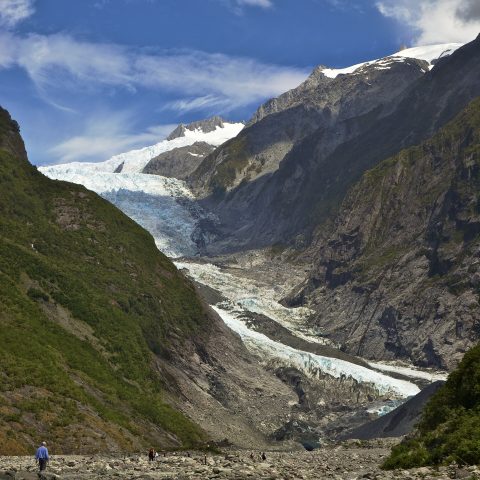
Sentinel Rock Track is one of those rare walks that make you forget everything but the path beneath your feet. It begins just outside the small settlement of Franz Josef, where the glacier of the same name spills down from the Southern Alps, its icy tongue meeting rainforest and alpine meadows in a landscape that feels alive. The air here carries the scent of damp earth and pine, and the only sounds are the rush of mountain streams and the occasional cry of a kea, the mischievous native parrot that treats hikers with bold curiosity. The trail winds through dense bush, where ferns rustle underfoot and ancient trees form a canopy so thick that sunlight barely filters through.
The route is short—just five kilometers one way—but it packs in more than most longer hikes. At first, the track meanders through forest, where vines coil around tree trunks and moss carpets the rocks in thick green layers. Then it opens up to reveal sweeping views of the valley, framed by towering peaks. Sentinel Rock itself isn’t just the endpoint; it’s a landmark, a jagged outcrop that rises above the landscape like a silent guardian. From its summit, the reward is a panorama of the Franz Josef Glacier, its ice glinting in the sunlight, and the distant Southern Alps, their peaks often shrouded in mist.
This place is shaped by the forces that have defined New Zealand’s wild west coast. The glacier, named after an Austrian emperor, is one of the most accessible in the world, and the track was once a route used by early explorers to reach its base. Long before them, the Māori knew these lands as Ka Roimata o Hinehukatere—the tears of a woman grieving for her lost love. For them, this was a place of power, where earth and sky met in an eternal dance. Today, the track retains that sense of untouched wilderness, though it’s now a favorite among visitors who come to experience its quiet magic.
Walking Sentinel Rock doesn’t require special skills, but it does demand attention. The weather here is famously unpredictable—sunshine can turn to rain in minutes, and fog can swallow the mountains without warning. After heavy rain, the trail becomes slick, and streams swell into rushing torrents. The best time to go is early morning, when the air is crisp and the light softens the forest’s edges. Sturdy, waterproof boots are a must; mud is a constant companion, and puddles can swallow shoes whole. A bottle of water and a snack are good ideas, too—there’s no better place to pause than at the summit, watching the glacier shift in the light while the wind hums through the tussock grass.
What makes this track special is how it unfolds like a story. Each bend reveals something new—a sudden glimpse of the glacier, a hidden waterfall, a gnarled tree with roots twisting like old bones. Unlike the crowded trails in more famous parks, this one offers solitude. There’s no need to rush, no pressure to keep up with a group. You can stop to examine a flower, listen to the call of a tūī, or simply stand still and let the silence settle around you.
For photographers, Sentinel Rock is a gift. The contrast of ice and forest, the play of light through the trees, the way mist curls over the valley—it’s a landscape that seems to shift with every glance. Sunset is particularly magical, when the mountains blush pink and the glacier takes on a cold blue glow. But even on overcast days, the place has a quiet drama. The damp air and swirling fog lend the scene an almost otherworldly feel, as if you’ve stepped into a different time.
This track is also a reminder of how people can move through a landscape without leaving a trace. There are no intrusive signs or man-made structures, just simple wooden bridges over streams and the occasional warning about slippery rocks. New Zealanders take pride in preserving places like this, understanding that their value lies in their wildness, not in how many people visit. That’s why it’s important to stick to the path, pack out what you bring in, and respect the wildlife. The kea, in particular, are known for their intelligence—and their habit of stealing anything shiny.
After the walk, Franz Josef township offers a quiet place to reflect. It’s a small settlement, more a cluster of lodges and cafes than a proper town, but it has a warmth that makes it feel like home. The locals are friendly, the coffee is strong, and the fireplaces are always lit. It’s the kind of place where conversations happen naturally, where travelers swap stories or simply sit in comfortable silence, replaying the views from the summit in their minds.
Sentinel Rock Track isn’t just a hike; it’s a chance to step outside of time. It reminds you how fragile and powerful nature can be, how important it is to slow down and really look at the world around you. There’s no checklist here, no need to tick off sights. Just the path, the wind, and the quiet understanding that sometimes, the best way to experience a place is to let it experience you. That’s why people keep coming back—not for the destination, but for the feeling of being part of something much bigger.