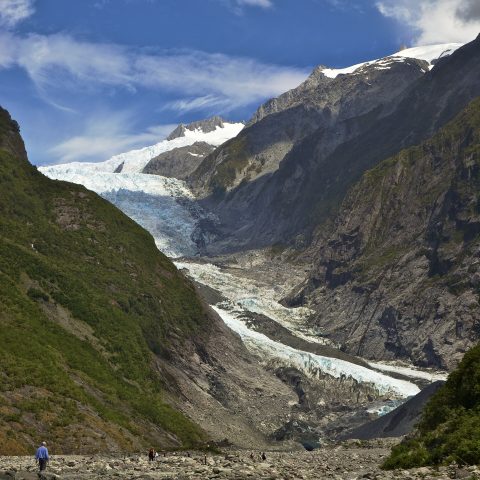
California Valley is one of those rare corners of New Zealand’s South Island where the landscape feels deliberately crafted—every ridge, river bend, and shadowed grove arranged to remind you what raw, untamed beauty looks like. Tucked just inland from the Franz Josef Glacier, the valley exists in its own quiet rhythm, far from the hum of tour buses and the chatter of guided groups. There are no crowds here, no neatly printed signs pointing the way, just the steady presence of the Southern Alps, the whisper of wind through the trees, and the occasional sharp cry of a kea, the alpine parrot that treats the valley like its own private kingdom.
The name itself is a puzzle, a relic of a time when prospectors and adventurers stamped their own stories onto the land. Some say it was gold miners in the late 1800s who named it, homesick for the wilds of America’s West Coast, where they’d once chased fortune. Others claim it was simply the valley’s untamed, lawless feel that earned the comparison—no roads, no settlements, just the same kind of rugged isolation that defined California during the gold rush. Whatever the truth, the name has outlasted the men who gave it, lingering like an echo of a time when this place was less a destination than a gamble.
Reaching California Valley is part of the experience. There are no roads, no shuttles, just a footpath that begins at the base of the Franz Josef Glacier and winds upward through dense, dripping rainforest. The first hour is a slow climb through a world of towering rimu and silver beech, their trunks draped in moss and tangled vines, the ground beneath your boots soft and uneven. The air is thick with the scent of wet earth and decaying leaves, the kind of smell that clings to your clothes long after you’ve left. Then, almost without warning, the trees thin, and the valley opens up—a wide, green bowl ringed by jagged peaks, the Waiho River cutting through it like a silver thread.
There are no grand monuments here, no carved stone or manicured gardens. The valley’s only architecture is the land itself: boulders slick with moss, trees twisted into impossible shapes by centuries of wind, ferns so ancient they seem to belong to another era. The only signs of human history are the crumbling remains of huts, their stone walls half-buried in the undergrowth, reminders of the prospectors who once scratched out a living here. These ruins are easy to miss if you’re not looking for them, but they add a layer of quiet history to the place, a sense that the valley has always been a refuge for those who preferred solitude over company.
What makes California Valley special is the way it resists the usual rhythms of travel. There’s no set route, no must-see checklist, just the freedom to wander until you’re ready to stop. Some people come for an hour, following the river until it narrows into a series of small waterfalls, then turning back. Others pitch tents on the valley floor, spending the night under a sky so clear the stars feel close enough to touch. The best days are the ones where you do nothing at all—just sit by the river, listening to the water tumble over rocks, watching the light shift across the mountains as the afternoon fades. The valley doesn’t demand anything from you; it simply offers itself, and that’s enough.
The time of year changes everything. In summer, from December to February, the trails are dry, the river calm, and the days long enough to linger. The forest is lush and green, the air warm but never stifling, and the only real challenge is the occasional sandfly, a tiny but persistent reminder that you’re a guest in nature’s domain. Autumn brings a different kind of beauty, the trees flaring into gold and crimson, the valley floor carpeted in fallen leaves. But the weather turns fickle, rain sweeping in without warning, and the river swells with the first of the winter snows. By June, the valley is all but deserted. Snow dusts the peaks, the trails vanish under a layer of frost, and the short days make even a short hike feel like a race against the light. Spring is the wild card—melting snow turns the river into a torrent, and parts of the trail disappear under water, but the valley feels more alive than ever, the air electric with the promise of renewal.
There’s a reason people return to California Valley, not for the thrill of discovery, but for the quiet it offers. It’s the kind of place that doesn’t reveal itself all at once, where the real magic lies in the details—the way the light slants through the trees in the late afternoon, the sudden hush when the wind drops, the way the river seems to hum just below the threshold of hearing. It’s not a place you conquer or even fully understand; it’s a place you meet, like an old friend who doesn’t need to say much to make you feel at home.
Perhaps that’s why it lingers in the memory long after you’ve left. The valley doesn’t need to be grand or dramatic to leave its mark. It’s enough that it exists, unchanged and unhurried, a reminder that some places are meant to be experienced, not just seen. You don’t come here to tick off a bucket list or snap the perfect photo. You come to remember what it feels like to be still, to let the land set the pace, and to walk away with the quiet certainty that some things—like the shape of a mountain or the sound of a river—don’t need to be explained.