Beyond the Postcard: The Trail Around Val di Braies
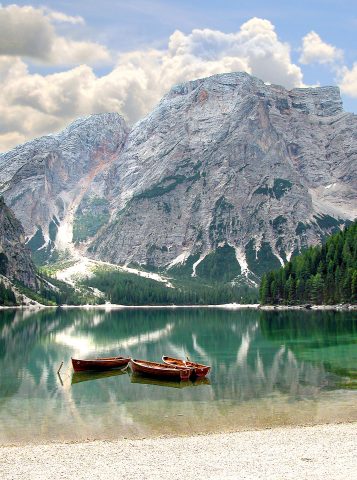
Lago di Braies appears on every list of places to see in the Dolomites—its emerald waters mirror jagged peaks under the sky. Yet the real story unfolds just past the lakeshore, along the path circling Val di Braies. This route isn’t for those chasing the most photographed scene. It’s for anyone who wants to feel why these mountains seem untouched by time.
The trail moves through landscapes that change without warning. Pine forests open into meadows. Rocky ridges drop into quiet pastures where cows graze with bells around their necks. The air carries the scent of wild herbs and damp earth. There are no crowds here. No rush from one viewpoint to the next. Only the slow rhythm of the mountains.
The Dolomites are made of dolomite rock, which glows pink and gold at sunrise and sunset—a phenomenon called enrosadira. The trail around Braies offers some of the best places to see this. From the Sesto Pass or the summit of Croda del Becco, a short detour reveals panoramic views of three valleys. On clear days, the horizon seems endless. The peaks dissolve into the sky like mirages.
These mountains are a record of ancient seas and shifting continents. Their layers of sediment tell a story millions of years old. Walking among them, you feel the weight of that history.
The route is manageable for most hikers. The full loop is about twelve kilometers, with an elevation gain of around six hundred meters. The path is well-trodden in places, sometimes paved with stones. Other sections require scrambling over rocks or crossing loose scree.
Start near Lago di Braies. A small parking area and a rifugio with basic refreshments mark the beginning of the ascent. The first part of the trail climbs through forest. Trees thin out, revealing the valley below. After a couple of hours, the first alpine huts appear. These rifugios offer rest, coffee, or a plate of pasta with local cheese. They’re more than pit stops. They show how people have lived in these mountains for centuries—adapting to the land, not trying to tame it.
The Dolomites were a battleground during World War I. Italian and Austro-Hungarian forces fought along high-altitude front lines. The trail passes remnants of that conflict—crumbling trenches, rusted barbed wire, and small fortifications carved into the rock. Between Sesto Pass and Monte Piana, the landscape still bears the scars of war. Memorial plaques mark key sites. On a clear day, the view extends to the plains below, where soldiers once fought over every inch of ground.
The trail changes with the seasons. In summer, cowbells ring, shepherds move their flocks, and hikers pause to catch their breath. Autumn brings a quieter mood, the air crisp, the mountains draped in gold and brown. Winter turns the route into a cross-country ski trail, but deep snow makes it impassable for walkers until late spring. When the snow melts, alpine flowers carpet the meadows. It’s a brief window when the mountains feel both fragile and full of life.
This trail is accessible. Unlike routes requiring multi-day treks, the loop around Braies can be completed in a single day. Yet it doesn’t feel overrun, even in peak season. Start early, and you might have entire stretches to yourself. The trail doesn’t lead to one iconic viewpoint. Instead, it offers quiet moments—the real experience is in the walking.
For locals, the trail is part of life. They graze cattle, gather herbs, and ski in winter. Alpine farming traditions remain alive. You might meet a shepherd moving his flock or a forager with a basket of mushrooms. Rifugios serve hearty food—polenta with cheese, barley soup, game stew—paired with wine from grapes grown in the foothills. There’s no pretension. Just hospitality born from living in a place where survival depends on knowing the land.
The trail is about silence. Not the absence of sound, but the kind that lets you hear the wind through the grass, the distant chime of cowbells, the crunch of gravel underfoot. Time slows down here. A single day can feel like a week. People return not for the views or the exercise, but for the chance to step into a rhythm rare in the modern world. The Dolomites make you forget what day it is, what time it is, even what year it is. For a little while, that’s enough.