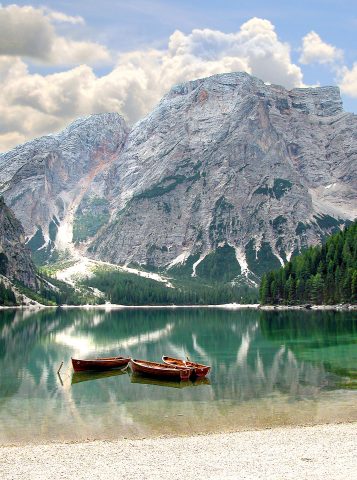
Perched on a quiet mountainside in the Val di Braies valley, the ruins of Heimenburg Fortress feel like a place where time has quietly settled into the stones. The fortress stands as a silent witness to centuries of Alpine life, its weathered walls blending into the landscape as if they’ve always been part of the hillside. From this vantage point, the view stretches across meadows and forests, with the distant shimmer of Lake Braies visible on clear days. There’s no grand entrance or polished tourist path here—just a narrow trail winding through pine trees, leading to what remains of a structure that once commanded the valley below.
The origins of Heimenburg are hazy, lost in the mists of medieval history, but the first written records place it in the 13th century. Back then, the region was under the influence of the Brixen bishops, and the fortress served as both a defensive stronghold and a symbol of their authority. Over the centuries, it changed hands multiple times, passing from local feudal lords to the powerful von Welsperg family in the 16th century. Each owner left their mark, reinforcing walls, adding towers, or expanding living quarters. What survives today are mostly fragments—crumbling foundations, partial walls, and the skeletal remains of what was once a formidable complex. Yet even in ruin, the fortress carries a sense of endurance, as if the stones themselves remember the weight of history they once bore.
Heimenburg’s architecture follows the classic design of Alpine fortresses from the Middle Ages. The central keep, or donjon, was the heart of the structure, its thick walls offering a last line of defense. Around it, the remains of living quarters, storage rooms, and a chapel hint at the daily life that once filled these spaces. The chapel, in particular, speaks to the fortress’s dual role as both a military outpost and a place of refuge. Though little more than outlines remain, the arched doorways and remnants of vaulted ceilings reveal the skill of the stonemasons who built it. Walking among the ruins, it’s easy to imagine the fortress in its prime—busy with activity, its courtyards echoing with the sounds of horses, voices, and the clatter of daily work.
Unlike many fortresses that played roles in famous battles, Heimenburg’s significance lies in its quiet, steady presence. It never saw epic sieges or dramatic conquests, but it was a crucial part of the region’s fabric. Perched along ancient trade routes crossing the Alps, it helped control movement through the valley, offering protection and a sense of stability in an era when borders were fluid and power often shifted. During times of conflict, it provided shelter for locals, its walls offering safety from raids and feuds. The fortress may not have been the stage for grand historical events, but it was a constant in the lives of those who lived in its shadow, a place where ordinary people sought refuge when the world beyond felt uncertain.
Today, Heimenburg is far from the bustling tourist spots that dot the Dolomites. There are no crowds here, no guided tours or souvenir stands—just the quiet rustle of wind through the trees and the occasional call of a bird. The lack of modern intrusions makes it feel like a place suspended in time. Visitors who make the trek up the hillside are rewarded not with flashy exhibits, but with something far more subtle: the chance to wander freely among the ruins, piecing together the past from the fragments left behind. Some come to sit on the old stones, gazing out at the valley below, while others simply enjoy the solitude, the way the light filters through the trees, or the way the silence seems to amplify the weight of history.
There’s a certain melancholy to Heimenburg, but it’s not the kind that feels heavy or oppressive. Instead, it’s a quiet kind of reflection, the kind that comes when you stand in a place that has seen so much life pass by. The fortress doesn’t demand attention or awe—it simply exists, its stones holding stories that will never be fully told. You might imagine the clatter of hooves on the old cobblestones, the murmur of guards on the watchtower, or the distant sound of a church bell from the chapel. Or you might just sit and listen to the wind, feeling the passage of time in a way that’s hard to describe but impossible to ignore.
What makes Heimenburg special is its unassuming nature. It’s not a place that tries to impress or entertain; it doesn’t need to. There are no grand narratives here, no dramatic tales of heroism or tragedy—just the quiet persistence of history in its most unfiltered form. The fortress doesn’t offer answers or explanations, but it invites you to slow down, to look closely at the details—the way the stones fit together, the patterns of moss growing in the cracks, the way the light changes as the day wears on. It’s a place that rewards patience, where the real experience isn’t in what you see, but in what you feel.
For those who seek it out, Heimenburg offers a rare kind of connection to the past. It’s not the kind of place you visit for an hour, snap a few photos, and move on. It’s the kind of place where you might linger, where the boundaries between then and now blur just enough to make you wonder about the people who once walked these same paths. There’s no agenda here, no scripted experience—just the quiet hum of history, waiting to be noticed by those who are willing to listen. In a world where so much is curated and polished for consumption, Heimenburg feels refreshingly real, a reminder that some of the most meaningful encounters with the past happen when we step off the beaten path and let the place speak for itself.