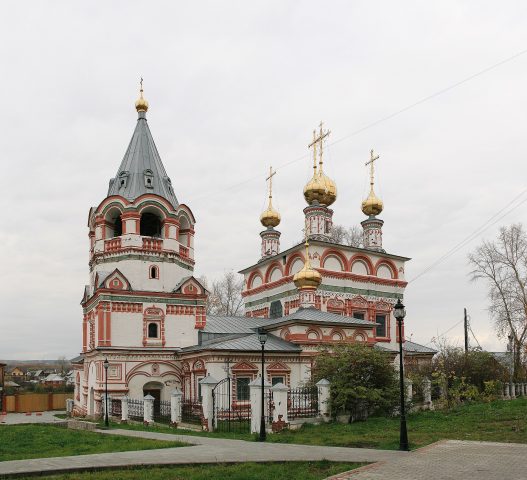
Perched on the high bank of the Kama River, Trinity Cathedral in Solikamsk feels like a quiet guardian of time. The city itself is often overlooked, tucked away in the folds of the Ural Mountains, but this cathedral has stood here for centuries, bearing witness to eras when Solikamsk was far more than just another provincial town. It was once the heart of Russia’s salt trade, a commodity so valuable it was called "white gold," and the cathedral’s very presence speaks to that legacy. There’s nothing flashy about its architecture—no gilded domes or elaborate carvings—but that restraint is precisely what gives it its character. The building carries a certain weight, not just in stone, but in the stories it holds within its walls.
The cathedral’s origins trace back to the early 17th century, a time when Solikamsk was flourishing. Salt production had turned the town into a wealthy and influential hub, and the first wooden church on this site was built in 1608. By the mid-18th century, it had been replaced with the stone structure that stands today, redesigned in the Russian Baroque style. This wasn’t just a place of worship; it was a statement. The architecture reflected both the piety of the era and the economic power of the city. The cathedral wasn’t merely a religious site—it was a symbol of Solikamsk’s prosperity, a monument to the wealth that flowed through its streets.
What makes Trinity Cathedral particularly interesting is how it blends tradition with the practicalities of its time. The building is symmetrical and solid, yet there’s a surprising lightness to it. The facades are adorned with pilasters and window frames that soften the massiveness of the walls, while the bell tower, crowned with a spire, reaches toward the sky like a beacon. Inside, the surviving frescoes and iconostasis offer a glimpse into the craftsmanship of the past, though much of the interior had to be restored after decades of neglect. The cathedral’s design wasn’t just about aesthetics—it was functional, too. In a town where trade routes converged, the building served as a landmark for travelers, a place where merchants could pause and reflect before continuing their journeys.
Solikamsk wasn’t always the quiet town it is today. In the 17th and 18th centuries, it was a bustling crossroads, a vital link between European Russia and Siberia. The cathedral stood at the center of this activity, not just as a religious institution but as a social and economic hub. The square in front of it would have been alive with the sounds of merchants haggling, the clatter of carts, and the hum of conversations. Winter fairs and festivals brought the community together, turning the area into a lively gathering place. Even now, walking around the cathedral, it’s easy to imagine the energy that once filled these streets. The past feels close here, as if the echoes of those days are still lingering in the air.
Like many religious sites in Russia, Trinity Cathedral suffered during the Soviet era. It was closed, repurposed as a warehouse, a club, and even a cinema. For a time, it seemed as though its story had come to an end. But in the 1990s, the cathedral was returned to the Orthodox Church, and a long process of restoration began. The work was painstaking, as years of disuse had taken their toll, but local efforts gradually brought the building back to life. Today, it stands as both a functioning church and a historical monument, open to worshippers and visitors alike. Some original elements remain, though much of the interior had to be recreated, a reminder of how fragile even the most enduring structures can be.
What draws people to Trinity Cathedral today isn’t just its architecture or its history—it’s the atmosphere. The cathedral is part of a larger tapestry of old Solikamsk, where wooden houses, cobblestone streets, and quiet courtyards create a sense of stepping back in time. In summer, the white walls of the cathedral contrast beautifully with the surrounding greenery, while the view from the riverbank stretches across the Kama and into the forests beyond. Winter transforms the scene entirely, turning the cathedral into a snow-dusted fairy-tale structure, as if plucked from a storybook. The seasons change, but the cathedral remains, a constant in a town that has seen so much.
Visiting Trinity Cathedral is more than just a stop on a tour—it’s a chance to connect with a history that feels tangible. This isn’t the kind of place where you read about the past in a guidebook; here, you can almost hear it. The murmur of merchants discussing deals, the toll of the bells, the rustle of pages in old ledgers—it’s all there, woven into the very fabric of the building. The cathedral doesn’t shout its stories; it lets them unfold quietly, inviting you to listen. It’s a reminder that history isn’t just about grand events or famous names. Sometimes, it’s about the quiet persistence of a place that has seen centuries pass, yet still stands, holding onto the memories of those who came before.